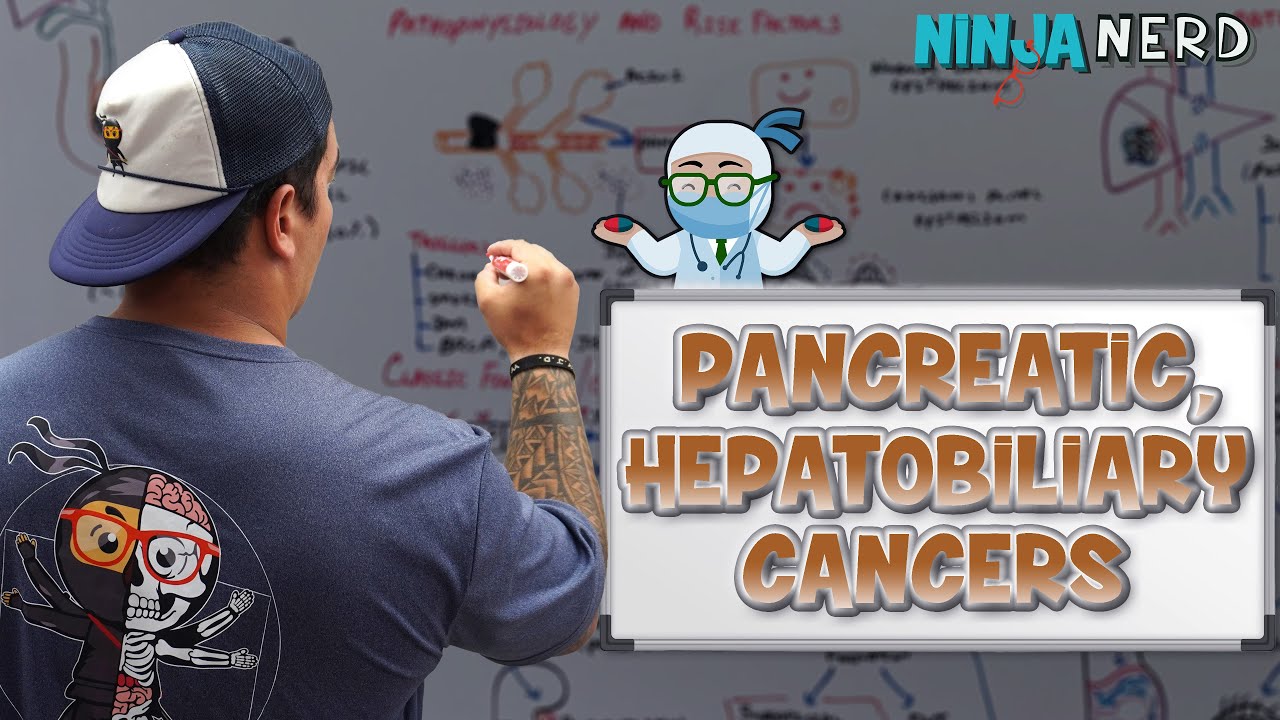
Pancreatic and Hepatobiliary Cancers | Clinical Medicine
Keywords
Summary
177 words
Critical Evaluation
Value of the Information & Strength of the Argument
The lecture provides substantial educational value, systematically covering each cancer type with a focus on high-yield exam points. The argumentation is clear and logical, building from pathophysiology to clinical presentation and management. The use of mnemonics and clinical signs (e.g., Courvoisier’s sign) enhances retention. However, the presentation is largely didactic without critical evaluation of evidence or discussion of controversies, which limits its depth for advanced learners.
Scientific Rigor, Source Quality, Title Accuracy
The scientific rigor is adequate for a medical education lecture, with accurate descriptions of disease mechanisms and clinical features. The sources are not explicitly cited within the video, but the content aligns with standard medical knowledge. The title accurately reflects the content. No comments were provided for analysis.
129 words
Title / Content Match
The title accurately reflects the content, which comprehensively covers pancreatic and hepatobiliary cancers.
Quality & Reliability
8/10
The lecture is well-structured, covering pathophysiology, clinical presentation, diagnosis, and treatment of pancreatic and hepatobiliary cancers. It aligns with standard medical education and includes specific signs, risk factors, and diagnostic tools. However, it lacks direct citations to primary literature and is presented as a didactic overview rather than a critical review.
Chapters
- Lab
- Pathophysiology and Risk Factors of Pancreatic Cancer
- Classic Findings and Complications of Pancreatic Cancer
- Pathophysiology and Risk Factors of Hepatocellular Carcinoma
- Classic Findings and Complications of Hepatocellular Carcinoma
- Pathophysiology and Risk Factors of Gallbladder Cancer
- Classic Findings and Complications of Gallbladder Cancer
- Pathophysiology and Risk Factors of Cholangiocarcinoma
- Classic Findings and Complications of Cholangiocarcinoma
- Diagnostic Approach to Pancreatic Cancer and Cholangiocarcinoma
- Diagnostic Approach to Hepatocellular Carcinoma
- Diagnostic Approach to Gallbladder Cancer
- Treatment of Pancreatic Cancer
- Treatment of Cholangiocarcinoma
- Treatment of Hepatocellular Carcinoma
- Treatment of Gallbladder Cancer
- Comment, Like, SUBSCRIBE!
Cited Sources
- Ninja Nerd Lecture Notes — Official lecture page with notes, illustrations, and quiz.
- Ninja Nerd Website — General website for additional resources.
- Ninja Nerd Podcast — Podcast platform for audio content.
- Ninja Nerd LinkedIn — Social media profile.
Concurring Sources
- Pancreatic cancer - Mayo Clinic — Concordant information on symptoms and risk factors.
Contribution & Novelties
The lecture offers a comprehensive, structured review of pancreatic and hepatobiliary cancers, integrating pathophysiology, clinical presentation, diagnostics, and treatment in a single resource. It emphasizes high-yield exam points and clinical reasoning, making it valuable for medical students. The use of visual aids and clear explanations enhances understanding.
Pour aller plus loin :
- Pancreatic cancer - Wikipedia — Overview of pancreatic cancer, including risk factors and treatment.
- Hepatocellular carcinoma - Wikipedia — Detailed information on HCC, including diagnosis and management.
- Cholangiocarcinoma - Wikipedia — Overview of bile duct cancer, including types and treatment.
- Courvoisier’s sign - Wikipedia — Explanation of this clinical sign and its significance.
- Whipple procedure - Wikipedia — Description of the surgical procedure for pancreatic cancer.
118 words
Radar Profile
The radar profile shows high scores in information quantity and quality, with moderate technical level and reliability. This indicates a comprehensive and accurate educational resource, though it may not delve into advanced research or critical analysis.