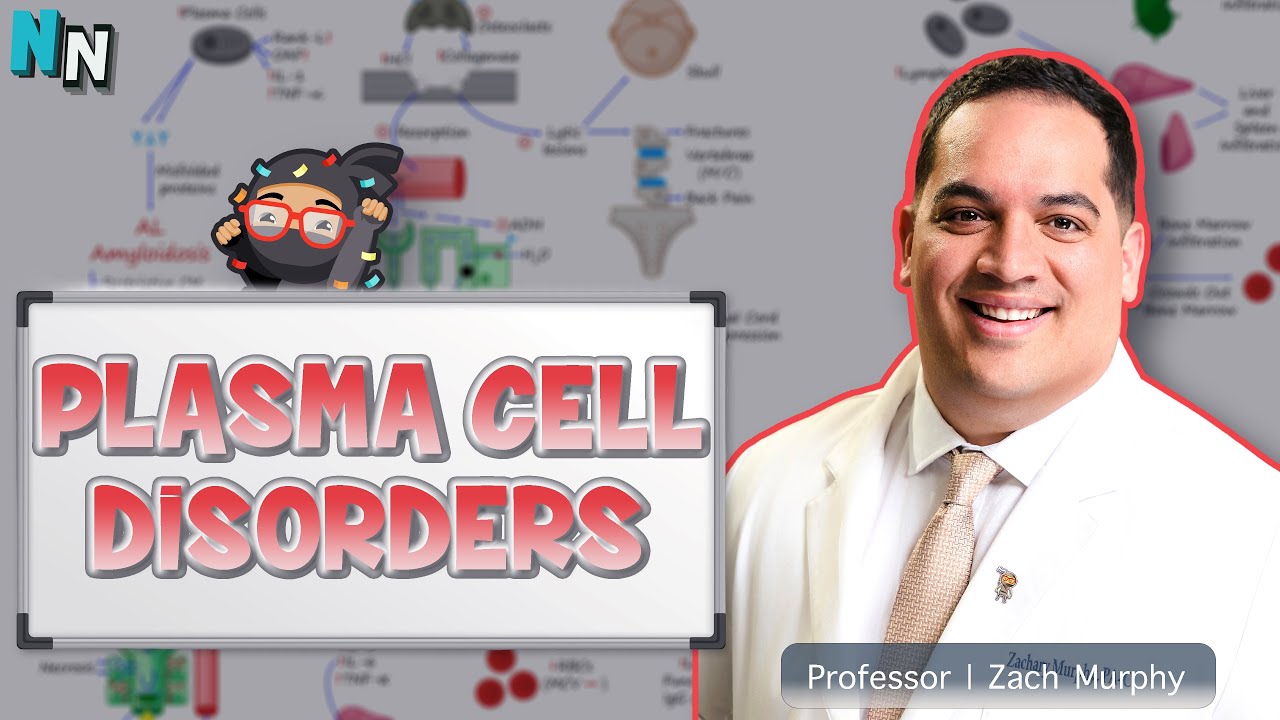
Plasma Cell Disorders | Clinical Medicine
Keywords
Summary
125 words
Critical Evaluation
Value of the Information & Strength of the Argument
The lecture provides valuable educational content, systematically breaking down complex hematological disorders into understandable segments. The argumentation is solid, using clear explanations and visual aids to reinforce key concepts. The progression from pathophysiology to clinical manifestations and treatment is logical and well-structured. However, the lecture is primarily didactic and does not engage in critical evaluation of evidence or alternative viewpoints, which limits its depth for advanced learners.
Scientific Rigor, Source Quality, Title Accuracy
The scientific rigor is adequate for an educational lecture, but it lacks explicit citations to primary literature. The content aligns with standard medical knowledge, but the absence of references reduces its verifiability. The title accurately reflects the content, and the lecture is well-organized with clear sections. The use of mnemonics and high-yield points enhances memorization but may oversimplify complex topics.
142 words
Title / Content Match
The title accurately reflects the content, which is a comprehensive clinical medicine lecture on plasma cell disorders.
Quality & Reliability
8/10
The lecture is a detailed educational overview of plasma cell disorders, covering pathophysiology, clinical features, diagnostics, and treatment. It is presented by a medical educator with a focus on high-yield concepts for students. The content aligns with established medical knowledge, though it lacks primary citations and is presented in a simplified manner.
Chapters
Cited Sources
- Ninja Nerd Lecture: Plasma Cell Disorders — Official lecture page with premium notes, slides, and quiz.
- Ninja Nerd Website — Main website for educational resources.
- Ninja Nerd Podcast — Podcast platform for audio versions of lectures.
- Ninja Nerd LinkedIn — Company page for professional updates.
Concurring Sources
- Mayo Clinic: Multiple Myeloma — General medical information consistent with the lecture.
Contribution & Novelties
The lecture offers a structured and accessible overview of plasma cell disorders, particularly useful for medical students. It synthesizes complex information into high-yield concepts, such as the CRAB criteria and M spike interpretation. The discussion of MGUS progression and the distinction between smoldering and active myeloma is particularly valuable. However, it does not introduce novel research or unique perspectives beyond standard medical education.
Pour aller plus loin :
- Multiple Myeloma - StatPearls — Comprehensive clinical review.
- Monoclonal Gammopathy of Undetermined Significance - Mayo Clinic — Patient-oriented overview.
- Waldenström Macroglobulinemia - National Organization for Rare Disorders — Detailed disease information.
99 words
Radar Profile
The radar profile shows high scores in information quantity, quality, and reliability, with a slightly lower technical level, indicating a comprehensive yet accessible educational resource. The balance across dimensions suggests a well-rounded lecture suitable for students seeking a solid foundation in the topic.