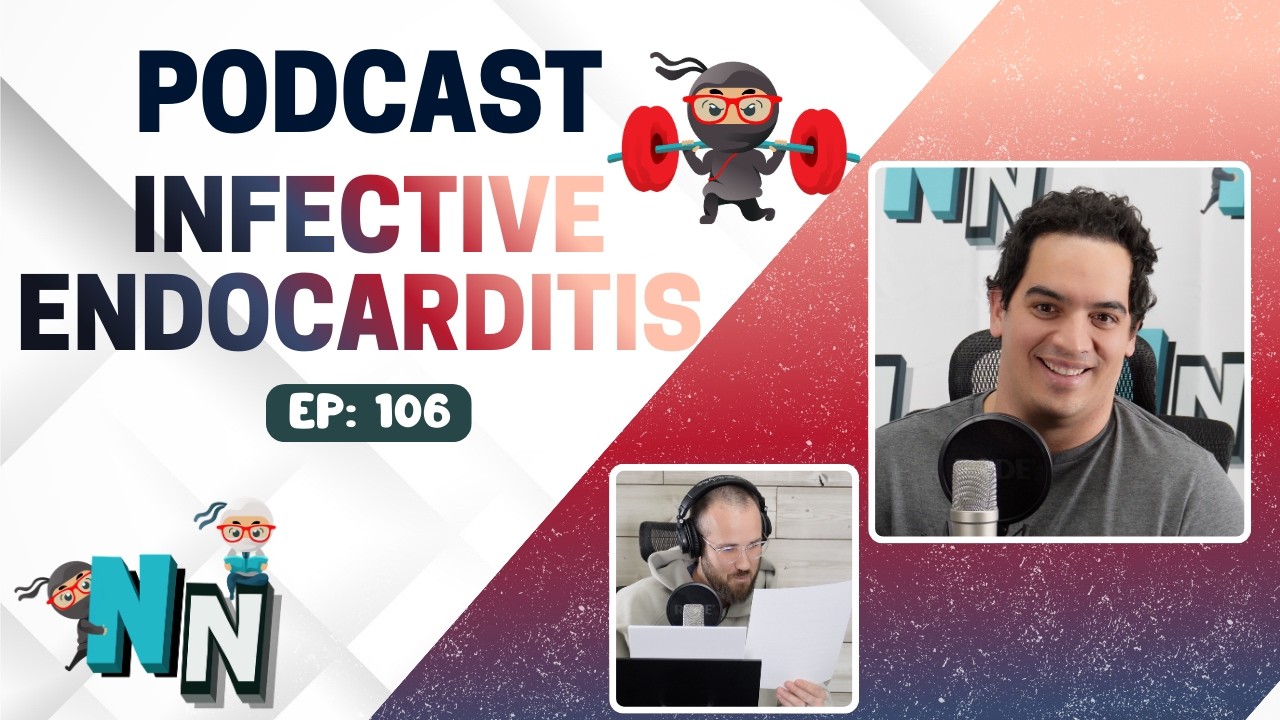
Infective Endocarditis | Podcast
Keywords
Summary
186 words
Critical Evaluation
Value of the Information & Strength of the Argument
The podcast provides valuable clinical insights into infective endocarditis, using realistic cases to illustrate key concepts. The argumentation is solid, grounded in clinical experience and standard medical knowledge. The hosts effectively explain the pathophysiology, diagnostic approach, and management, making complex information accessible. They also highlight common pitfalls, such as the importance of blood cultures before antibiotics and the use of TEE in certain scenarios. The discussion is coherent and well-structured, though it is an informal dialogue rather than a formal lecture.
Scientific Rigor, Source Quality, Title Accuracy
The scientific rigor is high for a podcast, with accurate representation of medical guidelines and clinical reasoning. The hosts do not cite specific sources, but their statements align with established medical literature. The title accurately reflects the content. The description provides links to the Ninja Nerd website and podcast, which are credible educational resources. No formal citations are given, but the information is consistent with current medical knowledge. The adéquation between title and content is excellent.
172 words
Title / Content Match
The title accurately reflects the content, which is a podcast episode focused on infective endocarditis.
Quality & Reliability
8/10
The podcast provides a detailed, case-based overview of infective endocarditis, consistent with current medical knowledge. The hosts are experienced clinicians, and the content aligns with established guidelines (e.g., Modified Duke criteria, blood culture protocols). However, it is an informal discussion without formal citations, and some nuances (e.g., timing of blood cultures) are debated.
Key Moments
Markers derived by PSI from the transcript: the creator did not define chapters.
- Definition of infective endocarditis and anatomy of the heart layers.
- Discussion of native vs prosthetic valve endocarditis and acute vs subacute presentations.
- Risk factors: abnormal valves, prosthetic valves, and bacteremia sources.
- Case 1: IV drug user with fever and new murmur; right-sided endocarditis.
- Importance of blood cultures before antibiotics; obtaining multiple sets.
- Echocardiography: TTE vs TEE indications.
- Case 2: Subacute endocarditis after dental procedure; Streptococcus viridans.
- Peripheral findings: Janeway lesions, Osler nodes, splinter hemorrhages, Roth spots.
- Modified Duke criteria and diagnostic approach.
- Case 3: Prosthetic valve endocarditis with perivalvular abscess.
- Rapid-fire scenarios: Enterococcus, Streptococcus gallolyticus, fungal endocarditis.
- Management principles: prolonged IV antibiotics, surgery indications, source control.
Cited Sources
- Ninja Nerd Website — Official website for educational resources.
- Ninja Nerd Podcast — Podcast platform for this episode.
- Ninja Nerd LinkedIn — Social media profile.
Concurring Sources
- Infective Endocarditis Guidelines (AHA) — Guidelines for management of infective endocarditis.
- Infective Endocarditis - Mayo Clinic — Patient information on infective endocarditis.
Dissenting Sources
- Timing of Blood Cultures — The hosts question the guideline recommendation to draw blood cultures 30-60 minutes apart, suggesting that continuous bacteremia makes timing irrelevant. This is a minor point of debate.
External References
Contribution & Novelties
This podcast offers a practical, case-based approach to infective endocarditis, emphasizing high-yield associations and clinical reasoning. It provides a clear framework for diagnosis and management, useful for medical students and clinicians. The discussion of subtle presentations and diagnostic pitfalls adds value beyond textbook knowledge.
Pour aller plus loin :
- Modified Duke Criteria — Key diagnostic criteria for infective endocarditis.
- Infective Endocarditis - StatPearls — Comprehensive review of infective endocarditis.
- Transthoracic Echocardiogram — Overview of echocardiography techniques.
76 words
Radar Profile
The radar profile shows high scores in quantity and quality of information, with a strong technical level and overall reliability. This indicates a comprehensive and trustworthy educational resource, though it is an informal discussion rather than a peer-reviewed source.
💬 No comments were provided for analysis.