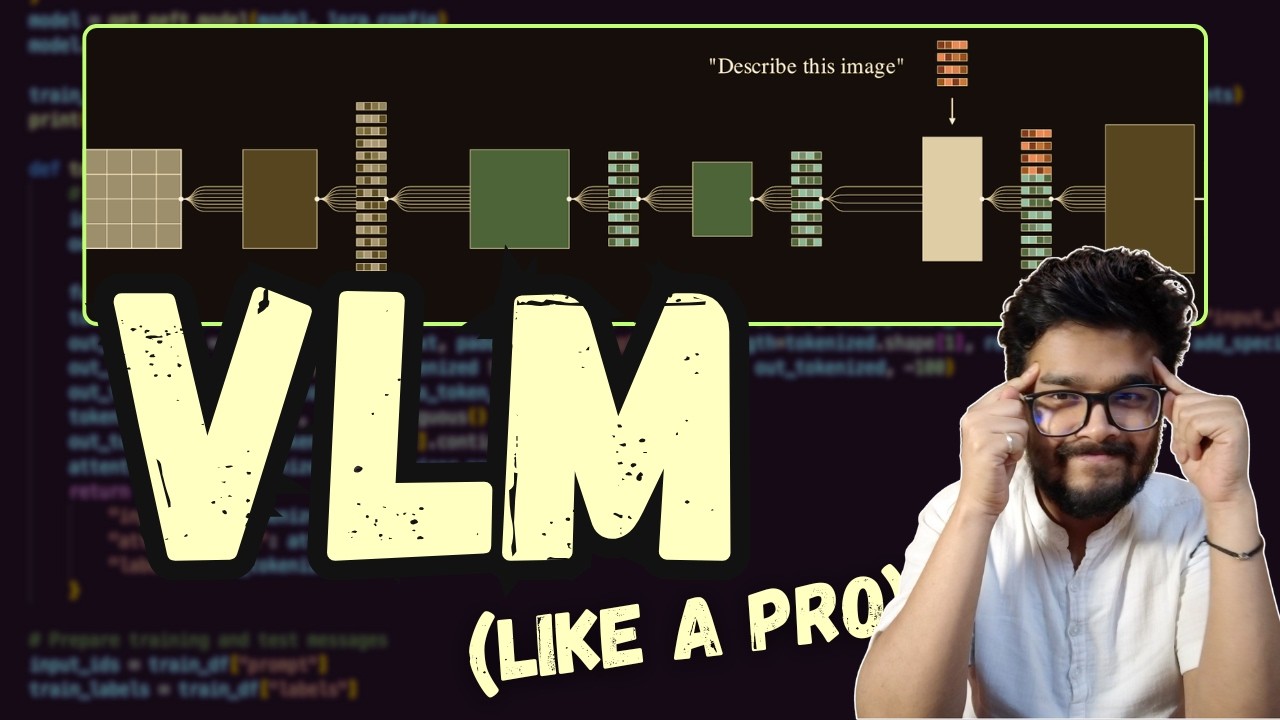
Let's train Vision Language Models (VLM) from scratch using just Text-Only LLMs!
Keywords
Summary
150 words
Critical Evaluation
Value of the Information & Strength of the Argument
The video provides a high-value, hands-on tutorial that demystifies the process of building a VLM from a text-only LLM. The argumentation is solid, as the creator explains the rationale behind each architectural choice, such as why a Q-Former is needed to bridge the gap between image and text embeddings. The use of a small model and limited data demonstrates the feasibility of the approach, making it accessible to practitioners. The explanation of cross-attention and contrastive loss is clear and intuitive, with analogies like the movie database search. The video also highlights practical considerations, such as freezing the ViT and using LoRA to reduce trainable parameters. Overall, the content is well-structured and provides a strong foundation for understanding VLM training.
Scientific Rigor, Source Quality, Title Accuracy
The video demonstrates scientific rigor by referencing the BLIP-2 paper and providing a link to it. The code is open-sourced on GitHub, allowing for reproducibility. The creator also provides links to related videos on attention mechanisms and vision transformers, which support the learning path. The title accurately reflects the content, as the video indeed shows how to train a VLM from a text-only LLM. The use of a small dataset and model is clearly stated, and the results are presented with appropriate caveats. The video does not overclaim, and the methodology is transparent. The only minor issue is that the video simplifies the training to a single loss function, but this is acknowledged and discussed in the Patreon video.
253 words
Title / Content Match
The title accurately reflects the content: the video demonstrates training a VLM from a text-only LLM, with a focus on the Q-Former architecture.
Quality & Reliability
8/10
The video provides a clear, step-by-step tutorial on building a VLM from a text-only LLM, with code and references to the BLIP-2 paper. The approach is well-explained and reproducible, though it simplifies some aspects (e.g., single loss function) and relies on the creator's own implementation.
Chapters
Cited Sources
- BLIP-2: Bootstrapping Language-Image Pre-training with Frozen Image Encoders and Large Language Models — The paper introducing the Q-Former architecture, which is the core of the video's approach.
- GitHub repository for the VLM training code — The open-source code used in the video, allowing viewers to reproduce the training.
- Attention to Transformers playlist — A playlist of videos explaining transformer concepts, including cross-attention, which is essential for understanding the Q-Former.
- Multimodal models theory video — A video covering the theory of multimodal models, providing background for the VLM approach.
- Guide to fine-tuning open source LLMs — A video explaining fine-tuning techniques, including LoRA, which is used in the final step.
- Vision Transformer (ViT) video — A video explaining Vision Transformers, which are used to embed images in the pipeline.
Concurring Sources
- BLIP-2 paper — The video's approach is directly based on this paper, and the results align with the paper's findings.
Contribution & Novelties
The video provides a practical, step-by-step guide to building a VLM from a text-only LLM, making the concept accessible to a wider audience. It demonstrates that with a small model and limited data, one can achieve reasonable performance, which is encouraging for practitioners with limited resources. The video also offers clear explanations of the Q-Former architecture and its training, filling a gap in educational content on this topic.
Pour aller plus loin :
- BLIP-2 paper — The foundational paper for the Q-Former architecture.
- Vision Transformer (ViT) paper — The ViT model used for image embedding.
- LoRA: Low-Rank Adaptation of Large Language Models — The technique used to fine-tune the LLM efficiently.
- Conceptual Captions dataset — The dataset used for training the Q-Former.
- CLIP paper — The contrastive loss function used in training.
132 words
Radar Profile
The radar profile shows high scores in information quantity, quality, and reliability, with a slightly lower technical depth. This indicates a well-balanced educational video that is both informative and trustworthy, though it may not delve into the most advanced technical details.