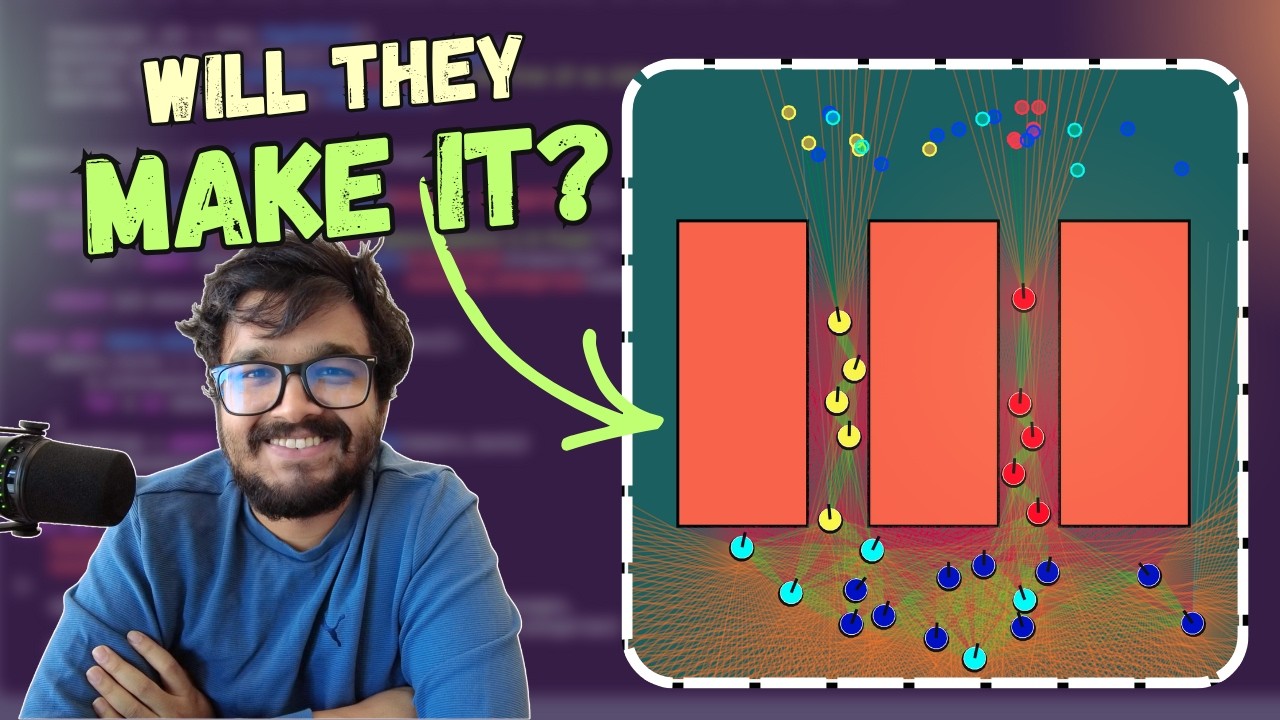
How to train Multi Agent Collaborative Agents with Reinforcement Learning (CTDE Explained)
Keywords
Summary
134 words
Critical Evaluation
Value of the Information & Strength of the Argument
The video provides valuable insights into multi-agent reinforcement learning, offering a practical guide that bridges theory and implementation. The author clearly explains the limitations of I-PPO, such as non-stationarity and lack of cooperation, and convincingly argues for the benefits of CTDE methods like MA-PPO. The argumentation is supported by visual demonstrations and references to key papers, making the case for centralized critics compelling. The tutorial is well-structured, progressing from single-agent to multi-agent scenarios, and includes practical tips on environment design and reward shaping.
Scientific Rigor, Source Quality, Title Accuracy
The video demonstrates scientific rigor by referencing foundational papers such as the PPO paper and MA-DDPG, and provides a link to a recent survey on CTDE. The open-source code repository enhances reproducibility. The title accurately reflects the content, and the video’s structure aligns with its claims. The author also mentions additional resources for deeper learning. Overall, the sources are credible and appropriately cited, and the title-content alignment is strong.
167 words
Title / Content Match
The title accurately reflects the content, which focuses on training multi-agent collaborative agents using reinforcement learning, with a detailed explanation of CTDE.
Quality & Reliability
8/10
The video provides a clear, well-structured tutorial on multi-agent reinforcement learning, with practical implementation details and references to key papers. The author demonstrates a solid understanding of the concepts, and the code is open-sourced. However, the video is a tutorial and not a peer-reviewed study, and some claims about emergent behavior are based on anecdotal evidence.
Chapters
Cited Sources
- An Introduction to Centralized Training for Decentralized Execution in Cooperative Multi-Agent Reinforcement Learning — Referenced as a useful paper for understanding CTDE methods.
- Proximal Policy Optimization Algorithms — Referenced as the PPO paper.
- Multi-Agent PPO in PyTorch — Referenced as a practical resource for implementing MA-PPO.
- Multi-Agent Actor-Critic for Mixed Cooperative-Competitive Environments — Referenced as the MA-DDPG paper, which inspired MA-PPO.
- GitHub repository for the project — The open-source code for the environment and algorithms.
Concurring Sources
- Multi-Agent Actor-Critic for Mixed Cooperative-Competitive Environments — The MA-DDPG paper, which the video's MA-PPO is inspired by, supports the CTDE approach.
- An Introduction to Centralized Training for Decentralized Execution in Cooperative Multi-Agent Reinforcement Learning — This survey provides theoretical backing for CTDE methods.
External References
Contribution & Novelties
The video offers a practical, hands-on approach to multi-agent reinforcement learning, which is often underrepresented in educational content. It provides a clear comparison between I-PPO and MA-PPO, highlighting the advantages of CTDE in promoting cooperative behaviors. The use of local coordinate systems is a notable technique for improving generalization across agents. The open-source code allows viewers to experiment and build upon the work.
Pour aller plus loin :
- Multi-Agent Reinforcement Learning: A Survey — Comprehensive overview of MARL methods.
- Centralized Training with Decentralized Execution — Detailed discussion of CTDE.
- Proximal Policy Optimization — The PPO algorithm.
- OpenAI Five — Example of large-scale multi-agent RL.
104 words
Radar Profile
The radar profile shows high scores in information quantity, quality, and reliability, with a slightly lower technical level, indicating a well-balanced tutorial that is accessible yet informative.