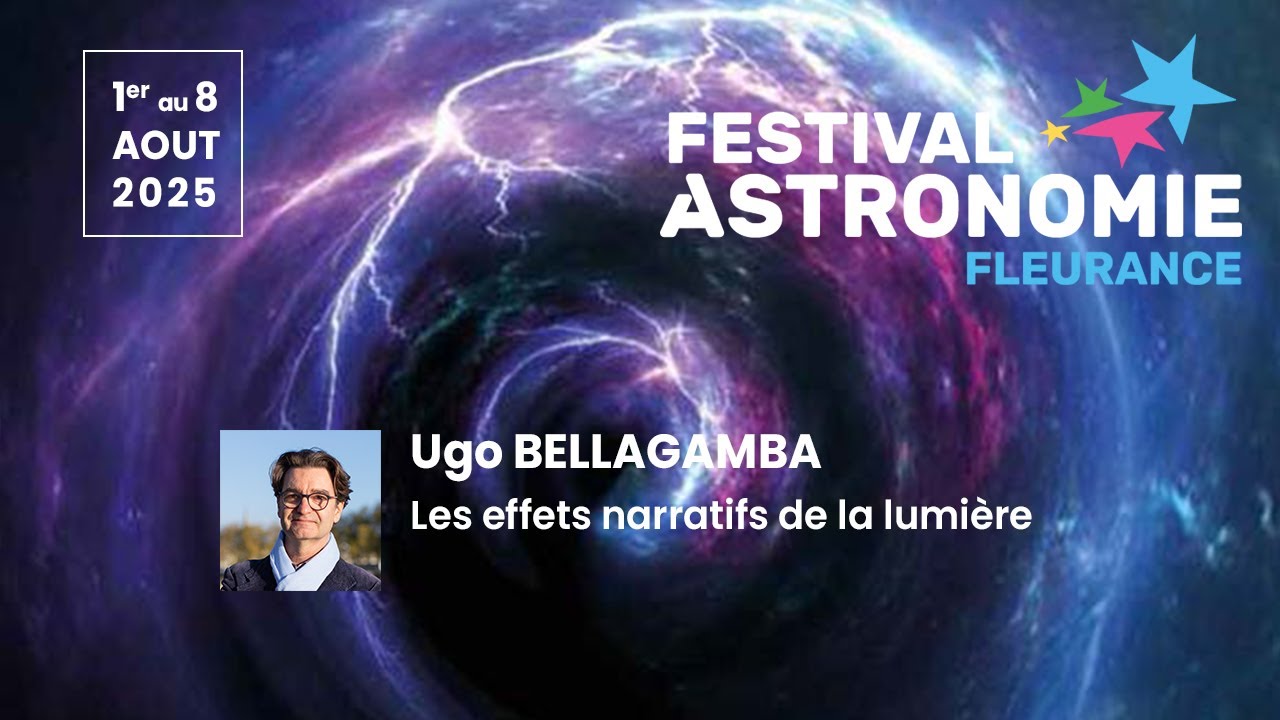
Les effets narratifs de la lumière par Ugo BELLAGAMBA au Festival d'Astronomie de Fleurance
Keywords
Summary
146 words
Critical Evaluation
The talk is intellectually stimulating and well-delivered, showcasing Bellagamba’s expertise in history, law, and science fiction. He effectively bridges ancient myths and modern utopian concepts, demonstrating the enduring power of light as a narrative element. The argumentation is solid, though it relies more on cultural and philosophical interpretations than on scientific evidence, which is appropriate given the speaker’s background. The sources cited are primarily literary and historical, such as Plato’s Republic and references to Egyptian mythology, which are relevant and credible. The talk does not delve into the physics of light, but that is not its aim; instead, it offers a humanistic perspective that complements the scientific discussions of the festival. The title accurately reflects the content, and the talk is well-structured with clear sections. The interactive quiz at the beginning engages the audience and sets a participatory tone. Overall, the talk is valuable for its interdisciplinary approach and its ability to connect ancient narratives with contemporary issues like Solarpunk. It encourages critical thinking about how we use light and color to construct our societies and imagine our futures.
179 words
Title / Content Match
The title accurately reflects the content: the talk focuses on the narrative effects of light, exploring how light and color are used in storytelling, mythology, and utopian visions.
Quality & Reliability
8/10
The speaker is a professor of law and history of law, and a science fiction author. He provides a well-structured talk with references to historical and philosophical sources (Egyptian mythology, Plato). The content is more cultural and literary than scientific, but it is rigorous in its historical and philosophical analysis.
Key Moments
Markers derived by PSI from the transcript: the creator did not define chapters.
- Introduction by Roland Lehoucq, presenting Ugo Bellagamba as a friend and professor of law.
- Bellagamba starts his talk, thanking the festival and introducing the theme of light and narrative.
- Interactive quiz begins: first question about which light source comes to mind.
- Discussion of Egyptian mythology: the sun god Ra and the solar barque, and the role of Set in fighting chaos.
- Introduction of Plato's Republic and the myth of Er, explaining how light holds the universe together.
- Transition to the second part: light as a technique, with references to utopian cities and the City of the Sun.
- Discussion of Solarpunk and how light and color are used in science fiction to imagine sustainable futures.
- Third part: light as a social principle, exploring how societies are organized around light and color.
- Conclusion: Bellagamba summarizes his points and thanks the audience.
Cited Sources
- Plato's Republic — Referenced for the myth of Er and the role of light in holding the universe together.
- The City of the Sun by Tommaso Campanella — Mentioned as an example of utopian city of light.
- Solarpunk — Discussed as a contemporary movement using light and color in speculative fiction.
Concurring Sources
- Plato's Republic — The myth of Er is used to illustrate the narrative power of light.
- The City of the Sun — Campanella's utopia is cited as an example of a city of light.
Contribution & Novelties
The talk offers a unique interdisciplinary perspective on light, combining history, law, and science fiction to show how light has been used as a narrative device across cultures and eras. It connects ancient myths with modern utopian movements, highlighting the enduring power of light in shaping human imagination and social organization.
Pour aller plus loin :
- The Allegory of the Cave — Plato’s allegory is directly related to the theme of light and knowledge.
- Utopia by Thomas More — A foundational utopian text that explores ideal societies, relevant to the discussion of the City of the Sun.
- The Solarpunk Movement — A contemporary speculative fiction genre that imagines sustainable futures, directly linked to the talk’s discussion of light and color.
120 words
Radar Profile
The radar profile shows high scores in quality of information and reliability, reflecting the speaker's expertise and the well-referenced content. The quantity of information is moderate, and the technical level is lower, as the talk focuses on cultural and philosophical aspects rather than scientific details.