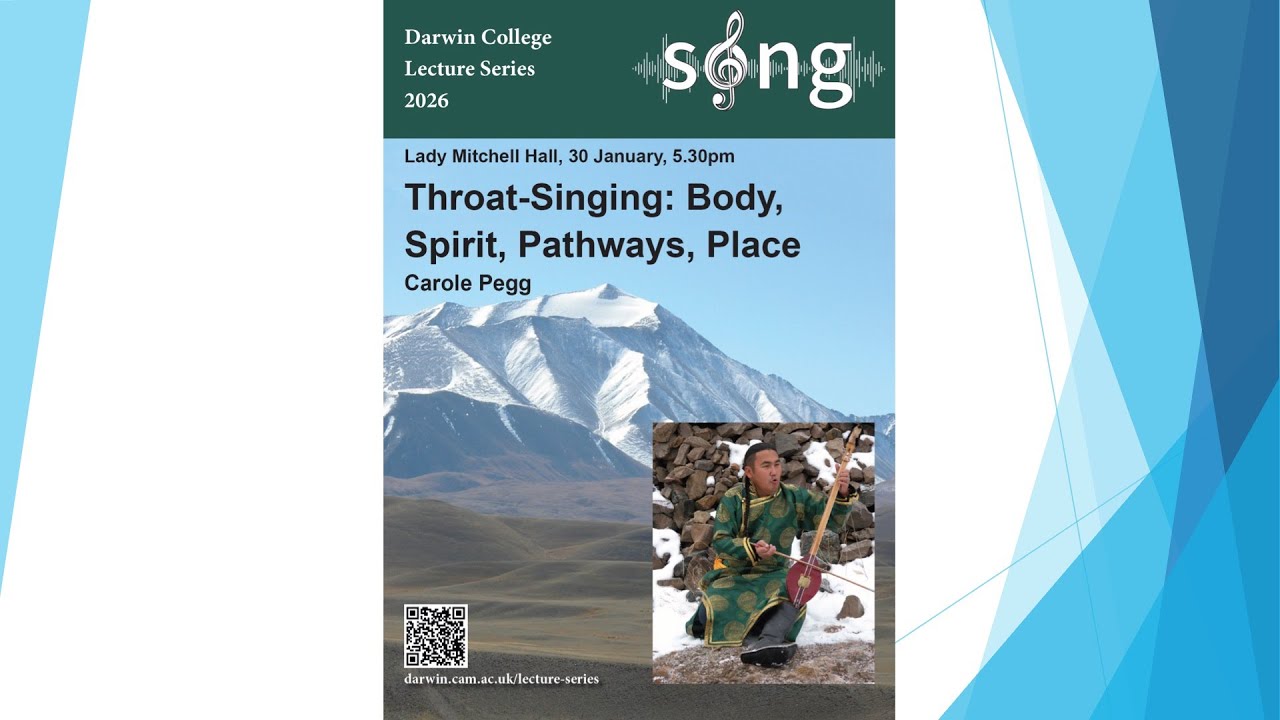
Throat Singing: Body, Spirit, Pathways, Place
Keywords
Summary
128 words
Critical Evaluation
Value of the Information & Strength of the Argument
The lecture provides valuable insights into the cultural and spiritual dimensions of throat singing, moving beyond technical analysis. Pegg’s argument is well-supported by ethnographic evidence and personal experiences. She effectively demonstrates how throat singing is embedded in nomadic cosmology, ecology, and social life. The concept of ‘ontological musicality’ offers a novel framework for understanding music as a relational practice. The argumentation is coherent and persuasive, though some claims rely on anecdotal evidence.
Scientific Rigor, Source Quality, Title Accuracy
Pegg’s academic credentials and extensive fieldwork lend high credibility. She references her own publications and mentions other scholars (e.g., Lajos Vargyas, Roberte Hamayon). The lecture is well-structured and the title accurately reflects the content. No external sources are cited beyond her own work, but the depth of her expertise is evident. The lecture is an expert opinion based on original research.
148 words
Title / Content Match
The title accurately reflects the lecture's focus on throat singing as a practice connecting body, spirit, pathways, and place.
Quality & Reliability
9/10
Lecture by a senior researcher with extensive fieldwork, published ethnographies, and academic credentials. The content is based on original research and personal experience, with clear explanations of cultural context. No obvious biases or unsupported claims.
Chapters
Cited Sources
- Mongolian Music, Dance and Oral Narrative: Performing Diverse Identities — Mentioned as her first ethnography based on fieldwork in Mongolia.
- Drones, Tones & Timbres: Sounding Place among Nomads of the Inner Asian Mountain-Steppes — Her recent book detailing the second research project.
Concurring Sources
- Khoomei - Wikipedia — Provides general information on Tuvan throat singing, consistent with the lecture's descriptions.
Contribution & Novelties
The lecture introduces the concept of ‘ontological musicality’ as a framework to understand throat singing as an inter-relational complex connecting identity, spirituality, and place. It challenges decontextualized Western appropriations and emphasizes the importance of local practices. The lecture provides rich ethnographic examples and personal insights.
Pour aller plus loin :
- Khoomei - Wikipedia — Overview of Tuvan throat singing styles.
- Ethnomusicology - Wikipedia — Academic discipline studying music in cultural context.
- Animism - Wikipedia — Belief system central to Inner Asian spirituality.
82 words
Radar Profile
The profile shows high scores across all dimensions, indicating a well-rounded and reliable lecture with substantial information, strong argumentation, and appropriate technical depth.