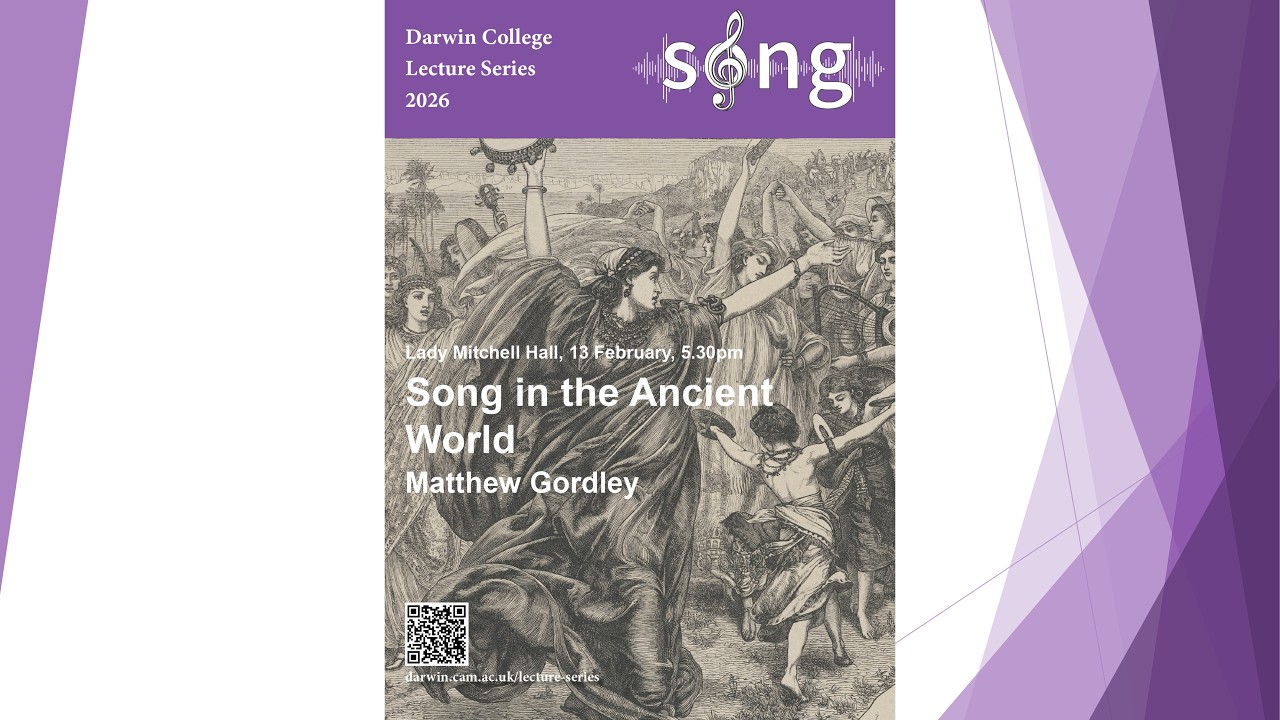
Song in the Ancient World: Echoes of Religion and Resistance
Keywords
Summary
156 words
Critical Evaluation
Value of the Information & Strength of the Argument
The lecture provides valuable insights into the social and political functions of ancient hymns, drawing on a range of primary sources and scholarly interpretations. Gordley’s argument is coherent and well-supported, using specific examples to illustrate how hymns functioned in different contexts. He effectively demonstrates the adaptability of hymn traditions and their role in community identity and resistance. The argumentation is solid, though it relies heavily on the speaker’s own research and does not engage with alternative scholarly perspectives in depth.
Scientific Rigor, Source Quality, Title Accuracy
The lecture demonstrates strong scholarly rigor, with references to primary texts such as Pliny’s letters, Isis hymns, and biblical psalms, as well as to the speaker’s own published monographs. The sources are appropriate and well-integrated. The title accurately reflects the content, focusing on the dual themes of religion and resistance in ancient song. The lecture is well-structured and the arguments are presented clearly, though the lack of explicit citations to other scholars’ works may limit its utility for those seeking a broader academic overview.
179 words
Title / Content Match
The title accurately reflects the content, focusing on the role of song in ancient religion and its use as a form of resistance.
Quality & Reliability
8/10
The lecture is based on the speaker's extensive research and publications in ancient religious song, with references to primary sources (e.g., Pliny's letter, Isis hymns, biblical psalms) and scholarly works. The content is well-structured and historically grounded, though it is a single expert's perspective without direct citation of specific academic sources in the talk itself.
Chapters
Cited Sources
- Pliny the Younger, Letters 10.96 — Referenced as the earliest non-Christian source for Christian hymn singing.
- Isis hymns (e.g., Hymn of Isidorus) — Discussed as examples of hymns to Isis and their spread in the Greco-Roman world.
- Apuleius, The Golden Ass — Cited as a novel showing the appeal of Isis worship.
- Plutarch, On Isis and Osiris — Mentioned as a philosophical interpretation of Isis mysteries.
- Exodus 15 (Song of the Sea) — Analyzed as an example of ancient Hebrew hymnody.
- Wisdom of Solomon — Discussed as a later adaptation of hymn traditions to encourage faithfulness.
- Psalms of Solomon — Mentioned as a collection of psalms reflecting resistance to Roman rule.
Concurring Sources
- The Colossian Hymn in Context — One of the speaker's monographs, supporting his expertise on early Christian hymns.
- Teaching through Song in Antiquity — Another monograph by the speaker, relevant to the didactic function of hymns.
Contribution & Novelties
The lecture offers a synthesis of ancient hymn traditions, highlighting their role in communal formation and resistance. It brings together examples from Greco-Roman, Jewish, and Christian contexts, showing how hymns were adapted to address contemporary challenges. The speaker’s expertise adds depth, but the content is largely a summary of existing scholarship rather than presenting new research.
Pour aller plus loin :
- Hymnody in the Ancient World — Overview of hymns and their functions.
- Cultural Memory — Concept relevant to how hymns preserve and shape communal memory.
- Mystery Cults — Background on the cult of Isis and other mystery religions.
99 words
Radar Profile
The radar profile shows high scores in information quantity, quality, and reliability, with a slightly lower technical level, indicating a lecture that is accessible yet scholarly. The balance suggests a well-rounded presentation suitable for a general academic audience.