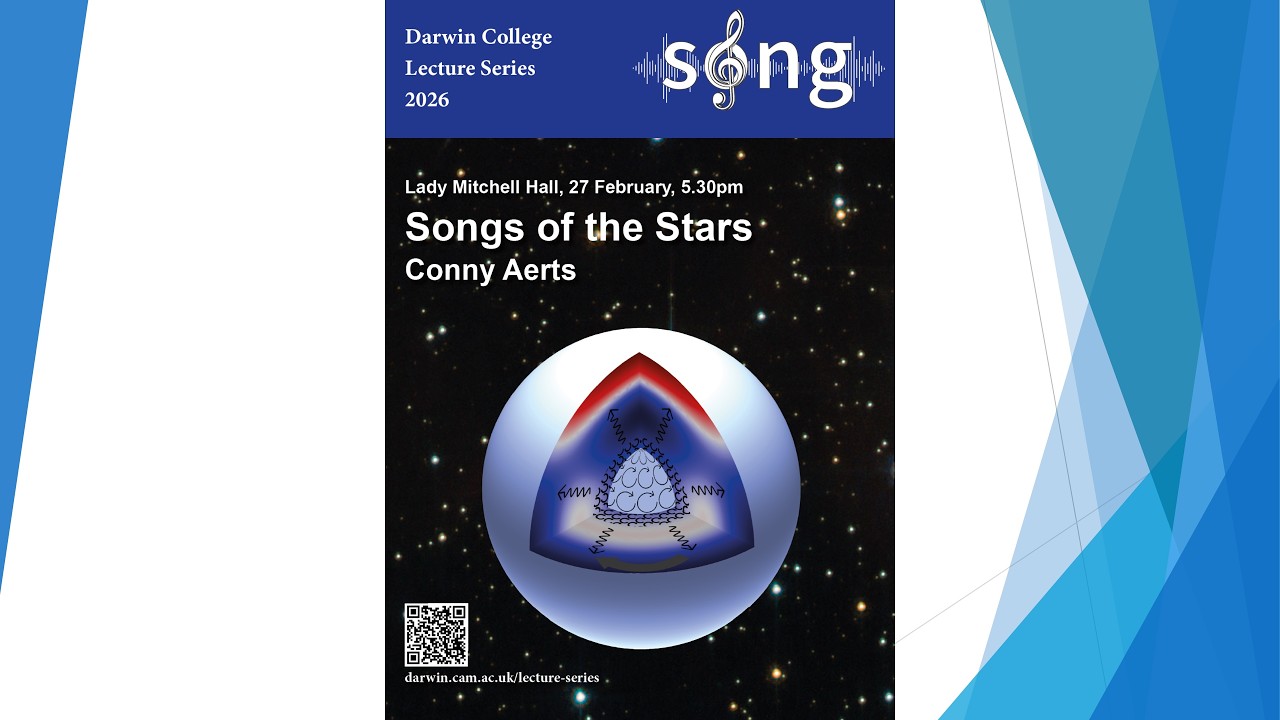
Songs of the Stars: Unravelling Stellar Music with Asteroseismology
Keywords
Summary
193 words
Critical Evaluation
Value of the Information & Strength of the Argument
The lecture provides a comprehensive and accessible overview of asteroseismology, emphasizing its value in revealing stellar interiors and advancing stellar physics. Aerts builds a compelling argument for the importance of this field, connecting it to broader questions of stellar evolution, element production, and even exoplanet characterization. She uses clear analogies (musical instruments, earthquakes) and visual aids to explain complex concepts, making the science understandable without oversimplifying. The argumentation is solid, grounded in decades of research and the success of space missions. Aerts also addresses the limitations and challenges, such as the need for high-precision data and the complexity of interpreting oscillation modes. Overall, the lecture is highly informative and persuasive, showcasing the power of asteroseismology as a unique tool for stellar astrophysics.
Scientific Rigor, Source Quality, Title Accuracy
The scientific rigor is exemplary. Aerts is a leading authority in the field, and her presentation is based on extensive peer-reviewed research and data from major space missions (CoRoT, Kepler, TESS). She accurately represents the current state of knowledge and appropriately cites the work of Eddington and others. The sources are not explicitly listed in the video, but the content is consistent with established scientific literature. The title accurately reflects the content, focusing on the ‘songs’ of stars as a metaphor for their oscillations. The lecture is well-structured, with clear explanations and appropriate technical depth for a general audience. The inclusion of audio demonstrations and animations enhances understanding without compromising accuracy.
248 words
Title / Content Match
The title accurately reflects the content, which focuses on asteroseismology as a means to 'hear' the internal music of stars.
Quality & Reliability
9/10
Lecture by a leading expert and laureate of the Kavli and Crafoord prizes, based on decades of peer-reviewed research and space mission data. The content is accurate, well-structured, and clearly explained, with appropriate caveats and analogies.
Chapters
Cited Sources
- CoRoT Mission — Mentioned as the first space mission dedicated to asteroseismology and exoplanet detection.
- Kepler Mission — Highlighted as the most productive mission for asteroseismology, observing 200,000 stars for four years.
- TESS Mission — Current NASA mission providing asteroseismic data for stars across the sky.
- Eddington's 'The Internal Constitution of the Stars' — Referenced as the century-old challenge of probing stellar interiors.
Concurring Sources
- Aerts, C., Christensen-Dalsgaard, J., & Kurtz, D. W. (2010). Asteroseismology. Springer. — Standard textbook on asteroseismology, providing comprehensive background.
- Chaplin, W. J., & Miglio, A. (2013). Asteroseismology of Solar-Type and Red-Giant Stars. Annual Review of Astronomy and Astrophysics. — Review article summarizing the state of the art in asteroseismology of solar-type and red-giant stars.
Contribution & Novelties
The lecture provides an excellent synthesis of the field of asteroseismology, highlighting its recent advances and future potential. It emphasizes the transformative impact of space missions in enabling high-precision photometry, and explains how asteroseismology allows us to ‘see the invisible’ by probing stellar interiors. The talk also underscores the importance of this field for understanding stellar evolution, element production, and even the characterization of exoplanets. Aerts’ presentation is particularly valuable for its clear explanations of the underlying physics and its demonstration of the power of combining observations with theoretical models.
Pour aller plus loin :
- Asteroseismology - Wikipedia — Overview of the field and its methods.
- Kepler Mission - NASA — Official NASA page on the Kepler mission.
- TESS Mission - NASA — Official NASA page on the TESS mission.
- Gravity modes in stars - arXiv — Recent research on gravity modes and their importance for stellar interiors.
148 words
Radar Profile
The radar profile shows high scores across all dimensions, with particularly strong performance in information quality and reliability. The lecture is rich in content, technically sound, and presented by a leading expert, making it an excellent resource for understanding asteroseismology.