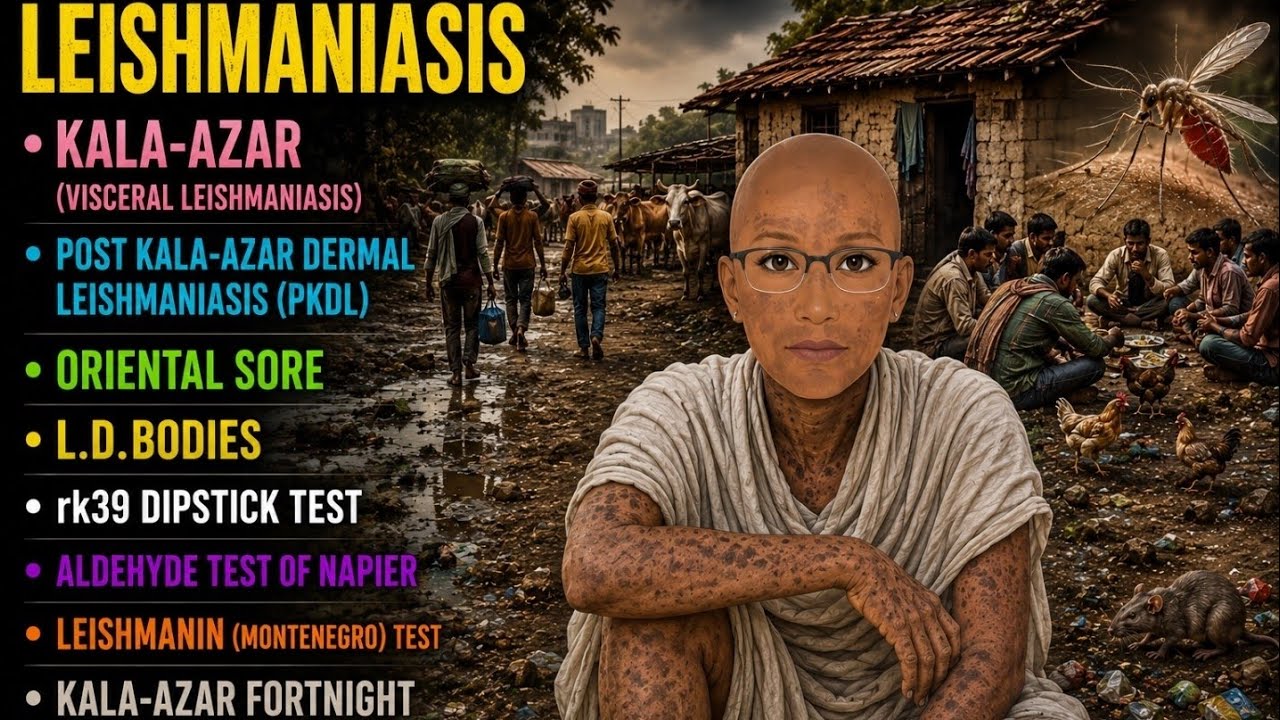
Leishmaniasis | Kalaazar | Post Kala-azar Dermal Leishmaniasis | PKDL | Oriental Sore | Arpits PSM
Keywords
Summary
98 words
Critical Evaluation
Value of the Information & Strength of the Argument
The video provides a thorough and accurate overview of leishmaniasis, with a strong emphasis on exam-relevant points. The presenter uses effective mnemonics and visual comparisons to clarify common confusions, such as the difference between sandfly and sand flea, and the species-disease associations. The argumentation is logical and well-organized, following a systematic approach from introduction to prevention. The inclusion of recent epidemiological data adds value, though the presenter does not delve into the underlying evidence or controversies.
Scientific Rigor, Source Quality, Title Accuracy
The video demonstrates good scientific rigor by aligning with WHO and national guidelines. The presenter mentions sources like the WHO and national programs, and provides a link to notes in the description. The title accurately reflects the content, covering all major forms of leishmaniasis. The video does not cite specific peer-reviewed studies, but the information is consistent with standard medical knowledge. The presenter’s teaching style is engaging and effective for exam preparation.
163 words
Title / Content Match
The title accurately reflects the content, which covers all major forms of leishmaniasis including Kala-azar, PKDL, and Oriental Sore.
Quality & Reliability
8/10
The video provides a comprehensive and structured overview of leishmaniasis, covering epidemiology, clinical features, diagnosis, treatment, and prevention. The information is consistent with WHO data and standard medical knowledge. The presenter uses mnemonics and visual aids to enhance understanding. However, the video is primarily educational and does not cite specific peer-reviewed sources, and some statistics (e.g., 2023 global cases) may be approximate.
Key Moments
Markers derived by PSI from the transcript: the creator did not define chapters.
- Introduction to leishmaniasis and its classification as a protozoal disease.
- Explanation of sandfly vs sand flea and their roles in disease transmission.
- Global epidemiology: distribution of visceral, cutaneous, and mucocutaneous leishmaniasis.
- Indian scenario: endemic districts, notifiable disease status, and case statistics.
- Agent factors: Leishmania species, reservoirs, and vectors.
- Life cycle of Leishmania in sandfly and human host.
- Clinical features of visceral leishmaniasis (Kala-azar) and PKDL.
- Diagnosis: laboratory tests including rK39 dipstick, aldehyde test, and parasite detection.
- Treatment options and drug regimens.
- Preventive measures: vector control, personal protection, and surveillance.
Cited Sources
- Leishmaniasis Notes (Google Drive) — The presenter provides comprehensive notes for the class, available in the video description.
Concurring Sources
- WHO Leishmaniasis Fact Sheet — The video's epidemiological data aligns with WHO reports on leishmaniasis distribution and burden.
Contribution & Novelties
The video offers a comprehensive, exam-oriented review of leishmaniasis, with unique mnemonic techniques to remember key associations. It consolidates information from WHO and national programs into a single accessible format, making it highly valuable for medical students.
Pour aller plus loin :
- Leishmaniasis - WHO — Official WHO fact sheet with global statistics and control strategies.
- Leishmania - NCBI Bookshelf — Detailed medical review of leishmaniasis, including clinical forms and treatment.
- Sandfly - Wikipedia — Overview of sandfly biology and role as disease vector.
84 words
Radar Profile
The radar profile shows high scores in quantity and quality of information, with a strong technical level, indicating a comprehensive and reliable educational resource. The overall reliability is high, though the lack of direct citations slightly reduces the score.
💬 Sur les 0 commentaires analysés, aucune tendance n'est disponible.