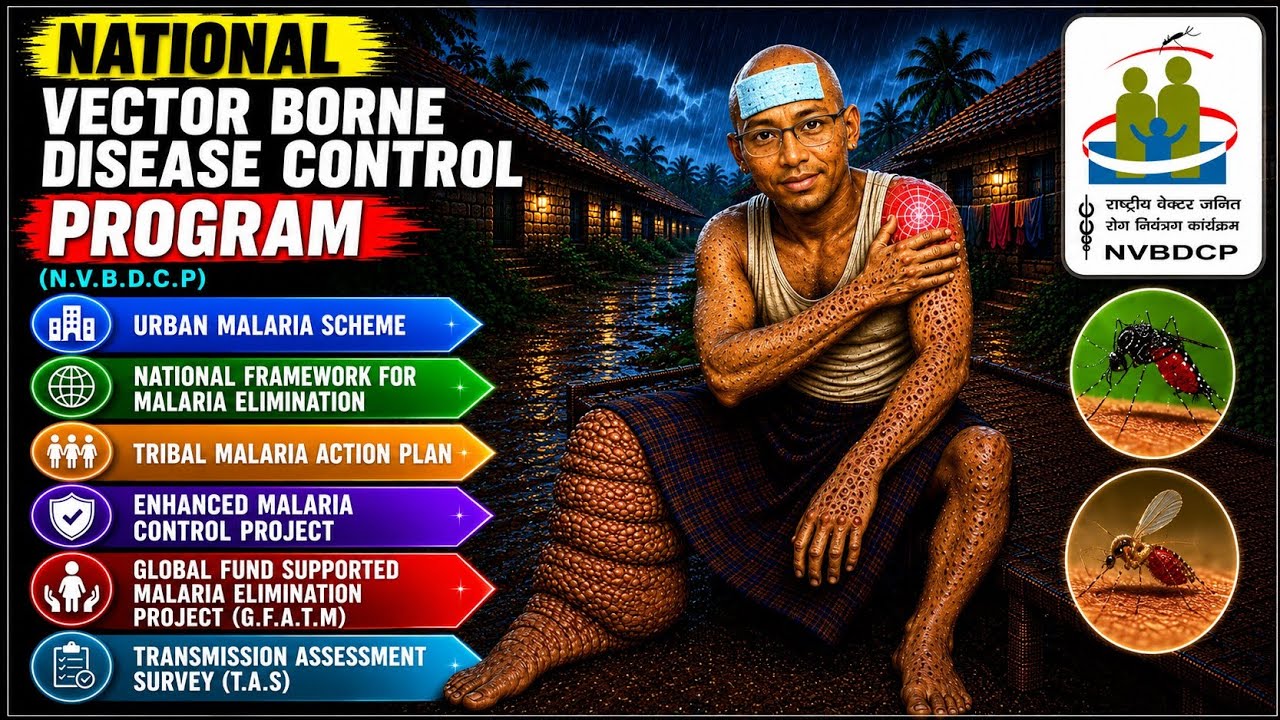
National Vector Borne Disease Control Program | NVBDCP | Urban Malaria Scheme | Arpits PSM made easy
Keywords
Summary
160 words
Critical Evaluation
Value of the Information & Strength of the Argument
The video offers substantial value for students and professionals seeking a clear, structured understanding of NVBDCP. The presenter systematically breaks down the program into components, using a consistent framework (milestones, organization, strategies) that aids comprehension and retention. He provides practical mnemonics and clarifies common confusions, such as the difference between presumptive and radical treatment. The argumentation is coherent and logically organized, building from the program’s history to its current implementation. However, the presentation is largely descriptive and lacks critical analysis or discussion of challenges and controversies. The reliance on mnemonics may oversimplify complex epidemiological concepts, but the core information is accurate and aligns with standard public health knowledge.
Scientific Rigor, Source Quality, Title Accuracy
The video demonstrates a good level of scientific rigor, as the presenter consistently references established public health frameworks and program guidelines. He accurately describes the six diseases, their vectors, and the program’s evolution. The sources cited are not explicitly mentioned in the video, but the description provides a link to detailed notes, which likely contain references to official documents. The title accurately reflects the content, which focuses on NVBDCP and includes a dedicated section on the Urban Malaria Scheme. The presentation is well-structured and adheres to the topic, with no significant deviations.
215 words
Title / Content Match
The title accurately reflects the content, which focuses on the NVBDCP and includes a section on the Urban Malaria Scheme.
Quality & Reliability
7/10
The video is a detailed tutorial on the National Vector Borne Disease Control Program (NVBDCP), covering its history, organization, strategies, and components. The content is based on standard public health knowledge and aligns with official program guidelines. However, the presentation is informal and relies on mnemonics and personal tips, which may oversimplify complex topics. The speaker occasionally mentions specific facts (e.g., population criteria for Urban Malaria Scheme) that are consistent with known program criteria, but no external sources are cited in the video itself. The description provides a link to notes, which likely contain more detailed information.
Key Moments
Markers derived by PSI from the transcript: the creator did not define chapters.
- Introduction to NVBDCP and the six vector-borne diseases
- Explanation of the program's organizational structure from national to village level
- Discussion of key milestones in the malaria control program
- Overview of strategies including disease management and integrated vector management
- Detailed explanation of the Urban Malaria Scheme and its criteria
- Explanation of presumptive and radical treatment for malaria
- Discussion on the role of ASHA and link workers in malaria control
- Summary of the malaria component and key takeaways
Cited Sources
- NVBDCP Notes (Google Drive) — The presenter mentions that detailed notes are available in the description box for reference.
Concurring Sources
- NVBDCP Official Website — The official program website provides detailed information on the six diseases and program strategies, aligning with the video's content.
- WHO Malaria Fact Sheet — WHO's fact sheet on malaria provides global statistics and prevention measures, consistent with the video's discussion on malaria control.
Contribution & Novelties
The video provides a comprehensive and structured overview of NVBDCP, making it a valuable resource for medical students and public health professionals. It offers mnemonics and memory aids that facilitate learning, and it clarifies common confusions such as the difference between presumptive and radical treatment. The presenter’s approach of organizing the program into milestones, organization, and strategies is effective for exam preparation.
Pour aller plus loin :
- National Vector Borne Disease Control Programme (NVBDCP) - Official Website — Official program details and updates.
- World Health Organization - Malaria — Global malaria information and guidelines.
- Integrated Vector Management (IVM) - WHO — WHO’s approach to vector control.
106 words
Radar Profile
The radar chart shows a balanced profile with high scores in quantity of information and reliability, indicating a comprehensive and trustworthy overview. The technical level is moderate, making it accessible to a broad audience. The quality of information is good, but the presentation style is informal, which may affect its perceived rigor.