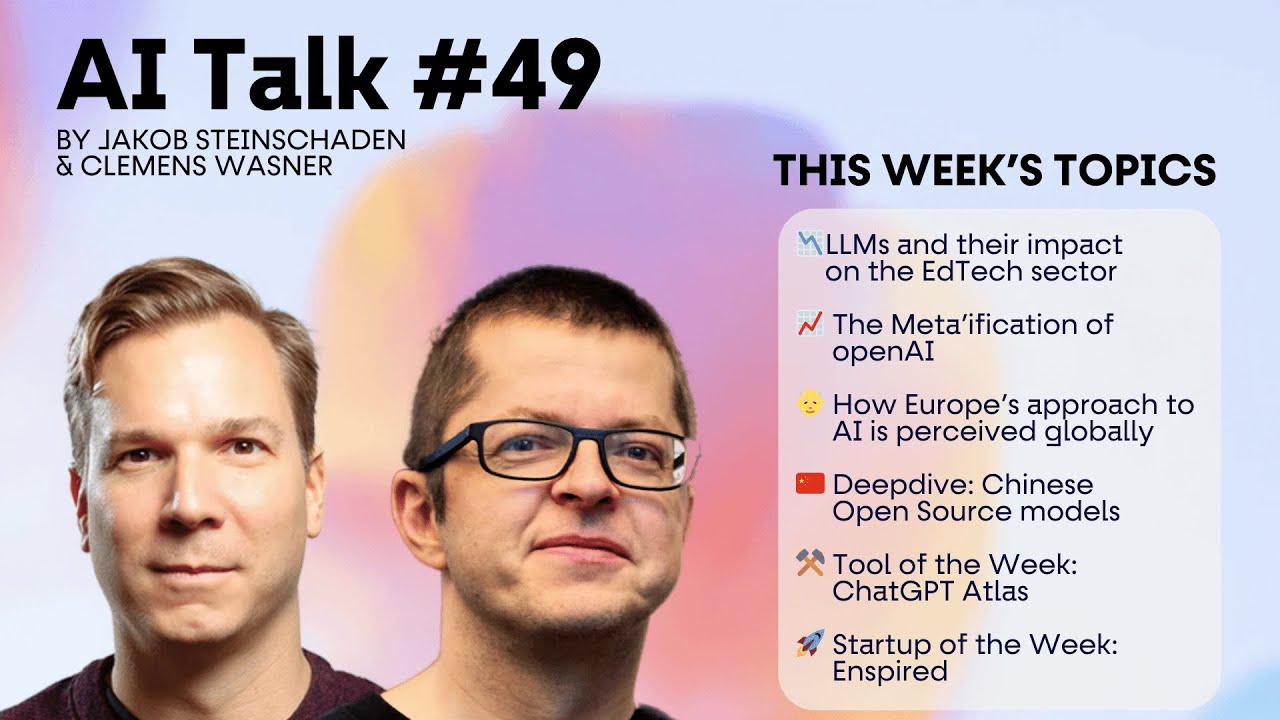
AI Talk 49: Metafizierung von OpenAI | Chinas OpenSource KI | ChatGPT Atlas | Enspired
Keywords
Summary
163 words
Critical Evaluation
Value of the Information & Strength of the Argument
The value of the information is high, as the hosts provide specific examples and data points, such as Chegg’s market cap, OpenAI’s user statistics, and the funding of Enspired. They also offer insightful analysis on the strategic implications of talent movement between Meta and OpenAI, and the rise of Chinese open-source models. The argumentation is generally solid, with hosts supporting their claims with concrete evidence and logical reasoning. However, some arguments rely on anecdotal evidence and personal opinions, particularly regarding the perceived inefficiency of European AI initiatives. The discussion is well-structured and engaging, with a clear narrative flow.
Scientific Rigor, Source Quality, Title Accuracy
The scientific rigor is moderate, as the podcast is a news review rather than a peer-reviewed analysis. The hosts cite specific companies, products, and events, but do not provide formal citations for their claims. The quality of sources is acceptable for a podcast, with references to public information and industry reports. The title accurately reflects the content, covering the main topics discussed. The hosts do not explicitly mention any sources, but they refer to public statements and reports, such as Brian Chesky’s interview and the State of AI Report 2025. Overall, the episode is informative and credible for a general audience, but lacks the depth of formal scientific analysis.
222 words
Title / Content Match
The title accurately reflects the main topics discussed: the 'Metafizierung' of OpenAI, China's open-source AI models, the ChatGPT Atlas tool, and the startup Enspired. The episode covers these subjects in depth.
Quality & Reliability
7/10
The hosts provide a balanced discussion of recent AI industry developments, referencing specific companies and events. While they cite some concrete data (e.g., Chegg's stock decline, OpenAI's user statistics), they rely heavily on anecdotal evidence and personal opinions. The podcast format allows for subjective analysis, but the overall information is generally accurate and up-to-date.
Key Moments
Markers derived by PSI from the transcript: the creator did not define chapters.
- Discussion on Chegg's stock crash and the impact of generative AI on EdTech.
- Analysis of the 'Metafizierung' of OpenAI, including talent moves from Meta.
- Critique of Europe's AI Factories and regulatory environment.
- Deep dive into Chinese open-source AI models and their global adoption.
- Review of ChatGPT Atlas, OpenAI's new browser tool.
- Spotlight on Enspired, an Austrian energy AI startup.
Cited Sources
- Chegg stock price history — Referenced when discussing Chegg's stock decline and market cap.
- OpenAI's weekly user statistics — Mentioned when discussing the number of weekly users and the percentage discussing suicide.
- Brian Chesky interview on AI models — Referenced when discussing Airbnb's use of Qwen.
- State of AI Report 2025 — Mentioned in the context of US companies abandoning open-source AI.
Concurring Sources
- Airbnb CEO Brian Chesky on using Qwen — Supports the claim that Western companies are adopting Chinese open-source models.
- State of AI Report 2025 — Corroborates the observation that US companies are moving away from open-source AI.
Dissenting Sources
- OpenAI's official stance on safety and responsibility — The podcast suggests that OpenAI's hiring of a Responsible AI lead is more about image than substance, which contrasts with OpenAI's public commitment to safety.
Contribution & Novelties
The podcast provides a current and insightful overview of AI industry trends, particularly the strategic shifts at OpenAI and the rise of Chinese open-source models. It offers a unique perspective on the ‘Metafizierung’ of OpenAI, highlighting the cultural and business model changes. The discussion on the adoption of Chinese models by Western companies is timely and adds value to the understanding of global AI competition.
Pour aller plus loin :
- Qwen (Alibaba’s AI model) — Relevant for understanding the capabilities and adoption of Chinese open-source models.
- DeepSeek — Another Chinese AI model mentioned in the episode, known for its performance and cost-effectiveness.
- AI Factories in Europe — Official EU page explaining the AI Factories initiative, relevant to the critique of European AI infrastructure.
- Cambridge Analytica scandal — Referenced in the context of data privacy concerns at Meta and OpenAI.
139 words
Radar Profile
The radar profile shows a balanced performance across all dimensions, with slightly higher scores in quantity of information and technical level, indicating a content-rich and moderately technical discussion. The lower score in fiabilite_globale reflects the reliance on anecdotal evidence and opinions rather than rigorous scientific sources.
💬 Sur les 0 commentaires analysés, aucune tendance n'a pu être dégagée.