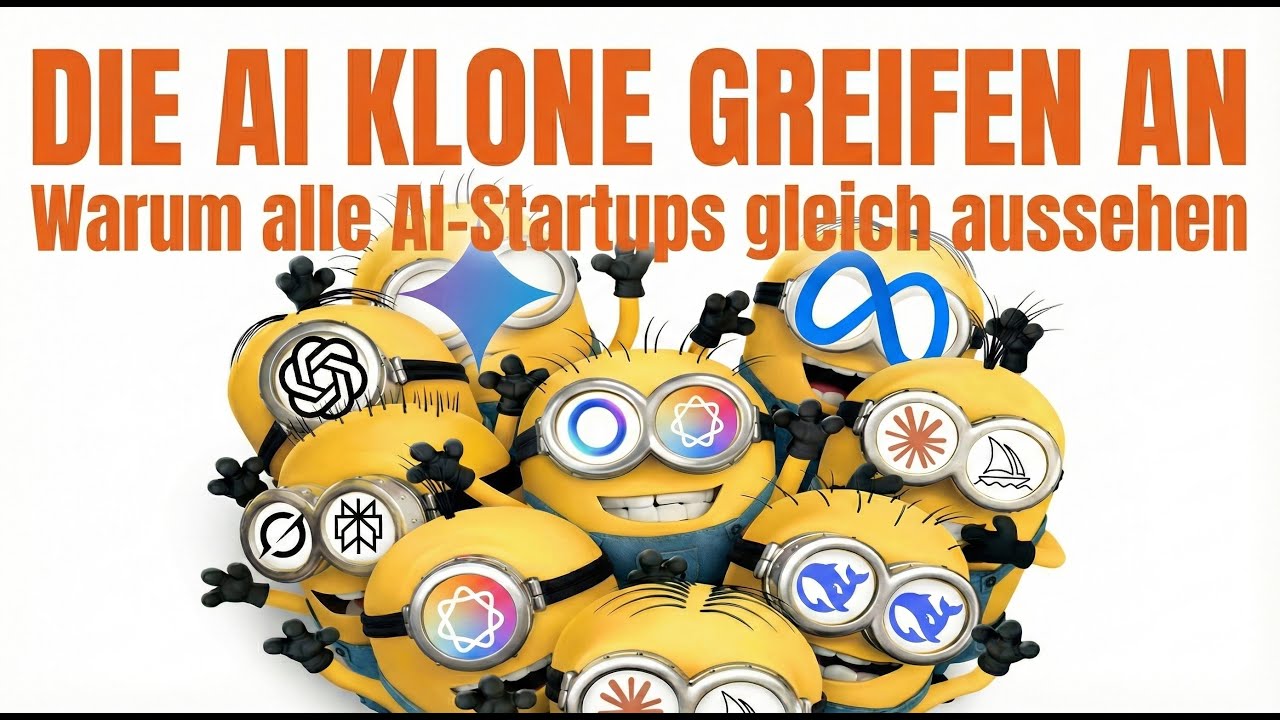
Die AI Klone greifen an - Warum (fast) alle AI-Startups gleich aussehen
Keywords
Summary
126 words
Critical Evaluation
Value of the Information & Strength of the Argument
The value of the information lies in its timely observation of a real trend in the AI startup ecosystem, supported by concrete examples and a live demonstration. The argumentation is coherent, moving from specific visual examples to broader strategic considerations. However, the discussion is largely anecdotal and lacks empirical data or systematic analysis, which limits its scientific rigor. The hosts and guest provide practical insights, but the claims are not backed by formal research.
Scientific Rigor, Source Quality, Title Accuracy
The scientific rigor is moderate: the episode relies on expert opinion and anecdotal evidence rather than peer-reviewed studies. Sources mentioned include Radek Szewczyk’s ‘Butthole Era’ concept and examples from Y Combinator, but no formal citations are provided. The title accurately reflects the content, and the discussion is well-structured. No comments were provided for analysis.
143 words
Title / Content Match
The title accurately reflects the content, which focuses on the homogeneity of AI startup branding and the reasons behind it.
Quality & Reliability
7/10
The podcast features a branding expert and hosts with industry experience, discussing observable trends in AI startup branding. Claims are supported by specific examples (YC startups, logos) and a live demonstration of prompt-based copywriting. However, the discussion is largely anecdotal and lacks systematic data or peer-reviewed sources.
Key Moments
Markers derived by PSI from the transcript: the creator did not define chapters.
- Intro and welcome
- Discussion on vibe coding and similar website designs
- Introduction of the 'Butthole Era' of AI logos
- Andreas Keck on generic startup messaging
- Uniform branding among Y Combinator startups
- Live fix: using AI to write better slogans
- Strategic vagueness and investor pitches
- Gasthaus Birner: embracing ugliness?
- Conclusion and outlook
Cited Sources
- Radek Szewczyk's 'Butthole Era' observation — Mentioned as the origin of the 'Butthole Era' concept for circular AI logos.
- Y Combinator startups examples — Used to illustrate generic messaging among funded startups.
Concurring Sources
- Y Combinator — The examples of startup messaging align with the episode's claims about generic descriptions.
Contribution & Novelties
The episode provides a fresh perspective on the homogenization of AI startup branding, linking it to the use of AI tools and the pressure to attract investors. It offers practical advice for differentiation, emphasizing customer outcomes and clear communication.
Pour aller plus loin :
- Vibe coding — Concept of using AI to generate code from natural language, relevant to the discussion of similar website designs.
- Skeuomorphism — Design trend mentioned in the episode, contrasting with current flat and circular logos.
- Y Combinator — Startup accelerator referenced for examples of generic messaging.
91 words
Radar Profile
The radar profile shows moderate scores across all dimensions, with slightly higher scores in information quantity and quality, reflecting the podcast's informative but anecdotal nature. The lower technical level and reliability scores indicate a focus on practical insights rather than deep technical or scientific rigor.