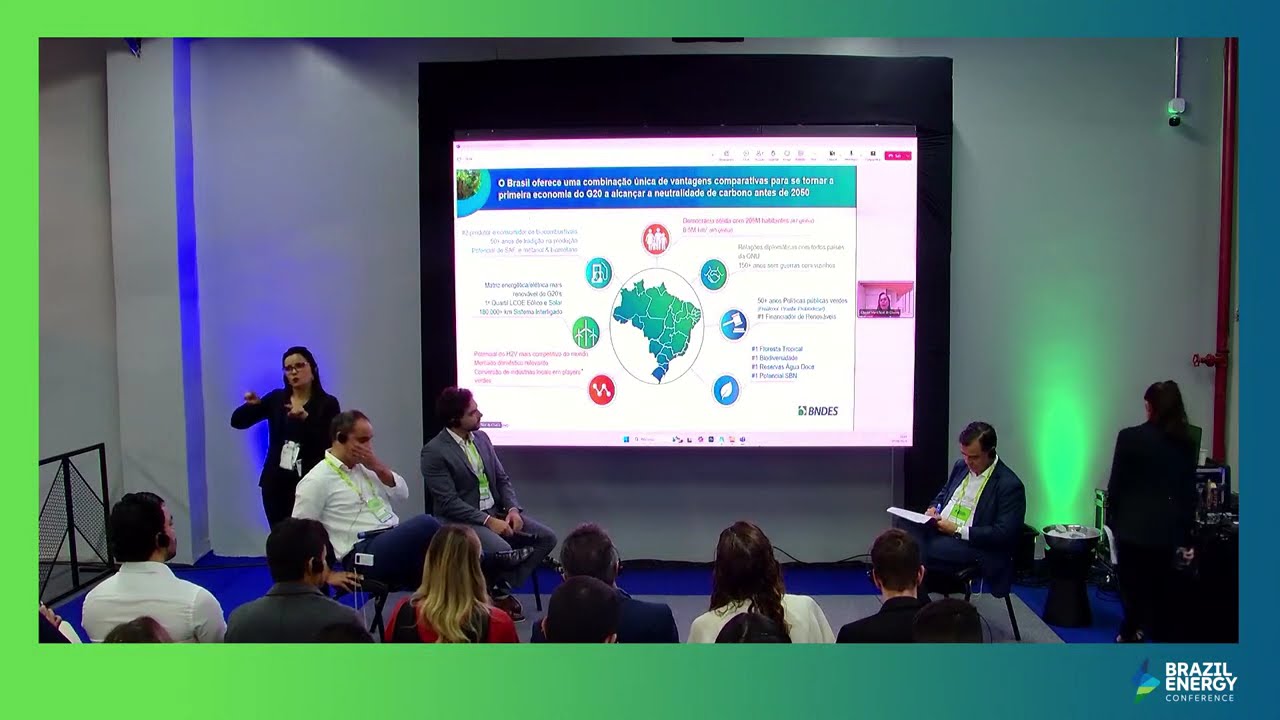
Painel 27: Políticas de Incentivo a Transição Energética | Brazil Energy Conference
Keywords
Summary
156 words
Critical Evaluation
Value of the Information & Strength of the Argument
The value of the information lies in the authoritative perspectives from key Brazilian institutions involved in energy policy. The argumentation is coherent but largely promotional, focusing on the positive aspects of current policies and the potential of renewable energy. There is limited critical examination of challenges such as regulatory barriers, social impacts, or the effectiveness of specific incentives. The speakers present their views as experts, but the discussion lacks depth in terms of data and evidence.
Scientific Rigor, Source Quality, Title Accuracy
The scientific rigor is moderate; the speakers cite general references like the International Energy Agency and mention specific laws and programs (e.g., Proinfa, PATM, Combustível do Futuro) without providing detailed sources. The quality of sources is institutional, which adds credibility but also potential bias. The title accurately reflects the content, which is a panel discussion on incentive policies for energy transition.
152 words
Title / Content Match
The title accurately describes the panel's focus on incentive policies for energy transition, including regulatory strategies and fiscal incentives.
Quality & Reliability
6/10
The panel brings together representatives from key institutions (BNDES, ABEEolica, ANEEL, ABDI) discussing policies and incentives for energy transition. The content is largely institutional and promotional, with limited critical analysis or data. The information is reliable in the sense that it reflects official positions, but it lacks independent verification and depth.
Key Moments
Markers derived by PSI from the transcript: the creator did not define chapters.
- Introduction and welcome to the panel on energy transition incentives.
- Cláudia Noel from BNDES begins her presentation on the bank's role in energy transition.
- Discussion on Brazil's comparative advantages and BNDES's financing of renewable energy.
- Marcello Cabral from ABEEolica discusses the evolution of wind energy and the need for subsidies for new technologies.
- Sandoval Feitosa Neto from ANEEL talks about the 'era of electricity' and the global commitment to triple renewables.
- Discussion on the importance of a just transition and the role of regulation.
- Q&A session and further elaboration on specific policies and challenges.
Cited Sources
- International Energy Agency — Referenced by Sandoval Feitosa Neto regarding the 'era of electricity' and global energy trends.
- BNDES — Cláudia Noel represents BNDES and discusses its role in financing energy transition.
- ABEEolica — Marcello Cabral represents ABEEolica and discusses wind energy policies.
- ANEEL — Sandoval Feitosa Neto is the Director-General of ANEEL and discusses regulatory aspects.
Concurring Sources
- International Energy Agency — Supports the claim of an 'era of electricity' and the need for renewable energy expansion.
Contribution & Novelties
The panel provides an overview of current Brazilian policies and institutional perspectives on energy transition incentives. It highlights the role of BNDES in financing renewable energy and the importance of transparent subsidies. However, it does not offer novel insights or critical analysis, as it is primarily a promotional discussion.
Pour aller plus loin :
- International Energy Agency - World Energy Outlook — Provides global energy scenarios and policy analysis.
- Brazilian National Energy Balance — Official data on Brazil’s energy matrix.
- Green Hydrogen in Brazil — Government initiative on green hydrogen development.
91 words
Radar Profile
The radar profile shows moderate scores across all dimensions, indicating a balanced but not exceptional panel discussion. The highest score is in 'fiabilite_globale' due to institutional credibility, while 'niveau_technique' is lower due to limited technical depth.
💬 No comments were provided for analysis.