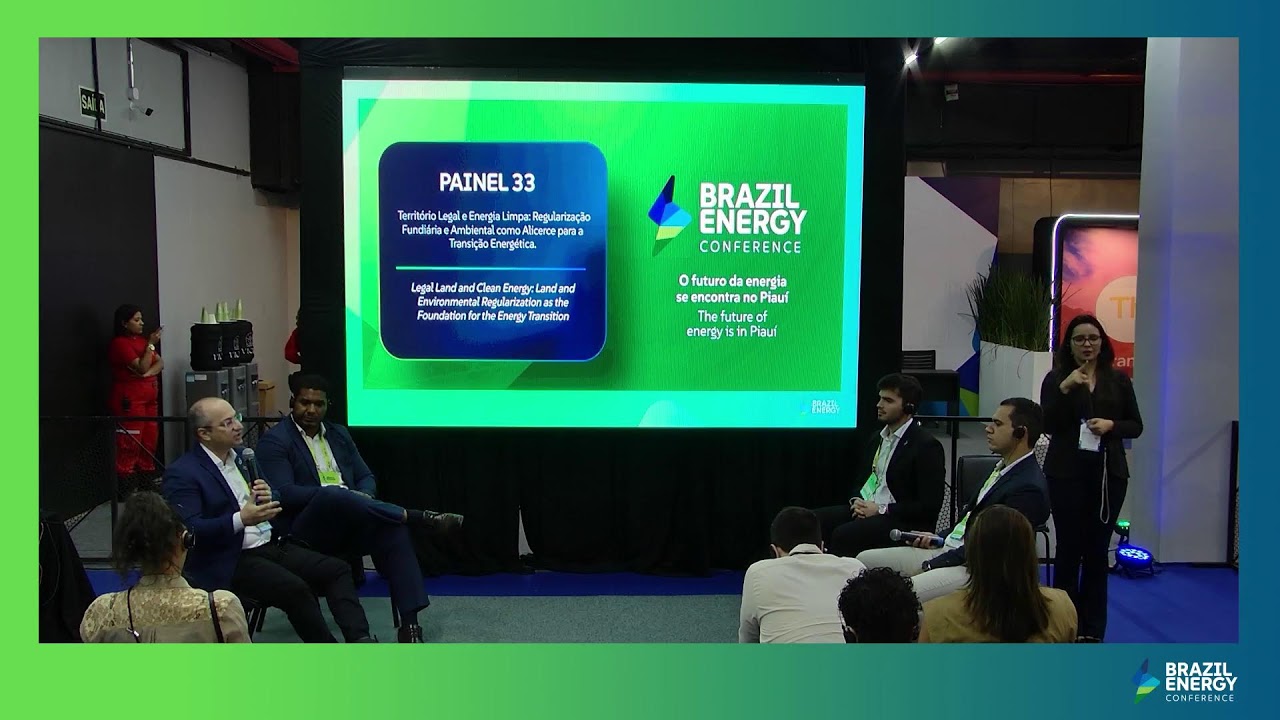
SALA B
Keywords
Summary
207 words
Critical Evaluation
Value of the Information & Strength of the Argument
The panel provides valuable insights into the institutional mechanisms and legal frameworks that support renewable energy development in Piauí. The speakers, all holding key positions in state agencies, offer firsthand knowledge of the processes involved in land regularization and environmental licensing. Their arguments are coherent and well-structured, emphasizing the importance of legal security, environmental sustainability, and social inclusion. The discussion is pragmatic, highlighting concrete examples and recent policy developments, such as the new decree and the CRD. However, the argumentation is largely descriptive and lacks critical analysis of potential shortcomings or challenges. The speakers present a positive view of the state’s efforts, with limited discussion of trade-offs or conflicts. Overall, the value lies in the practical knowledge shared, but the depth of critical evaluation is moderate.
Scientific Rigor, Source Quality, Title Accuracy
The scientific rigor is moderate. The speakers are institutional representatives, lending credibility to the factual claims about state policies and procedures. However, no external sources or data are cited, and the discussion is based on personal experience and institutional knowledge. The title ‘SALA B’ is generic and does not convey the specific topic, which is a significant mismatch. The content is more of a policy discussion than a scientific presentation, but it is grounded in real institutional practices. The adequacy between title and content is poor, as the title provides no indication of the subject matter.
237 words
Title / Content Match
The title 'SALA B' is generic and does not reflect the specific topic of land regularization and environmental licensing for energy transition.
Quality & Reliability
7/10
The panel features institutional representatives from state agencies (Investe Piauí, ITERP, SEMAR) discussing legal and environmental frameworks for renewable energy projects. The content is factual and grounded in institutional experience, but lacks independent verification and detailed technical data.
Key Moments
Markers derived by PSI from the transcript: the creator did not define chapters.
- Introduction of panelists and moderator, setting the context for the discussion.
- Ícaro Carvalho explains the role of Investe Piauí in attracting investments and ensuring legal security.
- Felipe Gomes da Silva discusses SEMAR's approach to environmental licensing for renewable energy projects.
- Rodrigo Cavalcante details the new decree 23692/2025 and the CRD instrument.
- Discussion on the importance of integrating land and environmental governance.
- Examples of successful projects, including the Sumidouro community and Lion Mining.
- Q&A session with the audience begins.
Cited Sources
- Decreto 23692/2025 — Mentioned as a recent state decree establishing rules for land regularization and the CRD.
Concurring Sources
- Brazilian Institute of Environment and Renewable Natural Resources (IBAMA) — Federal environmental agency mentioned as part of the regulatory framework.
Contribution & Novelties
The panel offers an insider perspective on the institutional coordination between state agencies to facilitate renewable energy projects while ensuring legal and environmental compliance. It highlights recent policy innovations, such as the CRD, which aim to streamline processes. The discussion underscores the importance of land regularization as a foundation for sustainable energy transition.
Pour aller plus loin :
- Land regularization in Brazil — Provides background on land tenure issues.
- Environmental licensing in Brazil — Overview of the licensing process.
- Renewable energy in Brazil — Context on the country’s renewable energy matrix.
91 words
Radar Profile
The radar profile shows moderate scores across all dimensions, with slightly higher scores in information quality and reliability, reflecting the institutional credibility of the speakers. The lower score in technical level indicates that the discussion is more policy-oriented than technical.