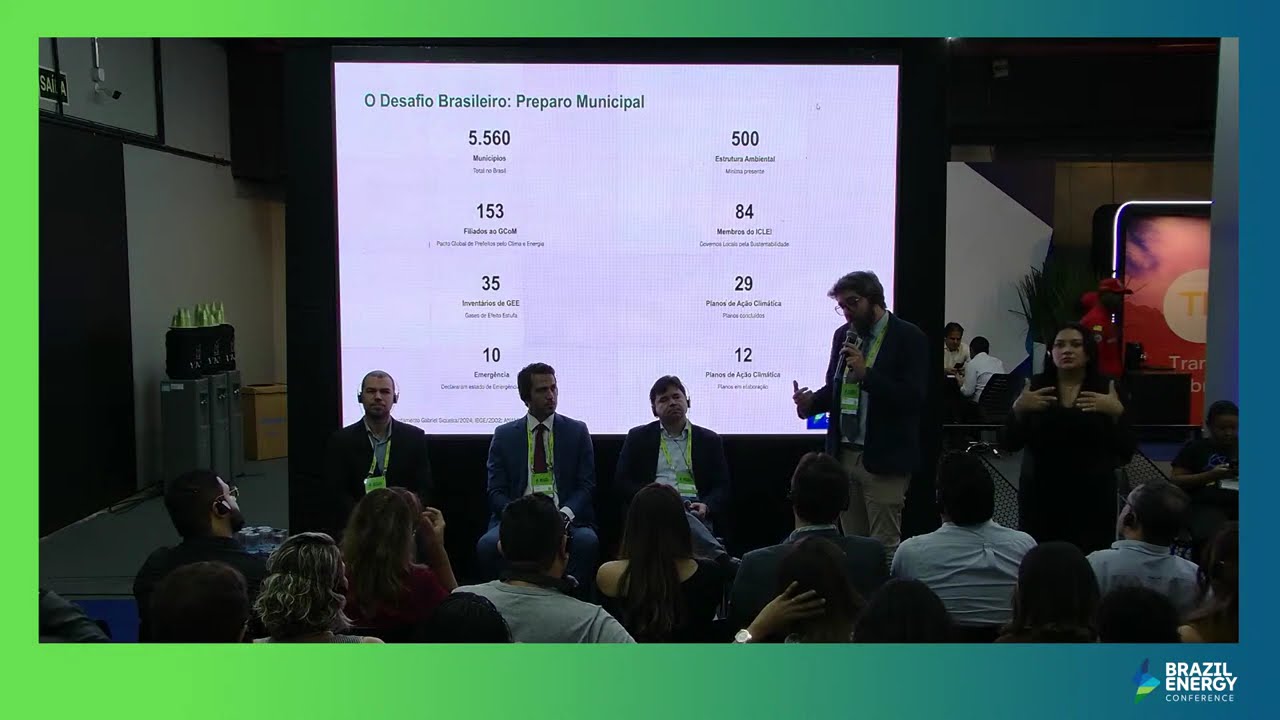
Painel 2: Indicadores de Impacto de Desenvolvimento | Brazil Energy Conference
Keywords
Summary
111 words
Critical Evaluation
Value of the Information & Strength of the Argument
The panel provides valuable insights into the practical challenges of implementing impact indicators for the energy transition, particularly in the Brazilian context. The speakers argue convincingly for the need for participatory and transparent processes, and they support their points with concrete examples from their own experiences. However, the argumentation is largely anecdotal and lacks rigorous quantitative evidence or detailed methodological explanations. The discussion is more of a call to action than a systematic analysis, and the speakers sometimes rely on rhetorical appeals rather than data.
94 words
Title / Content Match
The title accurately reflects the panel's focus on development impact indicators within the energy transition context.
Quality & Reliability
6/10
The panel features expert speakers with institutional backgrounds (ICLEI, UFSC, UESPI) and presents concrete examples of impact measurement initiatives, but lacks detailed methodological explanations and verifiable data sources. The discussion is more qualitative and experience-based than rigorously quantitative.
Key Moments
Markers derived by PSI from the transcript: the creator did not define chapters.
- Gabriel Siqueira presents ecovillage impact data from 2022, showing progress on SDG 2 (Zero Hunger).
- Discussion of local impact measurement using the 'Olho na Câmara' project in Teresina, highlighting transparency and civic engagement.
- Gabriel Siqueira introduces Causal, a Finnish startup, and its impact in 50 cities across 9 countries, with projected CO2 reductions.
- Analysis of Brazilian municipalities' lack of institutional capacity for environmental management and climate data.
- Rodrigo Perpétuo discusses global crises (biodiversity loss, climate change, ethical crisis) and the role of international agreements.
- Perpétuo explains ICLEI's role in supporting subnational governments and the importance of energy poverty as an indicator.
- Discussion of ICLEI's climate compliance methodology applied in Piauí and other states, emphasizing the need for data-driven management.
Cited Sources
- ICLEI - Local Governments for Sustainability — Rodrigo Perpétuo is the executive secretary of ICLEI South America and discusses the organization's role.
- Causal (startup) — Gabriel Siqueira presents Causal as a platform for climate action planning in cities.
- Instituto Nossileus — Gabriel Siqueira mentions the 'Olho na Câmara' project developed by this organization.
Concurring Sources
- IPCC Reports — The scientific consensus on climate change underpins the urgency of the transition.
- UN-Habitat — Urbanization and local governance are central to climate action.
Contribution & Novelties
The panel offers a unique perspective on the challenges of implementing impact indicators for the energy transition in Brazil, particularly at the municipal level. It highlights the gap between global frameworks and local realities, and emphasizes the need for participatory and transparent processes. The discussion provides practical examples from ecovillages, local transparency initiatives, and international platforms, illustrating both successes and barriers.
Pour aller plus loin :
- Sustainable Development Goals (SDGs) — The SDGs provide a framework for holistic impact assessment.
- Paris Agreement — The international climate accord referenced in the discussion.
- Energy poverty — A concept mentioned as a key indicator for energy transition.
- ICLEI - Local Governments for Sustainability — The organization’s work on climate compliance and subnational action.
120 words
Radar Profile
The radar profile shows moderate scores across all dimensions, indicating a balanced but not highly technical or rigorous presentation. The panel is strong on practical insights but weaker on quantitative detail and source citation.