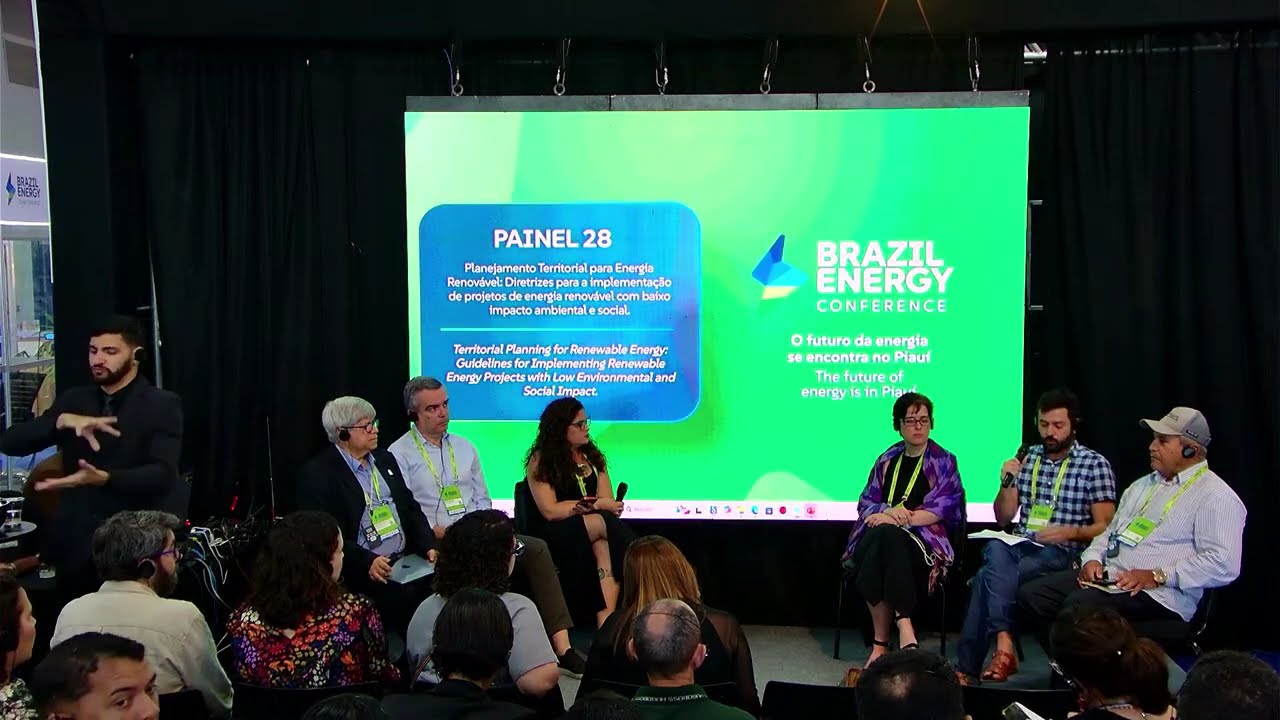
Painel 28: Planejamento Territorial para Energia Renovável | Brazil Energy Conference
Keywords
Summary
177 words
Critical Evaluation
Value of the Information & Strength of the Argument
The value of the information lies in its multi-stakeholder perspective, combining grassroots experience with institutional and academic insights. The argumentation is solid, with each speaker building on the previous ones. José Antônio Nonato provides a powerful firsthand account of the impacts on quilombola communities, questioning the ‘renewable’ label when projects cause environmental and social harm. Daniel Faggiano reinforces this by linking renewable energy projects to historical extractivist patterns and stressing the importance of consultation and rights. Ieva Lazareviciute adds a nuanced view on development, emphasizing that what constitutes development must be defined locally. Washington Rocha presents concrete data from MapBiomas showing deforestation linked to renewable energy projects, grounding the discussion in evidence. The arguments are coherent and well-structured, though some claims could benefit from more specific references.
Scientific Rigor, Source Quality, Title Accuracy
The scientific rigor is moderate. The panel relies on experiential knowledge and institutional data, but lacks formal citations. MapBiomas data is credible and publicly available, but other claims, such as those about health impacts, are anecdotal. The title accurately reflects the content, which is a panel discussion on territorial planning. The discussion is well-moderated and stays on topic. No specific sources are cited beyond the general mention of MapBiomas and UN climate panels, but the description lists the panelists’ affiliations, which adds credibility. Overall, the content is informative but would benefit from more explicit references to studies or reports.
241 words
Title / Content Match
The title accurately reflects the panel's focus on territorial planning for renewable energy, with discussions on environmental and social impacts.
Quality & Reliability
7/10
The panel brings together diverse stakeholders including community leaders, activists, UN representatives, academics, and government officials. While not a peer-reviewed study, it provides valuable firsthand accounts and data from MapBiomas, balanced by institutional perspectives. The discussion is coherent and grounded in real cases, though some claims lack detailed citations.
Key Moments
Markers derived by PSI from the transcript: the creator did not define chapters.
- Introduction of panelists and topic by mediator Kassya Fernandes.
- José Antônio Nonato shares concerns about renewable energy impacts on quilombola communities.
- Daniel Faggiano discusses the importance of free, prior, and informed consent and the risks of extractivist models.
- Ieva Lazareviciute talks about defining development locally and the need for inclusive dialogue.
- Washington Rocha presents MapBiomas data on deforestation linked to renewable energy projects.
- Washington Bonfim responds to the complexity of the transition and mentions political polarization.
Cited Sources
- MapBiomas — Washington Rocha presents data from MapBiomas on deforestation related to renewable energy projects.
- UNDP (PNUD) — Ieva Lazareviciute is from UNDP, and the panel discusses development and energy transition.
Concurring Sources
- MapBiomas — Data presented by Washington Rocha aligns with the panel's concerns about environmental impacts.
Contribution & Novelties
The panel provides a unique platform for direct voices from affected communities, particularly quilombola leaders, to discuss renewable energy planning. It highlights the often-overlooked social and environmental costs of renewable projects and calls for a more inclusive, participatory approach. The discussion integrates local knowledge with institutional perspectives, offering a holistic view of the challenges and opportunities.
Pour aller plus loin :
- Convention 169 on Indigenous and Tribal Peoples — This ILO convention is referenced in the discussion regarding free, prior, and informed consent.
- MapBiomas Project — The project provides data on land use and deforestation, central to the panel’s evidence.
- Just Transition Framework — The concept of a just transition is central to the discussion, ensuring that the shift to renewable energy does not leave communities behind.
127 words
Radar Profile
The radar profile shows high scores in quantity of information and moderate scores in quality and technical level, reflecting the panel's breadth of perspectives but limited depth in technical detail. The reliability is moderate, supported by institutional affiliations but lacking formal citations.
💬 No comments were provided for analysis.