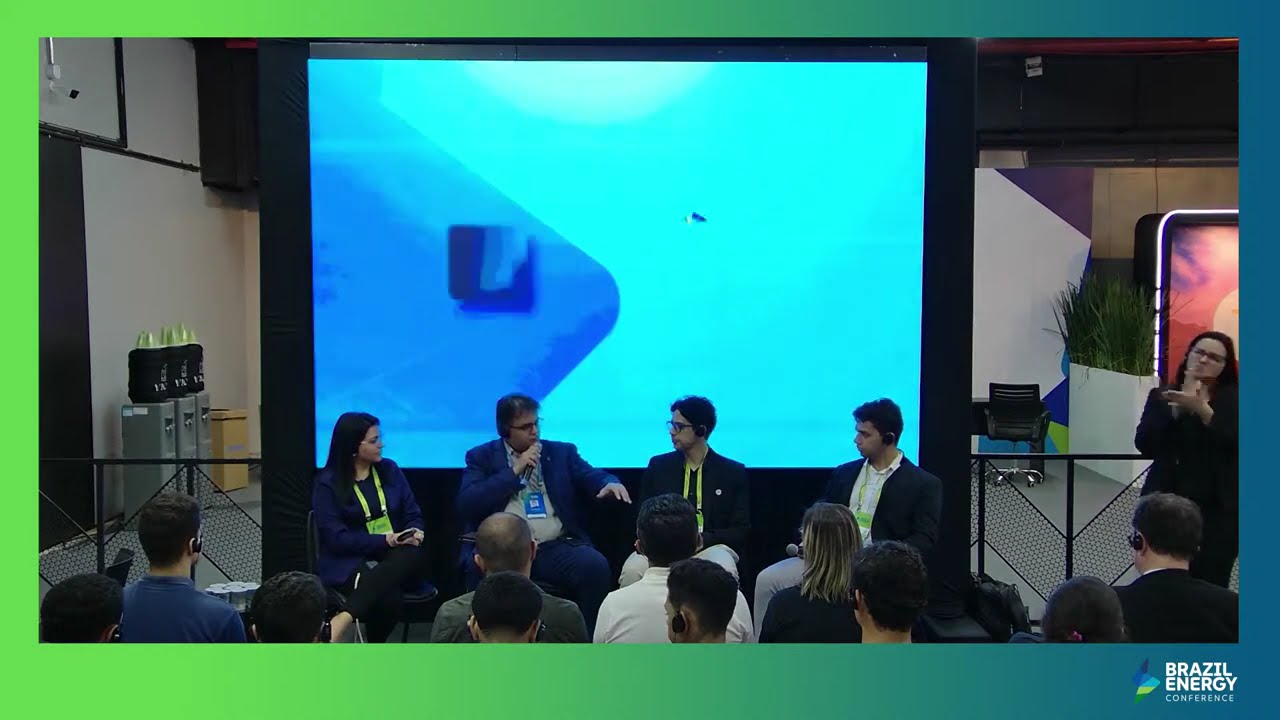
Panel 6 - SEMARH: Challenges and Opportunities in the Integration of Battery Energy Storage Systems
Keywords
Summary
191 words
Critical Evaluation
Value of the Information & Strength of the Argument
The panel provides valuable insights into the practical applications and challenges of BESS, particularly in the Brazilian context. The speakers effectively argue for the necessity of storage to address intermittency and grid constraints, using relatable examples like peak shaving and agrivoltaics. The argumentation is coherent and grounded in professional experience, though it lacks quantitative data or detailed technical analysis. The discussion highlights the economic and operational benefits of BESS, making a compelling case for its adoption, but it remains at an introductory level.
Scientific Rigor, Source Quality, Title Accuracy
The panel is scientifically rigorous in its conceptual explanations, but it does not cite specific studies or data sources. The speakers rely on their professional expertise and general knowledge, which adds credibility but limits verifiability. The title accurately reflects the content, focusing on challenges and opportunities. No comments were provided for analysis, so no public trends can be assessed.
157 words
Title / Content Match
The title accurately reflects the content: a panel discussion on challenges and opportunities for battery storage integration, moderated by SEMARH-related entities.
Quality & Reliability
6/10
The panel features experts from academia and a state investment agency, providing practical insights into BESS applications. However, the discussion is largely qualitative, lacks specific data or citations, and is a recorded conference panel rather than a peer-reviewed source.
Key Moments
Markers derived by PSI from the transcript: the creator did not define chapters.
- Introduction by moderator Laiz Hérida, setting the context of energy transition and grid challenges.
- Speaker introductions: Juan de Aguiar Gonçalves, Atos Borges, and Davi Rodrigues share their backgrounds.
- Discussion on the role of academia in developing contextualized technologies and specialized human capital.
- Atos Borges explains the intermittency of renewables and how BESS can provide grid stability and frequency control.
- Examples of BESS applications: peak shaving and agrivoltaics for poultry farms.
- Davi Rodrigues discusses the versatility of BESS and its role in addressing curtailment and grid capacity.
- Discussion on ultra-electro-intensive consumers like green hydrogen and data centers, and the need for storage.
- Q&A session with the audience, addressing specific concerns about BESS implementation.
- Closing remarks summarizing the key points and future outlook for battery storage in Brazil.
Contribution & Novelties
The panel offers a regional perspective on BESS integration, emphasizing the specific challenges and opportunities in Piauí, Brazil. It highlights the role of academia in adapting technologies to local contexts and the need for specialized workforce development. The discussion connects BESS to broader trends like green hydrogen and data centers, providing a holistic view of the energy transition.
Pour aller plus loin :
- Battery energy storage system — Overview of BESS technologies and applications.
- Grid energy storage — General concepts and benefits of storage in power systems.
- Curtailment (electricity) — Explanation of curtailment and its implications for renewable energy.
- Agrivoltaics — Combined use of land for agriculture and solar energy generation.
111 words
Radar Profile
The radar profile shows moderate scores across all dimensions, indicating a balanced but not highly technical discussion. The panel provides solid qualitative information but lacks depth in quantitative analysis and source citation, resulting in a moderate overall assessment.