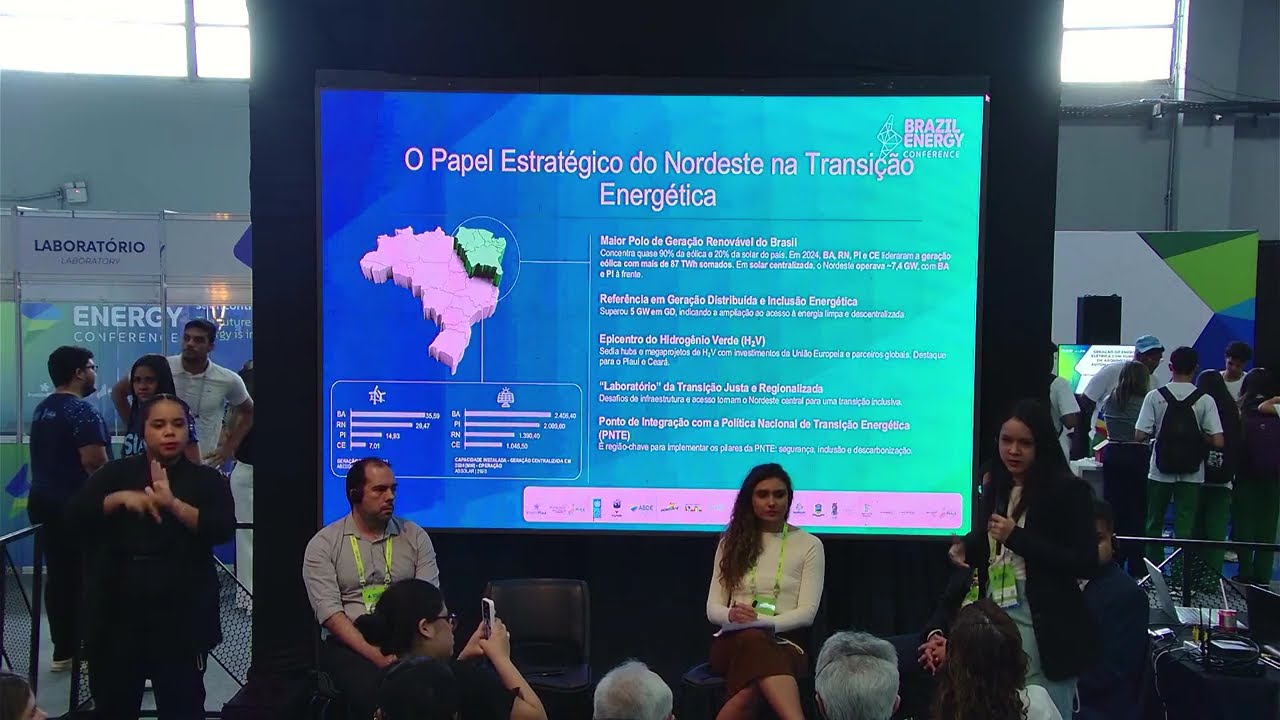
Painel 31: Participação do Piauí na Matriz Energética Nacional
Keywords
Summary
187 words
Critical Evaluation
Value of the Information & Strength of the Argument
The value of the information is significant for those interested in the energy transition in Brazil, particularly the state of Piauí. The speakers provide concrete data on renewable energy capacity, consumption, and future projections, which are useful for understanding the regional dynamics. The argumentation is coherent, emphasizing the need for a just and inclusive transition, balancing energy security, equity, and environmental sustainability. However, the presentation is largely promotional, focusing on achievements and potential without critical analysis of challenges or potential negative impacts. The argumentation relies on official data and government initiatives, but lacks independent verification or discussion of alternative perspectives.
Scientific Rigor, Source Quality, Title Accuracy
The scientific rigor is moderate. The speakers cite official sources such as the Brazilian Geological Survey, SEPLAN, and SUMER, and present data from government databases. However, the sources are not independently verified, and the presentation is more of an expert opinion than a peer-reviewed study. The title accurately reflects the content, which is a panel discussion on Piauí’s role in the national energy matrix. The content is well-structured, but the lack of critical discussion and reliance on official data limits its scientific rigor. No comments were provided for analysis.
204 words
Title / Content Match
The title accurately reflects the content, which focuses on Piauí's role in the national energy matrix and the challenges of the Northeast in the energy transition.
Quality & Reliability
7/10
The panel features experts from government and geological services, presenting official data and ongoing projects. However, it is largely promotional and lacks independent verification or critical discussion.
Key Moments
Markers derived by PSI from the transcript: the creator did not define chapters.
- Introduction to the panel and the importance of a just energy transition.
- Isadora presents Brazil's renewable energy leadership and the Northeast's role.
- Discussion of Piauí's renewable energy matrix and its position as a national leader.
- Presentation of green hydrogen projects in Piauí and the Northeast.
- Bruno introduces the Superintendence's work on data collection and integration.
- Details on the data engineering process and the creation of dashboards.
- Discussion of challenges in transmission infrastructure and planning.
- Future projections for renewable energy capacity in Piauí.
- Overview of distributed generation and consumption trends.
- Conclusion and emphasis on evidence-based planning for the energy transition.
Cited Sources
- Brazilian Geological Survey (SGB) — Mentioned as a data source for geological mapping and mineral resources.
- SEPLAN (Secretaria de Planejamento do Piauí) — Government agency involved in planning and data integration.
- SUMER (Superintendência de Mineração e Energias Renováveis) — State agency responsible for mining and renewable energy data.
- PENAD — Cited for data on rural population without access to energy in Piauí.
- ABSOLAR — Cited for solar power capacity data.
- ANEEL — Cited as a source for energy regulation and data.
- ONS — Cited as a source for national grid data.
- Equatorial — Cited as a source for distribution data.
Concurring Sources
- Brazilian Energy Research Office (EPE) — Official source for energy statistics and planning, consistent with the data presented.
- International Renewable Energy Agency (IRENA) — Global renewable energy data, supporting Brazil's renewable leadership claims.
Dissenting Sources
- Critical analysis of energy transition in Brazil — No specific discordant sources were mentioned, but independent analyses may question the feasibility of green hydrogen projects or the social impacts of large-scale renewable deployment.
Contribution & Novelties
The panel provides a detailed overview of Piauí’s renewable energy potential and the state’s efforts to become a leader in the energy transition. It highlights the importance of data-driven planning and the integration of various stakeholders. The presentation of the Superintendence’s data platform is a novel contribution, as it centralizes dispersed data and uses AI to make legislation accessible. However, the content is largely descriptive and lacks critical analysis or new research findings.
Pour aller plus loin :
- Brazil’s National Energy Plan 2050 — Official planning document for Brazil’s energy future.
- Green Hydrogen in Brazil — Government initiative for green hydrogen development.
- Energy Transition in the Northeast — Regulatory agency for electricity, relevant for understanding grid integration challenges.
118 words
Radar Profile
The radar profile shows moderate scores across all dimensions, with slightly higher scores in information quantity and reliability, reflecting the presentation of official data. The technical level is moderate, suitable for a general audience, and the overall quality is adequate but not exceptional.