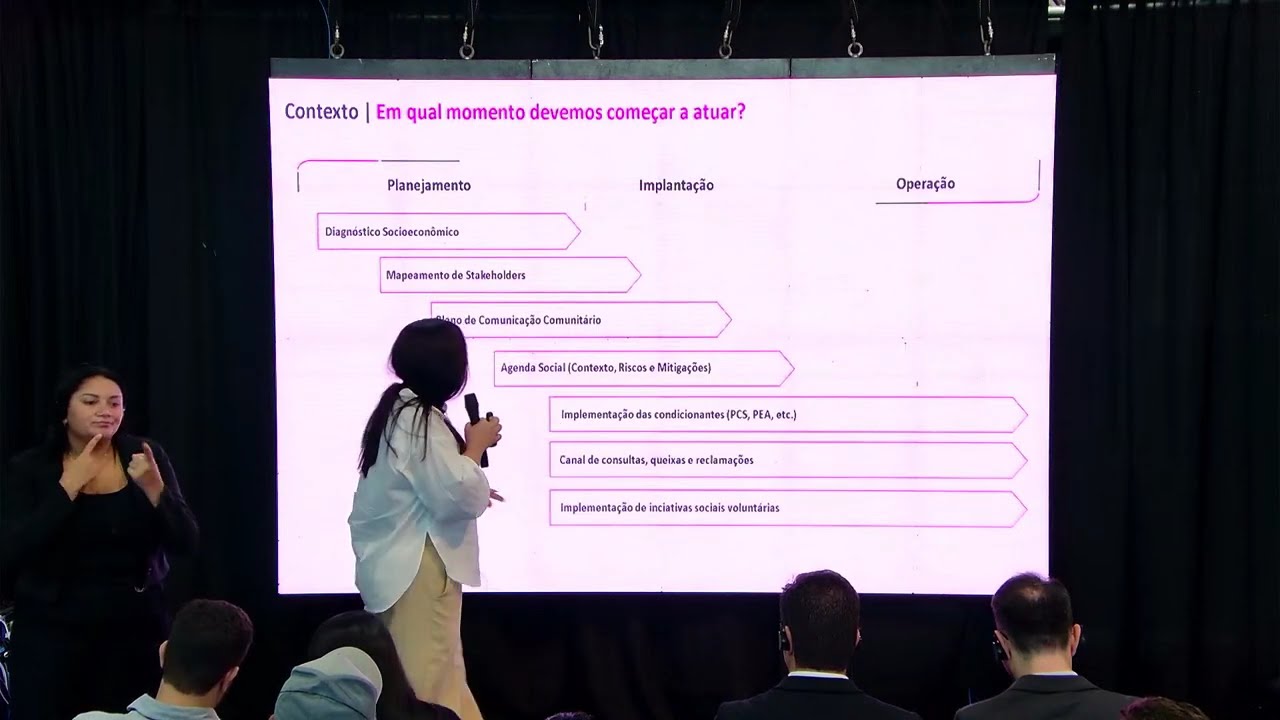
Painel 10 - SEMARH: Estratégias de relacionamento e desenvolvimento social no Sertão do Piauí
Keywords
Summary
168 words
Critical Evaluation
Value of the Information & Strength of the Argument
The panel provides valuable insights into the practical implementation of social strategies in renewable energy projects. The speakers argue convincingly that social engagement must be integrated from the planning stage, not just as a response to conflicts. They support their arguments with concrete examples, such as the Ramada village case and the comparison with another company that faced conflicts due to neglecting social aspects. The emphasis on local knowledge, dedicated teams, and adaptive communication methods (e.g., using audio messages) strengthens the credibility of their approach. However, the discussion is largely anecdotal and lacks quantitative data or independent evaluation, which limits the strength of the argumentation.
Scientific Rigor, Source Quality, Title Accuracy
The speakers reference international standards like UN Guiding Principles on Business and Human Rights, IFC Performance Standards, and ILO Convention 169, indicating a commitment to recognized frameworks. However, no specific sources or publications are cited, and the information is based on internal company experience. The title accurately reflects the content, focusing on social relationship strategies and development in the Sertão do Piauí. The discussion is coherent and well-structured, but the lack of external references and data reduces the scientific rigor.
200 words
Title / Content Match
The title accurately reflects the panel's focus on social relationship strategies and development in the Sertão do Piauí.
Quality & Reliability
7/10
The panel features experienced professionals from Auren Energy and SEMARH, discussing social strategies in renewable energy projects. The content is based on practical experience and references international standards, but lacks external verification and specific data.
Key Moments
Markers derived by PSI from the transcript: the creator did not define chapters.
- Introduction of panelists and topic.
- Jarbas Amaro introduces Auren's history and presence in Piauí.
- Discussion on the importance of starting social engagement from the planning phase.
- Explanation of the Diálogo Aberto channel and community committees.
- Presentation of the socio-economic context of the Sertão do Piauí.
- Discussion on the three main pillars of social action: education, work and income, and infrastructure.
- Case study of Ramada village and partnership with public authorities.
- Q&A session and closing remarks.
Cited Sources
- UN Guiding Principles on Business and Human Rights — Referenced as a framework guiding Auren's social practices.
- IFC Performance Standards — Mentioned as international standards for sustainability.
- ILO Convention 169 — Referenced in relation to free, prior, and informed consent for traditional communities.
Concurring Sources
- UN Guiding Principles on Business and Human Rights — Aligns with the panel's emphasis on human rights due diligence.
- IFC Performance Standards — Supports the need for stakeholder engagement and social assessment.
Contribution & Novelties
The panel provides a practical perspective on integrating social strategies into renewable energy projects, emphasizing early engagement and local partnerships. It highlights the importance of adapting communication methods to local contexts and the value of voluntary social investment as a risk mitigation tool.
Pour aller plus loin :
- UN Guiding Principles on Business and Human Rights — Key framework for corporate social responsibility.
- IFC Performance Standards — International standards for environmental and social sustainability.
- ILO Convention 169 — Relevant for indigenous and tribal peoples’ rights.
85 words
Radar Profile
The radar profile shows balanced scores across information quantity, quality, and technical level, with a slightly lower reliability score due to lack of external verification. The overall assessment is positive, reflecting the practical value of the discussion.