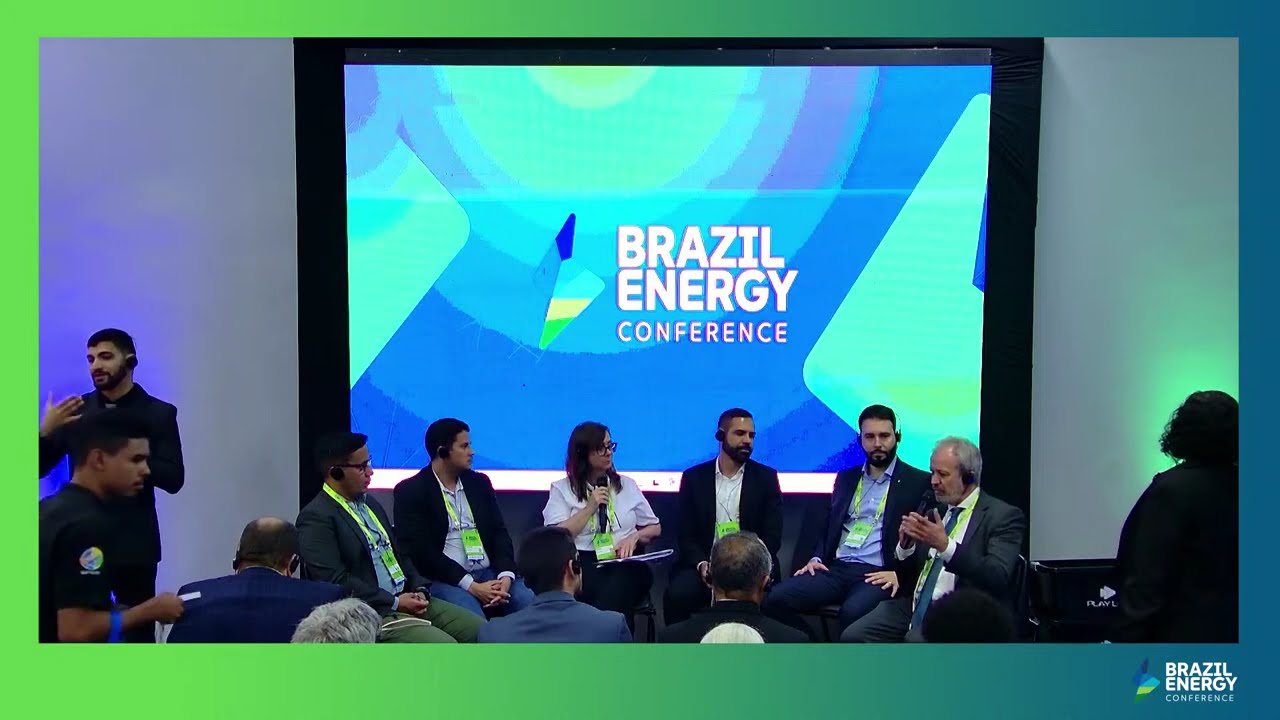
Painel 5 - ABDE: Inovação Financeira para Transição Energética | Brazil Energy Conference
Keywords
Summary
170 words
Critical Evaluation
Value of the Information & Strength of the Argument
The panel provides valuable insights into the practical financial mechanisms being developed by Brazilian public banks to support the energy transition. The arguments are grounded in concrete examples, such as Bandes’ decarbonization fund and Banco do Brasil’s green credit lines, which demonstrate the banks’ commitment and the feasibility of such initiatives. However, the discussion is largely descriptive, lacking critical evaluation of the effectiveness or potential challenges of these instruments. The panelists present their institutions’ actions positively, without addressing potential limitations or trade-offs. The argumentation is coherent but not deeply analytical, focusing more on showcasing initiatives than on rigorous assessment.
Scientific Rigor, Source Quality, Title Accuracy
The panel is based on institutional experiences and publicly available data, such as the estimated economic losses from climate disasters in Rio Grande do Sul and the Espírito Santo decarbonization plan. The speakers reference their own institutions’ reports and initiatives, which are credible but not independently verified. The title accurately reflects the content, which is a panel discussion on financial innovation for the energy transition. The discussion does not cite external academic sources, but relies on the speakers’ expertise and institutional data. The adequacy between title and content is high, as the panel directly addresses the topic of financial innovation for the energy transition.
218 words
Title / Content Match
The title accurately reflects the content, which is a panel discussion on financial innovation for the energy transition, focusing on regional development banks.
Quality & Reliability
7/10
The panel features representatives from major Brazilian financial institutions (Banco do Brasil, BNB, CAIXA, FINEP, Bandes) discussing concrete financial instruments and initiatives for the energy transition. The information is largely based on institutional experience and public data, but lacks independent verification and detailed technical analysis.
Key Moments
Markers derived by PSI from the transcript: the creator did not define chapters.
- Introduction by moderator Márcia Maia, welcoming panelists and setting the theme.
- Márcia Maia highlights Rio Grande do Norte's leadership in wind energy and mentions the Porto Indústria Verde project.
- Marcelo Saintive (Bandes) begins presentation on the Espírito Santo decarbonization fund.
- Saintive discusses the economic impact of climate disasters and the need for financial innovation.
- Saintive details the Espírito Santo decarbonization plan and investment needs.
- Saintive explains the FIDC structure and the selection process for fund managers.
- Gabriel Santamaria (Banco do Brasil) starts his presentation on sustainable finance.
- Santamaria highlights Banco do Brasil's renewable energy portfolio and commitments.
- Santamaria discusses differentiated credit conditions and international partnerships.
- Santamaria mentions Banco do Brasil's entry into the free energy market.
Cited Sources
- Plano de Descarbonização da Economia Capixaba — Referenced by Marcelo Saintive as the basis for the Bandes decarbonization fund.
- Atlas Digital de Desastres Climáticos — Cited by Marcelo Saintive for data on economic losses from climate disasters in Espírito Santo.
Concurring Sources
- Banco do Brasil Sustainability Report — Mentioned by Gabriel Santamaria as evidence of the bank's sustainable practices.
Contribution & Novelties
The panel offers a unique perspective on how regional development banks in Brazil are innovating financially to support the energy transition. It showcases concrete instruments like the FIDC for decarbonization and the use of sovereign fund resources, which are not widely discussed in mainstream literature. The discussion also highlights the role of public banks in mobilizing capital and promoting regional development.
Pour aller plus loin :
- Fundo de Investimento em Direitos Creditórios (FIDC) — Provides background on the financial instrument used by Bandes.
- Sovereign wealth fund — Relevant to the Espírito Santo sovereign fund concept.
- Green finance — Contextualizes the broader financial innovations discussed.
104 words
Radar Profile
The radar profile shows moderate to high scores across all dimensions, with a slight dip in technical level, reflecting the panel's focus on institutional experiences rather than deep technical analysis. The overall balance suggests a reliable and informative discussion, though not highly technical.
💬 No comments were provided for analysis.