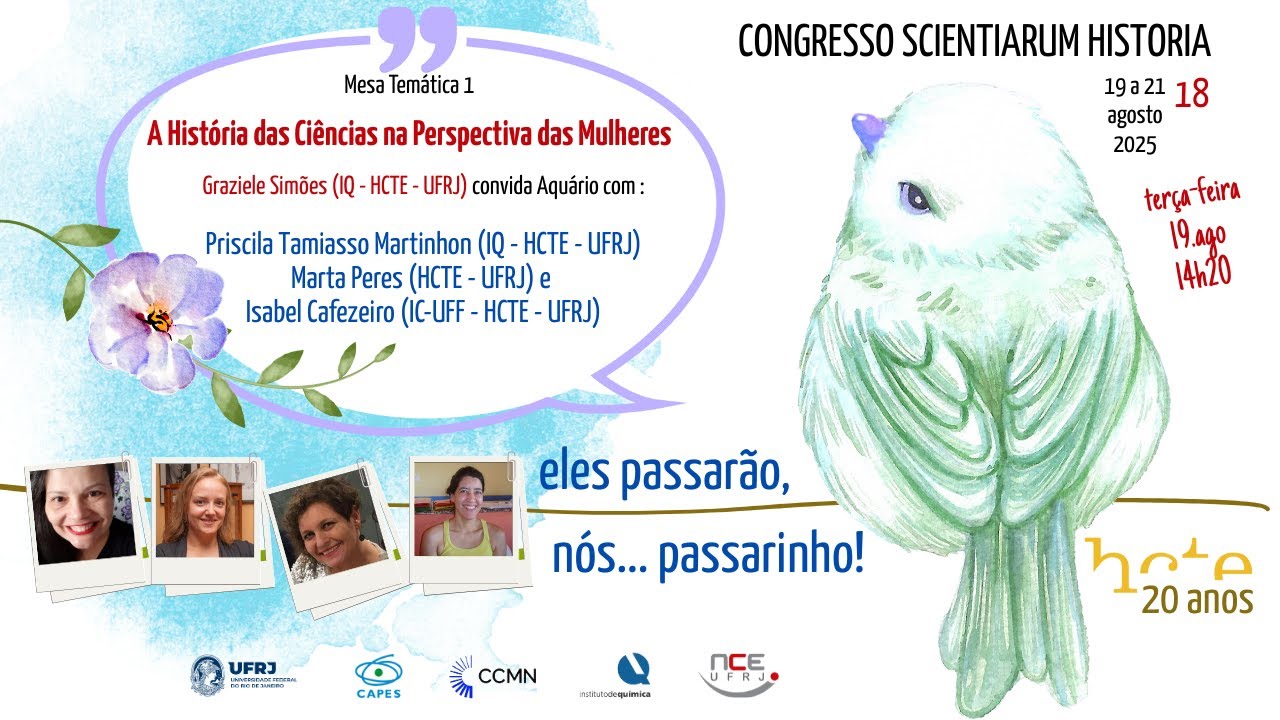
SH 18: Mesa Temática 1 - A história das ciências na perspectiva das mulheres
Keywords
Summary
183 words
Critical Evaluation
Value of the Information & Strength of the Argument
The value of the information lies in the personal testimonies and critical reflections on the academic system, particularly regarding gender and interdisciplinarity. The speakers provide concrete examples of discrimination and bureaucratic obstacles, such as Isabel’s ten-year struggle for maternity leave recognition and Priscila’s difficulty in obtaining CNPq funding despite a Nature publication. The argumentation is persuasive, drawing on personal experience and institutional critique. However, it is largely anecdotal and lacks systematic evidence or references to broader studies. The discussion is coherent and emotionally engaging, but the scientific rigor is limited by the format of a round table.
Scientific Rigor, Source Quality, Title Accuracy
The scientific rigor is moderate. The speakers are credible academics, but they do not cite specific sources or studies. The discussion is based on personal experience and institutional knowledge, which is valuable but not systematically verified. The title accurately reflects the content, and the video is a genuine debate on the history of science from a female perspective. The lack of formal citations is a limitation, but the speakers’ expertise lends some credibility. The adequacy between title and content is high.
193 words
Title / Content Match
The title accurately reflects the content: a thematic table discussing the history of sciences from the perspective of women, with personal narratives and critical reflections.
Quality & Reliability
7/10
The video is a round table discussion by three female academics sharing personal experiences and reflections on the history of science from a female perspective. The content is largely anecdotal and opinion-based, but grounded in their academic careers and institutional contexts. No formal citations are provided, but the speakers are credible academics from UFRJ. The discussion is coherent and insightful, though not a systematic study.
Key Moments
Markers derived by PSI from the transcript: the creator did not define chapters.
- Introduction of the panel and the theme.
- Graziele Simões shares her academic career, including a Nature publication on HCl.
- Isabel Cafezeiro discusses her career in computer science and the challenges of being a mother in academia.
- Isabel talks about the historical cátedra system and her mother's experience.
- Priscila Tamás Maron shares her journey from being seen as the 'researcher's wife' to embracing her identity as a witch and acupuncturist.
- Priscila describes the 'fuxico' teaching experience and the concept of 'tescituras'.
- Discussion on the well-behaved wave function and its connection to women's empowerment.
- Reflections on the Solvay Conference photo and the underrepresentation of women.
- Critique of productivity metrics and the exclusion of interdisciplinarity from CNPq funding.
- Closing remarks on the need to rethink academic practices and value diversity.
Contribution & Novelties
The video offers a unique perspective on the history of science by centering the experiences of women academics in Brazil, highlighting systemic biases and proposing alternative practices like ‘fuxico’ as a pedagogical tool. It contributes to the discourse on gender in science and the critique of metric-based evaluation.
Pour aller plus loin :
- Women in Science — Overview of historical and contemporary issues.
- Maternity leave and academic careers — Discussion on the impact of maternity on academic progression.
- Interdisciplinarity — Concept and challenges in academia.
85 words
Radar Profile
The radar profile shows moderate scores across all dimensions, with slightly higher scores in quantity and quality of information, reflecting the rich personal narratives and critical insights, but lower technical level and reliability due to the lack of formal citations and systematic analysis.