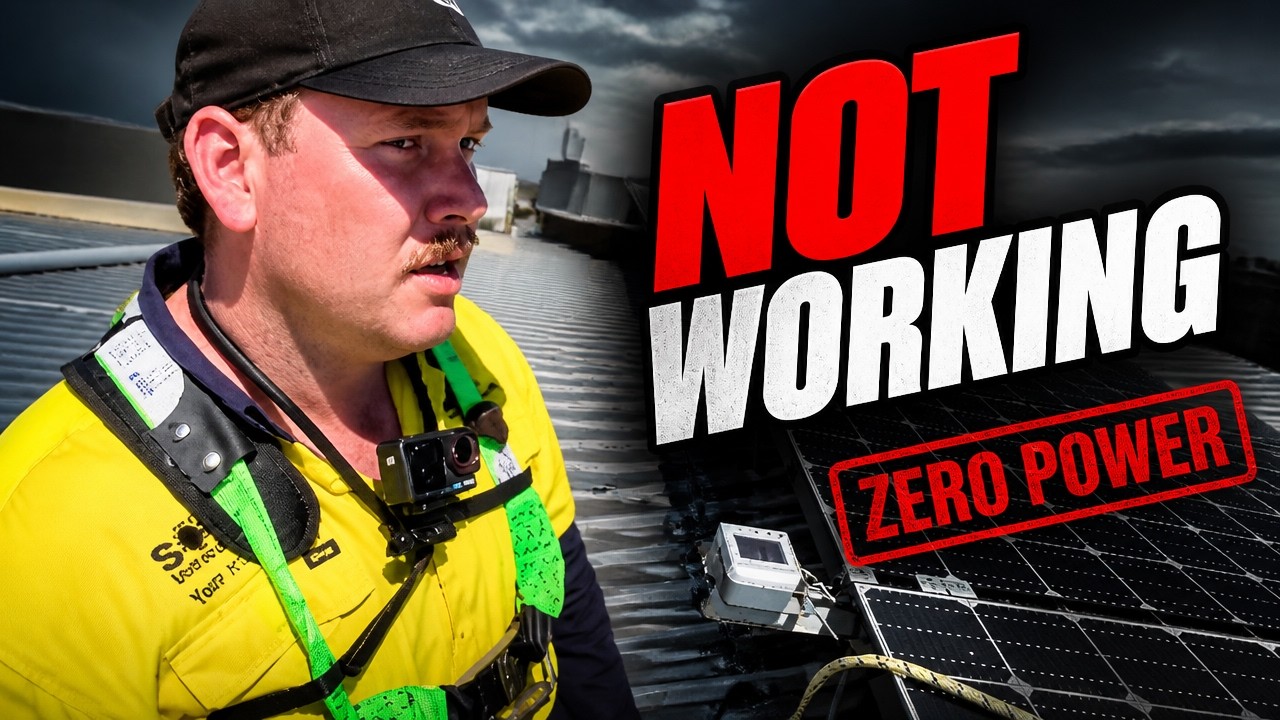
Why this $120,000 Solar System Stopped Working | No Body Noticed
Keywords
Summary
134 words
Critical Evaluation
Value of the Information & Strength of the Argument
The video provides valuable practical insights into the failure modes of commercial solar systems, emphasizing the critical role of monitoring and maintenance. The argumentation is solid, based on direct inspection and expert commentary, with clear cause-and-effect reasoning. The discovery of the manual shutdown is well-supported by evidence and site records. The video effectively argues that regular maintenance is essential, using the case study to illustrate the financial and safety consequences of neglect. However, the argument could be strengthened by including quantitative data on performance degradation and more detailed technical explanations.
Scientific Rigor, Source Quality, Title Accuracy
The video is a field investigation with direct observations, which lends credibility. The sources cited are primarily the company’s own website and social media, which are not independent. The title accurately reflects the content, and the video does not overstate claims. The lack of external references or peer-reviewed studies reduces the scientific rigor, but the practical nature of the content compensates. The video’s adéquation titre/contenu is high, as it directly addresses the mystery of the non-working system. The comments show a mix of criticism and appreciation, with some questioning the management’s oversight.
197 words
Title / Content Match
The title accurately reflects the content: a detailed investigation into why a commercial solar system stopped working, with the key finding that it was manually turned off.
Quality & Reliability
7/10
The video is a field investigation by a solar services company, providing direct observations and expert commentary. It lacks peer-reviewed sources but offers practical insights and references to industry practices. The claims are plausible and supported by visual evidence, though some technical details (e.g., backsheet failure) are simplified.
Chapters
- The $30,000 annual loss: Discovering a dead 81kW system
- The 10-year milestone for commercial solar systems
- Panel Inspection: Failing back sheeting on LG 300W modules
- Safety Risks: Water ingress and potential rooftop fires
- Cable containment: Steel vs. plastic ties
- The lichen problem and why you shouldn't pressure wash panels
- Design flaws: Overshadowing and lack of maintenance access
- Inverter Bay: Red fault lights and sun-damaged screens
- Why the monitoring systems were dead
- Searching for the solar distribution board and poor labeling
- Hazard alert: Birds nesting under the panels
- Powering the system back up
- The Mystery Solved: A 4-year-old error by an AC crew
- Summary of additional site issues: UV damage and homemade tilt frames
- Conclusion: Why commercial systems need regular "tune-ups
Cited Sources
- Your Energy Answers — Main website of the channel, providing additional resources and information.
- Find an Installer — Resource for finding quality local solar installers.
- Why This Commercial Solar System Stopped Generating Power — Article expanding on the topic of the video.
- Your Energy Media LinkedIn — Company LinkedIn page.
Concurring Sources
- Solar panel degradation — Supports the discussion on backsheet failure and performance loss.
- Photovoltaic system monitoring — Reinforces the importance of monitoring in detecting system failures.
Dissenting Sources
- Commenter questioning backsheet failure — One commenter expressed skepticism about the backsheet failure causing glass collapse, suggesting potential exaggeration.
Contribution & Novelties
The video provides a real-world case study of a commercial solar system failure due to human error and lack of maintenance, highlighting the importance of monitoring and regular inspections. It offers practical advice for solar system owners, such as avoiding pressure washing panels and ensuring proper labeling. The ‘Pour aller plus loin’ section suggests exploring topics like solar panel degradation, monitoring systems, and maintenance best practices.
Pour aller plus loin :
- Solar panel degradation — Understanding how panels degrade over time.
- Photovoltaic system monitoring — The role of monitoring in detecting issues.
- Solar inverter — Key component in solar systems, its failure modes and maintenance.
105 words
Radar Profile
The radar profile shows high scores in information quantity and quality, with moderate technical depth and reliability. This indicates a well-rounded video that is informative and credible, though not highly technical or heavily sourced.
💬 The comments are predominantly negative, with many viewers criticizing the lack of oversight and management failure. There is also appreciation for the educational value, but the overall tone is critical of the system owner and the solar industry's maintenance practices.