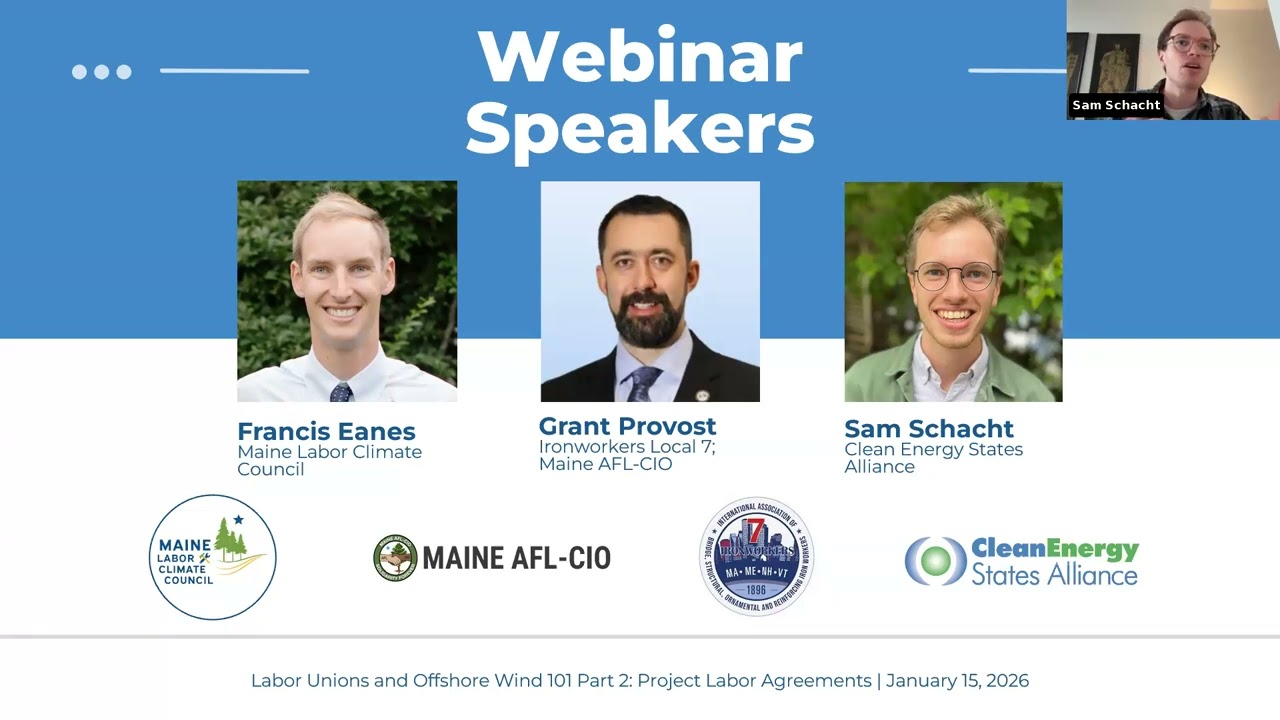
Labor Unions and Offshore Wind 101 Part 2: Project Labor Agreements (1.15.26)
Keywords
Summary
176 words
Critical Evaluation
Value of the Information & Strength of the Argument
The webinar provides valuable insights into the practical application of Project Labor Agreements in offshore wind development. The speakers, drawing on their direct experience, offer concrete examples and explain the rationale behind PLAs from multiple perspectives. The argumentation is coherent and well-structured, addressing common questions and misconceptions. However, the presentation is advocacy-oriented, presenting PLAs in a uniformly positive light without discussing potential drawbacks or criticisms. The speakers’ expertise lends credibility, but the lack of counterarguments or independent data weakens the overall balance.
Scientific Rigor, Source Quality, Title Accuracy
The webinar is produced by the Clean Energy States Alliance, a reputable organization, and features speakers with direct professional experience in labor and construction. The information is presented as expert opinion and practical knowledge rather than peer-reviewed research. The title accurately reflects the content, which is focused on PLAs in the context of offshore wind. The webinar builds on a previous session and references the CESA website for further resources. No external sources are cited within the presentation, and the description provides links to CESA’s website and the Offshore Wind Power Hub. The content appears reliable within its scope, but it is not a scientific study and should be viewed as informed commentary.
210 words
Title / Content Match
The title accurately reflects the content, which focuses on Project Labor Agreements in the context of offshore wind.
Quality & Reliability
8/10
The webinar features experienced practitioners (union representative, labor council director) and is hosted by a reputable clean energy organization. It provides detailed, practical information on PLAs, though it is advocacy-oriented and lacks independent verification.
Key Moments
Markers derived by PSI from the transcript: the creator did not define chapters.
- Introduction and webinar logistics
- Sam Shact introduces CESA and the webinar topic
- Francis Eanes explains the purpose and history of PLAs
- Grant Provost discusses who negotiates PLAs and when
- Benefits of PLAs for union and non-union workers
- Benefits of PLAs for developers and states
- PLAs as tools for equity and local hiring
- How states can facilitate the use of PLAs
- Q&A session begins
Cited Sources
- CESA Offshore Wind Power Hub — Mentioned as a resource for tracking offshore wind projects and policies.
- CESA Webinar: Labor Unions and Offshore Wind 101 — Referenced as the first part of the webinar series.
Concurring Sources
- Project Labor Agreements: A Review of the Literature — Economic Policy Institute report supporting the benefits of PLAs.
Dissenting Sources
- Project Labor Agreements: A Critical Analysis — Heritage Foundation report arguing that PLAs increase costs and limit competition.
Contribution & Novelties
The webinar provides a detailed, practitioner-oriented explanation of Project Labor Agreements specifically in the context of offshore wind, which is a relatively new and rapidly developing industry. It offers insights into the negotiation process, benefits for various stakeholders, and the role of states in promoting PLAs. The presentation is practical and accessible, making it a useful resource for policymakers, developers, and community members.
Pour aller plus loin :
- Project Labor Agreement - Wikipedia — Provides a general overview of PLAs, their history, and legal aspects.
- U.S. Department of Labor - Collective Bargaining — Official information on collective bargaining and labor relations.
- National Offshore Wind Research and Development Consortium — Resource for offshore wind research and development in the U.S.
119 words
Radar Profile
The radar profile shows high scores in information quantity, quality, and reliability, reflecting the webinar's detailed and expert-driven content. The technical level is moderate, making it accessible to a broad audience. The overall high scores indicate a valuable resource for understanding PLAs in offshore wind.