Offshore Wind Community Engagement: Recommendations for State Agencies
Keywords
Summary
187 words
Critical Evaluation
Value of the Information & Strength of the Argument
The webinar provides valuable insights into the challenges and opportunities of community engagement in offshore wind development. The recommendations are practical and actionable, developed through a collaborative process that includes both state agencies and community-based organizations. The argumentation is solid, grounded in real-world examples and the experiences of the working group members. The emphasis on equity and environmental justice is well-articulated, and the report’s structure (purpose, key considerations, examples) enhances its utility for policymakers. However, the presentation is largely descriptive and does not delve into potential criticisms or limitations of the recommendations.
Scientific Rigor, Source Quality, Title Accuracy
The webinar is based on a report that is publicly available and was developed through a structured process involving multiple stakeholders. The sources cited include the report itself and the webinar slides, both accessible via the provided links. The title accurately reflects the content, which focuses on community engagement recommendations for state agencies. The presentation is well-organized and the speakers are knowledgeable, but the lack of peer review or independent verification limits the scientific rigor. The webinar does not include a formal literature review or empirical data, relying instead on expert opinion and case examples.
202 words
Title / Content Match
The title accurately reflects the content, which focuses on community engagement recommendations for state agencies in offshore wind development.
Quality & Reliability
8/10
The webinar presents a report developed collaboratively by state agencies and community-based organizations, with clear methodology and concrete recommendations. The content is expert-driven and grounded in practical experience, though it is not peer-reviewed and relies on qualitative insights.
Key Moments
Markers derived by PSI from the transcript: the creator did not define chapters.
- Introduction to CESA and the Offshore Wind Accelerator program.
- Overview of the Offshore Wind Power Hub and its recent updates.
- Background on the Offshore Wind and Equity project and its timeline.
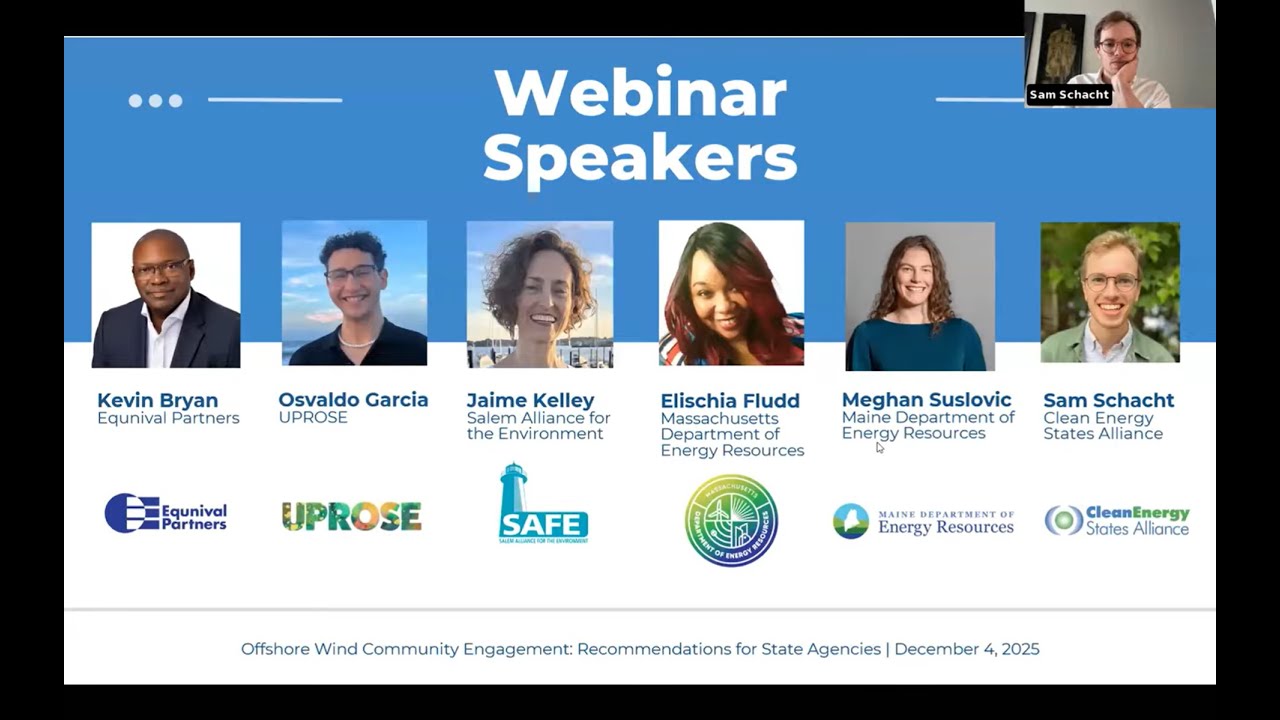
- Introduction of project partners and the working group members.
- Presentation of the four recommendations: share information, increase access, build capacity, and develop investment frameworks.
- Detailed discussion of recommendation 1: Share information.
- Detailed discussion of recommendation 2: Increase access.
- Detailed discussion of recommendation 3: Build and sustain community capacity.
- Detailed discussion of recommendation 4: Develop standards and frameworks for investment in communities.
- Panel discussion with working group members begins.
Cited Sources
- Strengthening Offshore Wind Community Engagement: Recommendations for State Agencies — The report discussed in the webinar, providing the basis for the recommendations.
- Webinar Slides — Slides presented during the webinar, containing visual aids and summaries.
Concurring Sources
- Strengthening Offshore Wind Community Engagement: Recommendations for State Agencies — The report itself, which aligns with the webinar content.
Contribution & Novelties
The webinar presents a collaborative framework for community engagement in offshore wind, emphasizing equity and environmental justice. It offers four concrete recommendations that are actionable for state agencies, developed through a partnership between state and community organizations. The report’s structure, with purpose, key considerations, and examples, provides a practical guide for implementation.
Pour aller plus loin :
- Environmental justice — Foundational concept for understanding the equity focus of the recommendations.
- Community benefits agreement — A tool mentioned in the report for ensuring community investment.
- Offshore wind power — Provides background on the technology and its development.
96 words
Radar Profile
The radar profile shows high scores in information quantity, quality, and reliability, with a moderate technical level. This indicates a well-structured, expert-driven presentation that is accessible to a broad audience, with strong emphasis on practical recommendations and stakeholder collaboration.
💬 No comments were provided for analysis.