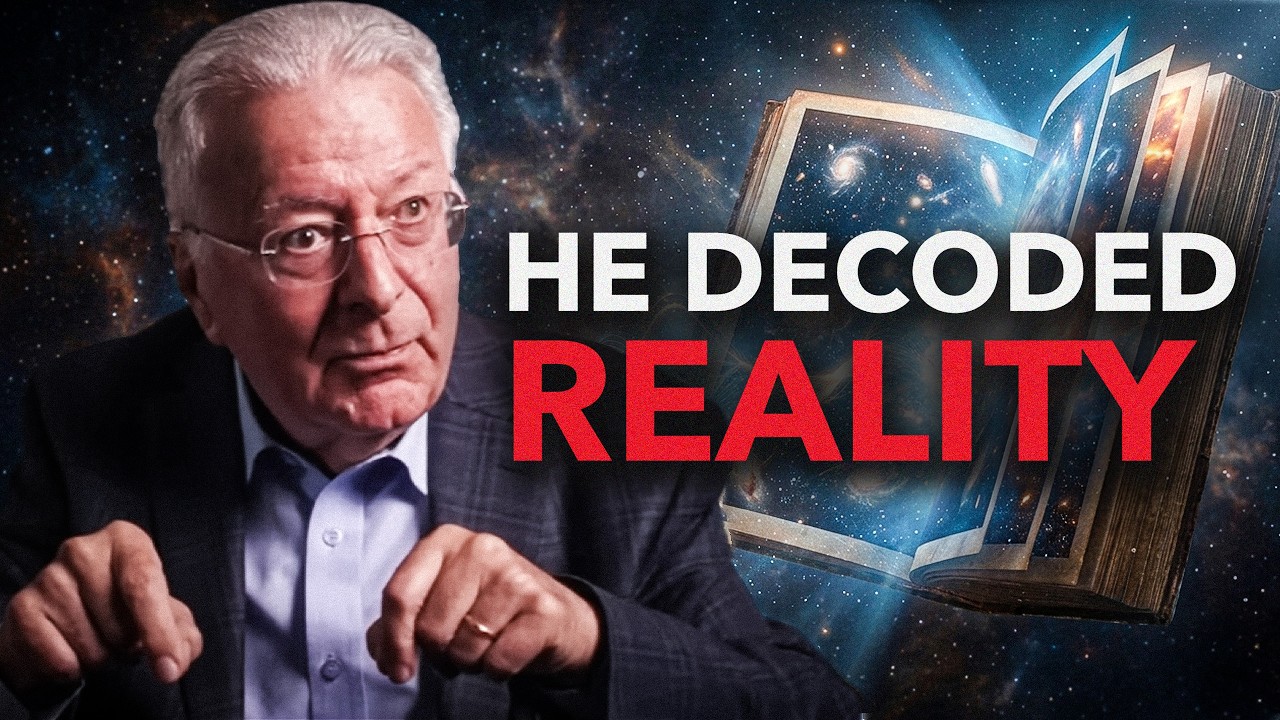
TRUE Reality May Be COMPLETELY Different ft. Federico Faggins | Full-Length Documentary
Keywords
Summary
205 words
Critical Evaluation
The video offers a thought-provoking synthesis of ideas from physics, philosophy, and consciousness studies, but it does so with a strong speculative bent. The presentation is engaging and visually compelling, using analogies like the writer and the novel to make abstract concepts accessible. However, the scientific rigor is uneven. The video accurately references the hard problem of consciousness as coined by David Chalmers and the fine-tuning of the cosmological constant, which is a genuine puzzle in physics. Yet, it presents Faggin’s theory of a conscious quantum field as a plausible explanation without acknowledging that it is a highly speculative and not widely accepted hypothesis. The argumentation often relies on rhetorical questions and analogies rather than empirical evidence, which weakens its scientific credibility. The video also conflates scientific concepts with metaphysical claims, such as equating the unmoved mover with a creator outside time, which is a philosophical leap. The sources cited are limited to the sponsor’s links, and while the video mentions specific papers and books (e.g., Faggin and D’Ariano’s paper, Rees’s ‘Just Six Numbers’), it does not provide direct references in the description, making it difficult for viewers to verify the claims. The adéquation between title and content is good, as the video does challenge conventional views of reality, but the title’s emphasis on ‘TRUE Reality’ may overstate the certainty of the presented ideas. Overall, the video is valuable as an introduction to these concepts and for stimulating curiosity, but it should be consumed with a critical eye, recognizing the distinction between established science and speculative philosophy.
257 words
Title / Content Match
The title accurately reflects the video's central theme of questioning the nature of reality, though it overstates the certainty of the alternative view.
Quality & Reliability
7/10
The video presents a philosophical and speculative exploration of consciousness and reality, referencing real physicists (Faggin, D'Ariano, Chalmers, Rees, Hawking, Greene) and scientific concepts (hard problem, cosmological constant, fine-tuning). However, it blends these with metaphysical claims and analogies that are not scientifically established, and the presentation is more persuasive than rigorous. The sources cited are limited to the sponsor's links, not the scientific papers mentioned.
Chapters
- What you can't see
- Qualia don't start in the brain
- Aristotle's unmoved mover
- Proving a forest is alive
- The cosmological constant
- Tue or false is an approximation
- A very boring universe
- The thing that finally woke up was...
- The seed that grows itself
- Human brain is a Turing machine
- A loop that never ends
- A child vs AI
- The final question
Cited Sources
- Planet Wild - Join — Sponsorship link for the Planet Wild nature conservation platform.
- Planet Wild - Reforestation Mission — Sponsorship link to a specific Planet Wild mission video.
- Beeyond Ideas Membership — Link to support the channel via YouTube membership.
Concurring Sources
- Hard Problem and Free Will: An Information-Theoretical Approach — Paper by Faggin and D'Ariano mentioned in the video, supporting the idea of consciousness as fundamental.
- Just Six Numbers — Book by Martin Rees that discusses the fine-tuning of fundamental constants, aligning with the video's argument.
Dissenting Sources
- Materialist theories of consciousness — Mainstream neuroscience typically views consciousness as emergent from brain activity, contradicting Faggin's field-based theory.
Contribution & Novelties
The video’s original contribution lies in its accessible synthesis of complex ideas from quantum physics, philosophy of mind, and cosmology, presenting them in a narrative that challenges materialist assumptions about consciousness. It popularizes Federico Faggin’s theory of a conscious quantum field, which is not widely known outside academic circles, and connects it to historical philosophical questions. The use of the writer-novel analogy is a creative pedagogical tool. However, the video does not present new research or data; it is a commentary and interpretation of existing ideas.
Pour aller plus loin :
- Hard problem of consciousness — Provides background on the philosophical problem central to the video.
- Cosmological constant — Explains the physical constant and the fine-tuning problem discussed.
- Federico Faggin — Biography of the physicist whose theory is featured.
- Multiverse — Overview of the multiverse hypothesis as a response to fine-tuning.
- Just Six Numbers — Martin Rees’s book referenced in the video.
152 words
Radar Profile
The radar profile shows high scores in quantity of information and technical level, reflecting the video's dense content and scientific references. However, the quality of information and global reliability are slightly lower due to the speculative nature of the central thesis and the lack of direct citations. This suggests a content that is informative but requires critical evaluation.