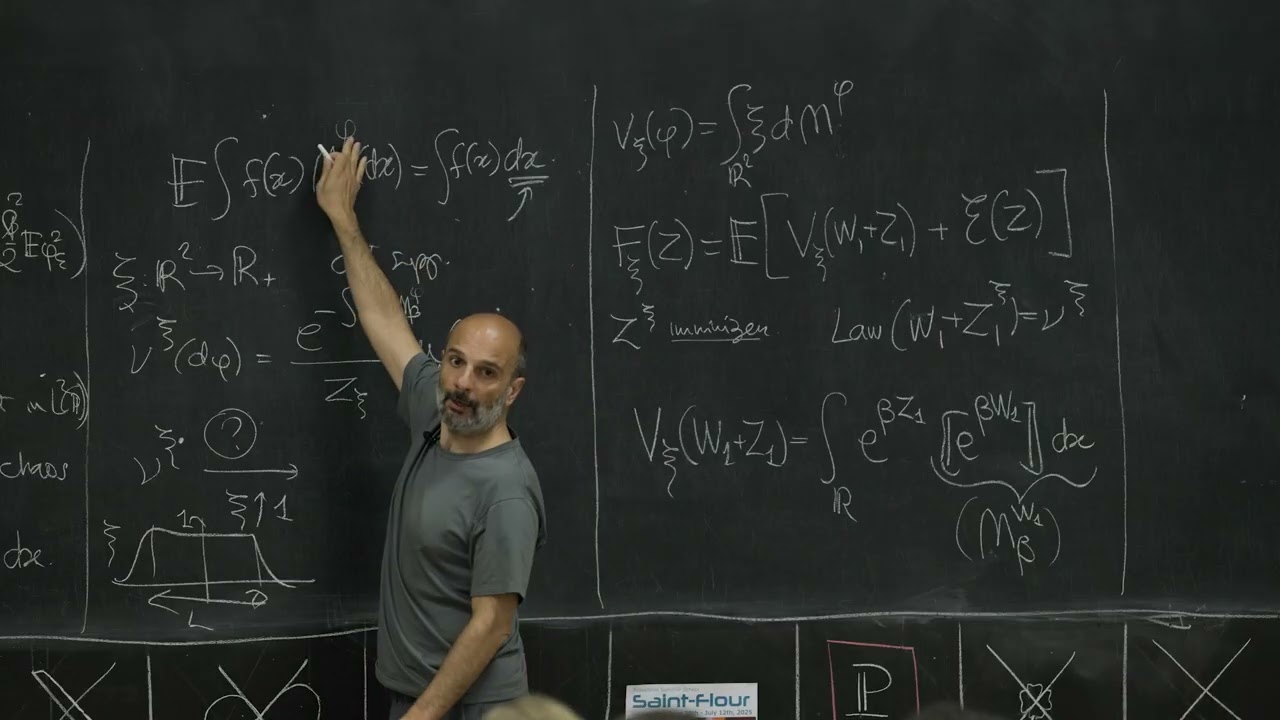
Massimiliano GUBINELLI C7
Keywords
Summary
137 words
Critical Evaluation
Value of the Information & Strength of the Argument
The lecture provides deep insights into the construction of Euclidean fields via stochastic quantisation, specifically focusing on the exponential interaction model. Gubinelli presents a clear variational framework and demonstrates how to derive the Euler-Lagrange equation, highlighting the negative sign of the minimizer and its consequences. The argumentation is rigorous, with careful attention to technical details such as regularity and integrability. The value lies in the advanced mathematical techniques and the connection between probability theory and quantum field theory.
Scientific Rigor, Source Quality, Title Accuracy
The lecture is scientifically rigorous, presented by a leading expert. Gubinelli references his own work and the general framework of stochastic quantisation, but does not cite specific external sources during the talk. The title is generic, but the description provides context. The content is highly technical and assumes prior knowledge, but the reasoning is sound and well-structured.
150 words
Title / Content Match
The title is generic (lecture number), but the description clearly indicates the topic: stochastic analysis perspective on Euclidean fields.
Quality & Reliability
8/10
Lecture by a leading expert in stochastic analysis and singular SPDEs, presenting rigorous mathematical arguments. The content is advanced and technically sound, but as a lecture it is not peer-reviewed and relies on the speaker's authority.
Key Moments
Markers derived by PSI from the transcript: the creator did not define chapters.
- Introduction and recap of previous lecture on exponential interaction.
- Discussion of Gaussian multiplicative chaos and its properties.
- Construction of the model via tilting the Gaussian free field.
- Infinite volume limit and variational approach.
- Derivation of the Euler-Lagrange equation.
- Observation that the minimizer is negative.
- Technical challenges due to limited integrability.
- Tightness and existence of the limit.
- Uniqueness via convexity and coupling argument.
Cited Sources
- Lecture notes or related papers by M. Gubinelli — The speaker refers to his own notes and prior work, but no specific URLs are provided in the description.
Concurring Sources
- Gaussian multiplicative chaos — The lecture discusses Gaussian multiplicative chaos as a key object, and this Wikipedia article provides background.
- Stochastic quantization — The lecture mentions stochastic quantisation as a method to construct Euclidean fields.
Contribution & Novelties
The lecture presents a novel variational approach to construct Euclidean fields, specifically the exponential interaction model, and highlights the negative sign of the minimizer, which is a distinctive feature. It also discusses technical challenges and potential directions for future research.
Pour aller plus loin :
- Gaussian multiplicative chaos — Relevant concept central to the lecture.
- Stochastic quantization — Method discussed for constructing Euclidean fields.
- Gaussian free field — Fundamental object in the construction.
73 words
Radar Profile
The radar profile shows very high technical level and information quality, with slightly lower scores in quantity and reliability due to the lecture format and lack of external citations. The content is highly specialized and rigorous.