Peter BARTLETT C7
Keywords
Summary
161 words
Critical Evaluation
Value of the Information & Strength of the Argument
The lecture provides substantial value by presenting recent theoretical results on deep learning, particularly the extension of implicit regularization to near-homogeneous functions and the formalization of benign overfitting. Bartlett’s argumentation is rigorous, building on previous lectures and using precise mathematical definitions. He clearly states theorems and conditions, and he addresses questions from the audience, clarifying technical points. The discussion of open problems, such as the case of L=0 (e.g., softmax), adds depth. The presentation is well-structured, moving from specific results to broader implications.
Scientific Rigor, Source Quality, Title Accuracy
The lecture demonstrates high scientific rigor, with careful definitions, theorems, and proofs. Bartlett references prior work (e.g., Wilkie’s theorem on o-minimal structures) and recent papers (e.g., Belkin, Rakhlin, and Tsybakov on kernel smoothing). The sources are appropriate and credible, though not all are explicitly cited with full details. The title is minimal but accurately reflects the content as part of a lecture series. The lecture is not peer-reviewed, but it is delivered by an expert and likely based on published research.
179 words
Title / Content Match
The title is minimal, but the content matches the expected lecture series on deep learning from a statistical perspective.
Quality & Reliability
8/10
Lecture by a renowned expert (Peter Bartlett, UC Berkeley) presenting rigorous mathematical results on deep learning theory, with clear derivations and references to recent research. The content is technical and precise, though not peer-reviewed in this format.
Key Moments
Markers derived by PSI from the transcript: the creator did not define chapters.
- Introduction and recap of o-minimal structures
- Definition of near-homogeneous functions
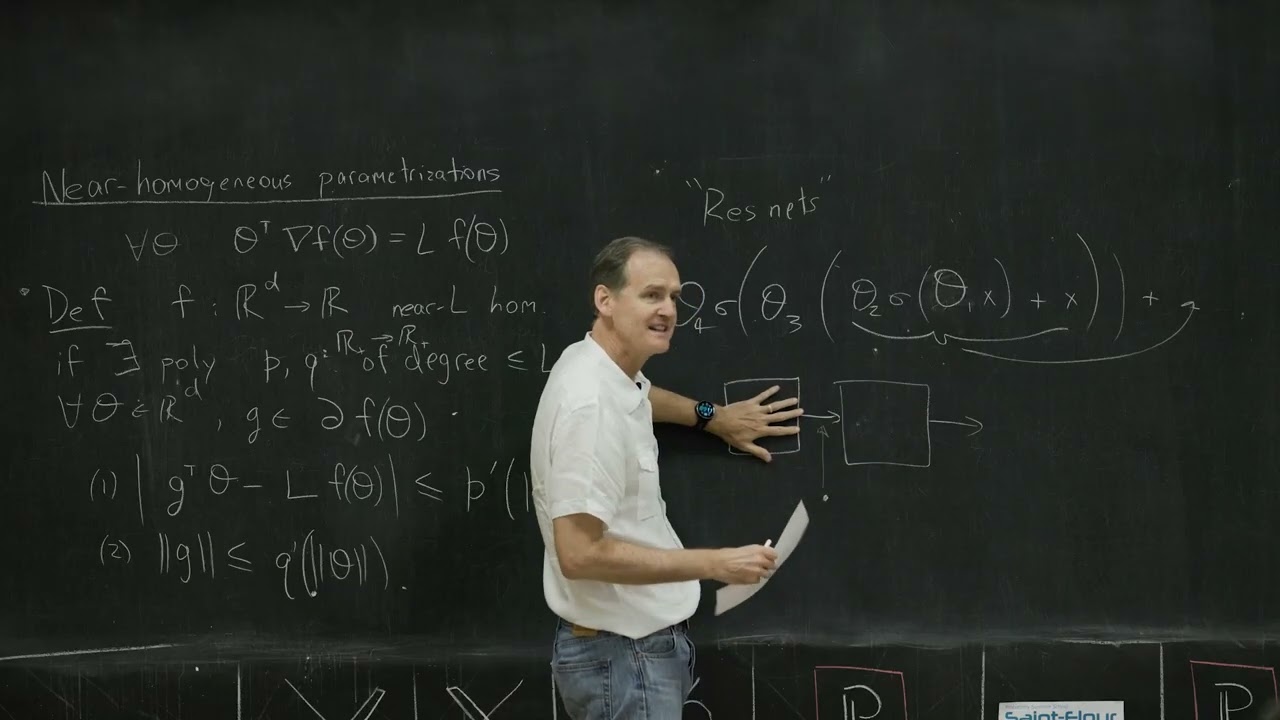
- Examples: residual networks as near-homogeneous
- Homogenization and main theorem for implicit regularization
- Discussion of L=0 case and open problems
- Transition to benign overfitting
- Bias-variance decomposition for regression
- Introduction to kernel smoothing and Hilbert kernel
Cited Sources
- Wilkie's theorem on o-minimal structures — Mentioned as a result from the 1990s that allows adding exponentials to o-minimal structures.
- Belkin, Rakhlin, and Tsybakov (2019) on kernel smoothing — Referenced as the source for the result on kernel smoothing with Hilbert kernel.
Concurring Sources
- Bartlett, Long, Lugosi, and Tsigler (2020) on benign overfitting — Related work on benign overfitting in linear regression, consistent with the lecture's theme.
Contribution & Novelties
The lecture provides a novel extension of implicit regularization theory to near-homogeneous parameterizations, which includes many modern architectures like residual networks. It also introduces the concept of benign overfitting in a rigorous framework. The presentation clarifies the role of homogenization in max-margin problems and highlights open questions, such as the case of non-polynomial growth rates.
Pour aller plus loin :
- Implicit regularization in deep learning — Overview of regularization concepts.
- Benign overfitting — Paper by Bartlett, Long, Lugosi, and Tsigler on benign overfitting in linear regression.
- O-minimal theory — Mathematical background for definability conditions.
94 words
Radar Profile
The radar profile shows high scores in technical level and information quantity, reflecting the advanced mathematical content. Quality and reliability are also strong, but the lecture's narrow focus and lack of visual aids may limit accessibility. The overall profile indicates a rigorous, specialized presentation.