Justin SALEZ C3
Keywords
Summary
166 words
Critical Evaluation
Value of the Information & Strength of the Argument
The lecture provides a clear and rigorous exposition of the connection between functional inequalities and mixing times. The argumentation is solid, building from a general lemma to specific applications. The speaker carefully explains the trade-offs between different divergences and the limitations of the approach for proving cutoff. The value lies in the pedagogical clarity and the unification of various known inequalities under a single framework.
Scientific Rigor, Source Quality, Title Accuracy
The lecture is mathematically rigorous, with definitions and proofs presented carefully. The speaker references standard concepts such as the Dirichlet form, spectral gap, and Poincaré inequality, but does not cite specific external sources. The title is generic but accurately reflects the content. The description mentions the cutoff phenomenon and its connections to entropy, curvature, and concentration, which are indeed explored in the lecture.
143 words
Title / Content Match
The title is generic, but the content matches the expected topic of a lecture on cutoff phenomena and functional inequalities.
Quality & Reliability
8/10
Lecture by a recognized expert in Markov chain mixing times, presenting rigorous mathematical content with proofs and connections to functional inequalities. The presentation is self-contained and technically accurate, though it is a lecture rather than a peer-reviewed publication.
Key Moments
Markers derived by PSI from the transcript: the creator did not define chapters.
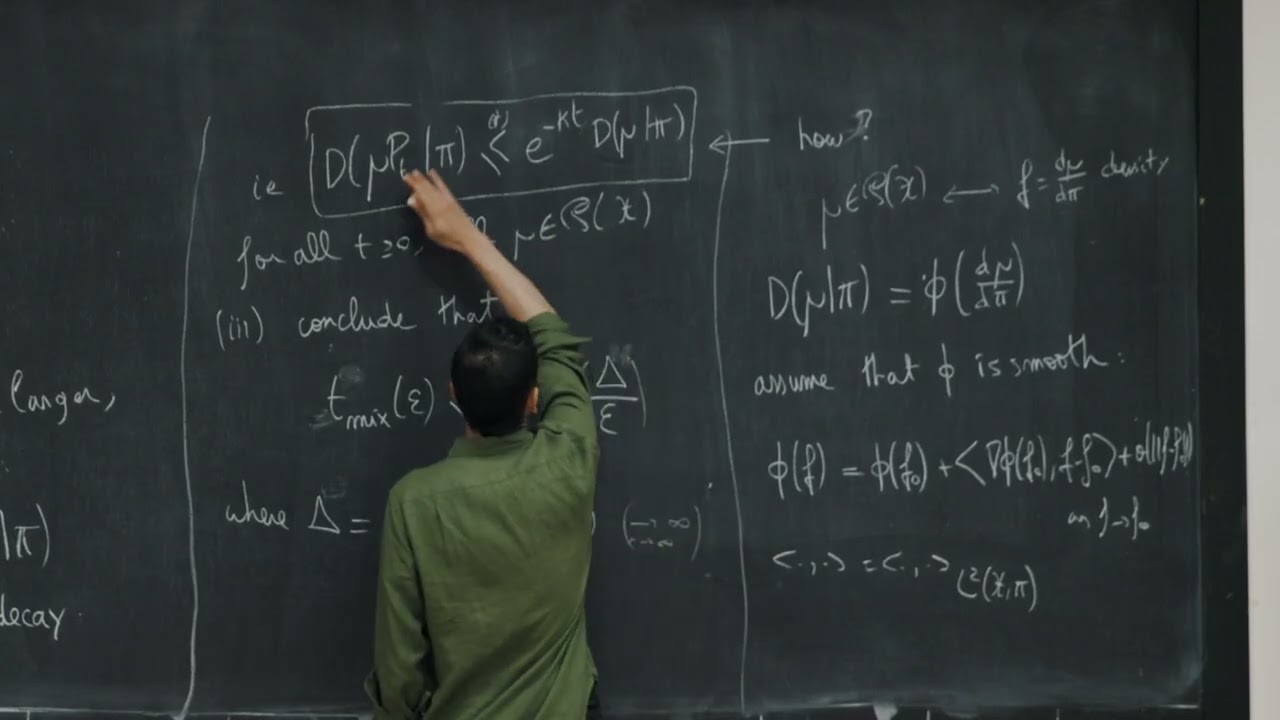
- Introduction and plan: presenting the general strategy for bounding mixing times using functional inequalities.
- General recipe: replace total variation distance by a larger but more tractable quantity, prove exponential decay, and derive mixing time bound.
- Introduction of the Dirichlet form and the key lemma connecting exponential decay to a functional inequality.
- Proof of the lemma: differentiating the divergence and using the Dirichlet form to obtain the equivalence.
- First concrete choice: chi-squared divergence and the Poincaré inequality, leading to the spectral gap.
- Application to simple random walk on the cycle: bound on mixing time of order n^2 log n, which is sharp up to log factor.
- Application to the hypercube: bound on mixing time, illustrating the trade-off between precision and tractability.
- Discussion of limitations: these methods do not yield cutoff, which requires sharper bounds and more refined techniques.
- Preview of connections to entropy, curvature, and concentration, to be explored in later lectures.
Cited Sources
- Course description — The video description provides an overview of the cutoff phenomenon and the lecture's goals.
Concurring Sources
- Levin, Peres, Wilmer - Markov Chains and Mixing Times — Standard reference for mixing times, covering functional inequalities and spectral gap.
Contribution & Novelties
The lecture offers a clear and unified presentation of how functional inequalities, particularly the Poincaré inequality, can be used to bound mixing times. It emphasizes the trade-off between tractability and sharpness, and highlights the limitations of these methods for proving cutoff. The presentation is self-contained and suitable for graduate students.
Pour aller plus loin :
- Cutoff phenomenon — Wikipedia article on the cutoff phenomenon.
- Poincaré inequality — Wikipedia article on Poincaré inequality.
- Spectral gap — Wikipedia article on spectral gap.
- Markov chain mixing time — Wikipedia article on mixing times.
90 words
Radar Profile
The radar profile shows high scores in quality of information, technical level, and reliability, with slightly lower but still strong scores in quantity of information. This indicates a dense, rigorous lecture with substantial content, though the pace may be challenging for non-specialists.