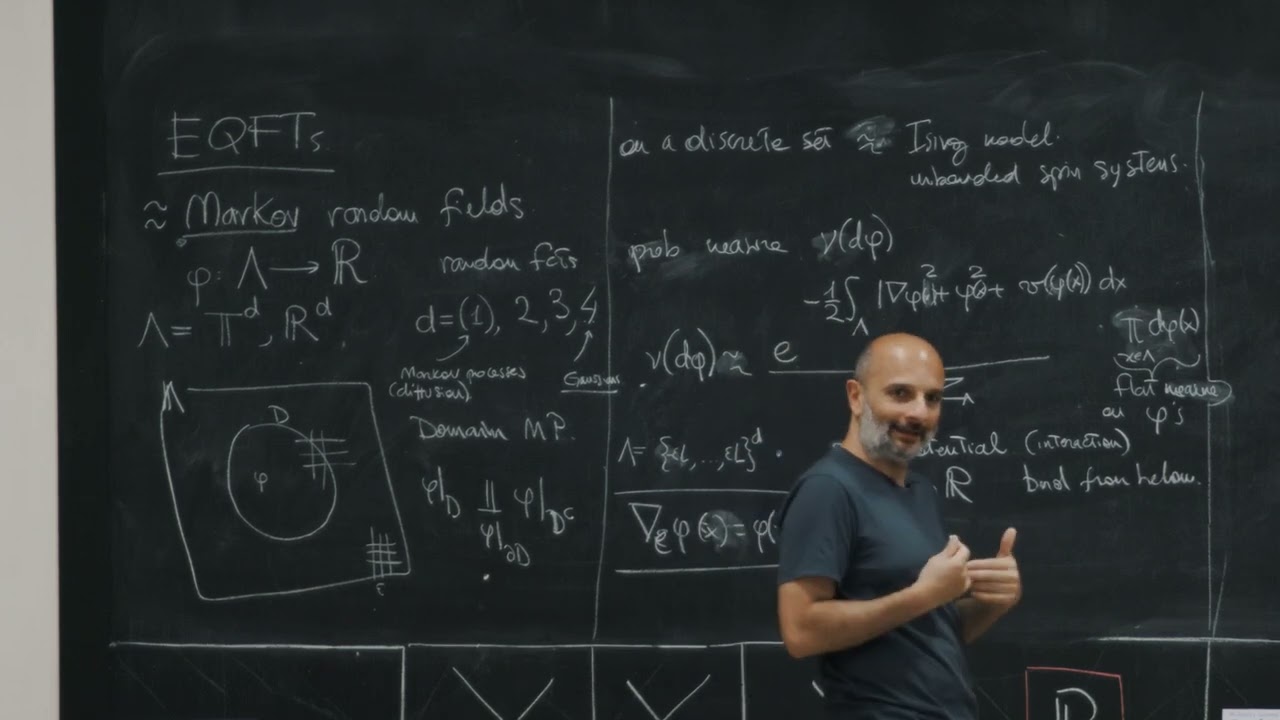
Massimiliano GUBINELLI C1
Keywords
Summary
156 words
Critical Evaluation
Value of the Information & Strength of the Argument
The lecture provides a high-value introduction to a cutting-edge research area, clearly explaining the motivations and challenges in constructing Euclidean quantum fields rigorously. Gubinelli’s argumentation is solid: he starts from the domain Markov property as the guiding principle, justifies the path integral form through factorization, and identifies the three main technical obstacles. He effectively bridges probability theory and mathematical physics, making the subject accessible to probabilists while maintaining mathematical rigor. The discussion of the Gaussian free field as a distribution and the need for renormalization is particularly insightful. The lecture does not shy away from open problems, which adds to its value for researchers.
Scientific Rigor, Source Quality, Title Accuracy
The lecture demonstrates high scientific rigor, with precise mathematical statements and clear reasoning. Gubinelli mentions the lecture notes by Biskup and (possibly) others on the Gaussian free field, but does not provide explicit references in the video. The description does not include links to sources. The title is minimal but accurate, identifying the lecturer and lecture number. The content matches the title, as it is the first lecture in a series on stochastic analysis perspective on Euclidean fields.
197 words
Title / Content Match
The title is minimal but accurate: it identifies the lecturer and lecture number, matching the content of a first lecture in a series.
Quality & Reliability
8/10
Lecture by a leading expert in stochastic analysis and singular SPDEs, presenting rigorous mathematical content with clear motivation and open problems. The presentation is technical and assumes advanced background, but the reasoning is sound and well-structured.
Key Moments
Markers derived by PSI from the transcript: the creator did not define chapters.
- Introduction: motivation for studying Euclidean quantum field theory as higher-dimensional Markov processes.
- Formal path integral formulation and the role of the potential V.
- Introduction of the Gaussian free field as the simplest example.
- Discussion of the domain Markov property and its importance.
- Three main problems: renormalization, large field problem, and infinite volume limit.
- Explanation that the field is a distribution in higher dimensions.
- Mention of the Yang-Mills Millennium Prize problem as a specific example.
- Conclusion: outline of the lecture series and open problems.
Contribution & Novelties
The lecture provides a clear and rigorous introduction to Euclidean quantum field theory from a stochastic analysis perspective, emphasizing the domain Markov property as the central guiding principle. It identifies three fundamental challenges (renormalization, large field problem, infinite volume limit) and sets the stage for stochastic quantization methods. The lecture is valuable for probabilists and analysts interested in this interdisciplinary field.
Pour aller plus loin :
- Gaussian free field — Provides background on the Gaussian free field, a key object in the lecture.
- Stochastic quantization — Introduces the method of stochastic quantization, which is central to the lecture series.
- Parisian stochastic analysis — Not directly relevant; instead, consider Regularity structures — A framework developed by Martin Hairer for solving singular SPDEs, closely related to the topics discussed.
127 words
Radar Profile
The radar profile shows high scores in quality of information and technical level, with slightly lower scores in quantity and reliability, reflecting the lecture's depth and the presenter's expertise, though the content is highly specialized and assumes prior knowledge.