Justin SALEZ C5
Keywords
Summary
189 words
Critical Evaluation
Value of the Information & Strength of the Argument
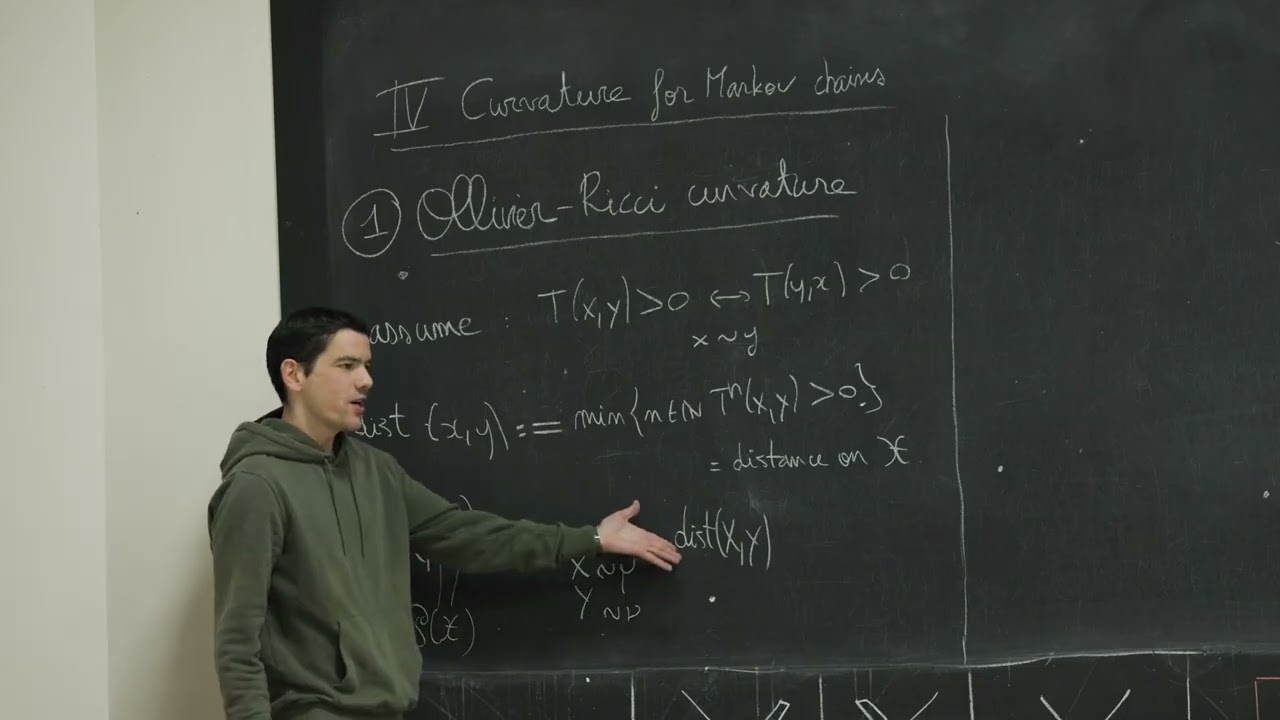
The lecture provides a clear and insightful introduction to Ollivier-Ricci curvature, connecting geometric intuition with rigorous mathematical definitions. The argumentation is solid: the speaker motivates each step, from the Wasserstein distance to the definition of curvature, and demonstrates its utility through examples. The use of couplings to bound curvature is well-explained, and the examples (cycle and hypercube) effectively illustrate the concepts. The lecture also highlights the limitations of the approach, such as when curvature is zero, and mentions extensions. Overall, the content is valuable for anyone interested in Markov chains and their quantitative analysis.
Scientific Rigor, Source Quality, Title Accuracy
The lecture is based on a survey by Ollivier (2010), which is a reliable source. The mathematical reasoning is rigorous, with definitions and proofs sketched appropriately. The title ‘Justin SALEZ C5’ is not descriptive, but it is likely part of a series; the content matches the expected topic. The lecture does not cite specific papers beyond the survey, but it is a self-contained introduction. The speaker is an expert, and the content is presented with clarity and precision.
187 words
Title / Content Match
The title 'Justin SALEZ C5' is not descriptive, but it is likely part of a series. The content matches the expected topic of a course on Markov chains and curvature.
Quality & Reliability
8/10
The lecture is a self-contained introduction to Ollivier-Ricci curvature for Markov chains, based on a well-known survey by Ollivier. The mathematical content is rigorous, with clear definitions and proofs sketched. The speaker is an expert in the field. The presentation is clear and well-structured, though it is a lecture and not peer-reviewed.
Key Moments
Markers derived by PSI from the transcript: the creator did not define chapters.
- Introduction to the lecture on curvature for Markov chains.
- Motivation from Riemannian geometry: geodesics on positively curved manifolds converge.
- Definition of Wasserstein distance via optimal transport.
- Definition of Ollivier-Ricci curvature as exponential decay of Wasserstein distance.
- Derivation of mixing time and spectral gap bounds from curvature.
- Example: cycle graph has zero curvature, leading to O(n^2) mixing time.
- Example: hypercube has curvature at least 2/n, leading to O(n log n) mixing time.
- Discussion of optimality and comparison with spectral gap.
Cited Sources
- Ricci curvature of Markov chains on metric spaces — Survey by Yann Ollivier, mentioned as the basis for the lecture.
Concurring Sources
- Ricci curvature of Markov chains on metric spaces — The survey by Ollivier is the primary source and is consistent with the lecture's content.
Contribution & Novelties
The lecture provides a clear and accessible introduction to Ollivier-Ricci curvature, emphasizing its practical utility for bounding mixing times via couplings. It highlights the connection between geometry and Markov chains, and demonstrates the method on simple examples. The lecture also discusses the limitations and extensions, such as the case of zero curvature.
Pour aller plus loin :
- Ollivier-Ricci curvature on Wikipedia — Overview of the concept and its applications.
- Wasserstein metric on Wikipedia — Background on optimal transport and the Wasserstein distance.
- Mixing time on Wikipedia — Definition and bounds for mixing times of Markov chains.
96 words
Radar Profile
The radar profile shows high scores in information quality and technical level, with slightly lower scores in quantity and reliability. This indicates a lecture that is rich in content and technically rigorous, but may not cover a broad range of topics or provide extensive external references.