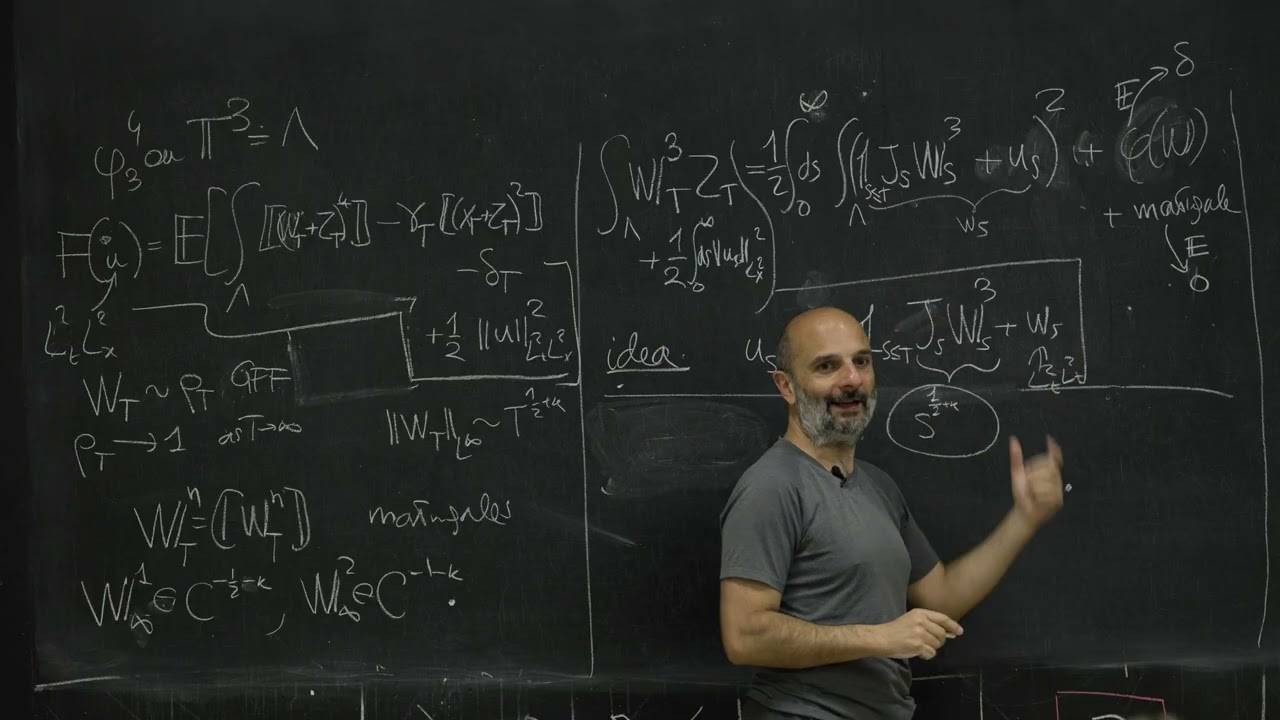
Massimiliano GUBINELLI C8
Keywords
Summary
143 words
Critical Evaluation
Value of the Information & Strength of the Argument
The lecture provides deep insights into the rigorous construction of Euclidean fields, a central problem in mathematical physics. Gubinelli’s argumentation is rigorous and well-structured, building on previous lectures and introducing new tools (paraproducts) to overcome technical difficulties. He clearly explains the motivations behind each step and the challenges encountered, making the material valuable for researchers in the field. The use of Littlewood-Paley theory and the discussion of regularity are particularly instructive.
Scientific Rigor, Source Quality, Title Accuracy
The lecture is scientifically rigorous, with precise mathematical statements and derivations. Gubinelli references standard tools like Littlewood-Paley theory and paraproducts, but does not cite specific papers or sources in the lecture itself. The title is minimal but accurate, as the content is a lecture by Gubinelli. The description mentions the goal of introducing Euclidean quantum field theory as probability objects, which aligns with the content. No external sources are provided in the description, so the evaluation relies on the internal consistency and expertise of the speaker.
172 words
Title / Content Match
The title is minimal, but the content matches the expected topic of a lecture by Massimiliano Gubinelli on stochastic analysis and Euclidean fields.
Quality & Reliability
8/10
Lecture by a leading expert in stochastic analysis and regularity structures, presenting advanced research-level material with rigorous mathematical derivations. The content is highly technical and assumes prior knowledge, but the reasoning is precise and based on established mathematical frameworks.
Key Moments
Markers derived by PSI from the transcript: the creator did not define chapters.
- Introduction and recap of previous lecture on the variational problem for the stochastic process.
- Discussion of the regularity of the Gaussian free field and its powers, and the need for renormalization.
- Introduction of the weak renormalization and the martingale property of the constructed objects.
- Derivation of the first correction term using Itô calculus and the definition of the new control W.
- Analysis of the next problematic term involving W^3 and the need for a new tool.
- Introduction of paraproducts to handle nonlinear operations on distributions.
- Decomposition of products using Littlewood-Paley blocks and discussion of the three regimes.
- Explanation of how paraproducts help in isolating divergent terms and the role of regularity.
- Further technical details on the estimates and the use of Littlewood-Paley theory.
- Conclusion and outlook for the next steps in the construction.
Contribution & Novelties
This lecture provides a detailed exposition of the stochastic quantization approach to Euclidean fields, focusing on the technical challenges in three dimensions. The introduction of paraproducts as a tool to handle nonlinearities is a key contribution, offering a clear method to isolate and renormalize divergent terms. The lecture also emphasizes the importance of Littlewood-Paley theory and the regularity of distributions in this context.
Pour aller plus loin :
- Paraproducts and their applications — Provides an overview of paraproducts and their role in harmonic analysis.
- Regularity structures — Introduces the theory of regularity structures, a related framework for solving singular stochastic PDEs.
- Stochastic quantization — Discusses the general approach of stochastic quantization in quantum field theory.
115 words
Radar Profile
The radar profile shows very high scores in technical level and information quantity, reflecting the advanced and dense nature of the lecture. The quality and reliability scores are also high, indicating a trustworthy source. The overall balance suggests a highly specialized content with strong scientific rigor.