Peter BARTLETT C5
Keywords
Summary
136 words
Critical Evaluation
Value of the Information & Strength of the Argument
The lecture provides a rigorous theoretical analysis of implicit regularization in deep learning, specifically focusing on early stopping for logistic regression. The argumentation is solid, built on formal proofs and established results from statistical learning theory. The speaker carefully derives bounds and explains the intuition behind each step, making the content valuable for researchers in the field. The discussion on parameterization highlights an important and often overlooked aspect of gradient descent, showing how the choice of parameterization can significantly affect the implicit bias. Overall, the value lies in its deep mathematical treatment and the insights it offers into the mechanisms behind the success of deep learning.
Scientific Rigor, Source Quality, Title Accuracy
The lecture demonstrates high scientific rigor, with precise mathematical statements and proofs. The speaker references prior work and builds on classical learning theory, though specific citations are not explicitly mentioned in the transcript. The title is somewhat generic, but the content aligns with the expected topic of deep learning theory. The adequacy between title and content is good, as the lecture indeed covers a statistical perspective on deep learning. The sources are not explicitly listed, but the theoretical framework is well-established in the literature.
205 words
Title / Content Match
The title is minimal, but the content matches the expected topic of a deep learning theory lecture.
Quality & Reliability
8/10
Lecture by a leading researcher (UC Berkeley) presenting rigorous theoretical results with proofs, based on established statistical learning theory. The content is advanced and mathematically precise, though not peer-reviewed in this format.
Key Moments
Markers derived by PSI from the transcript: the creator did not define chapters.
- Introduction and recap of previous result on early stopping for logistic regression.
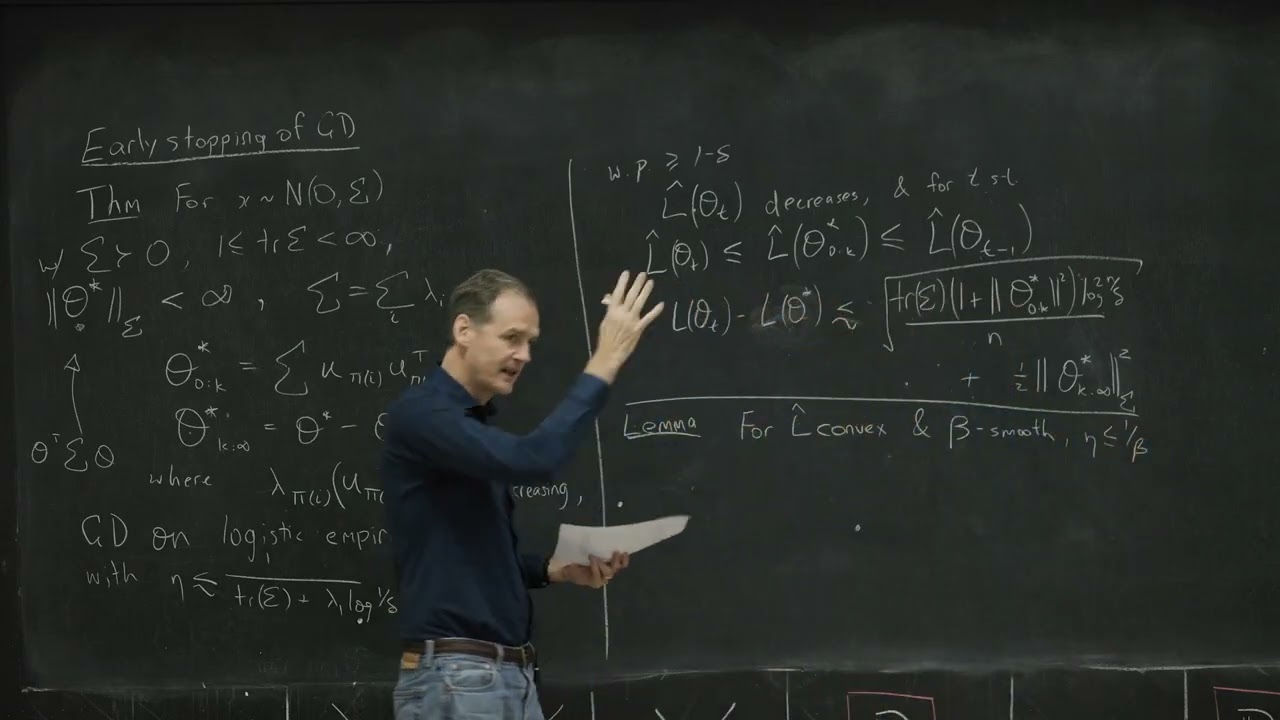
- Statement of the main theorem on early stopping with bounds on excess risk.
- Proof sketch: decomposition of risk and use of Rademacher complexity.
- Derivation of smoothness properties for logistic loss and concentration bounds.
- Application of comparison lemma to control the norm of gradient descent iterates.
- Discussion on the impact of parameterization on implicit bias.
- Introduction of exponential loss and parameterized families.
- Analysis of gradient descent with different parameterizations and their asymptotic behavior.
Contribution & Novelties
The lecture provides a rigorous theoretical analysis of implicit regularization in deep learning, specifically focusing on early stopping for logistic regression. It offers a detailed proof of the excess risk bound, highlighting the role of smoothness and Rademacher complexity. The discussion on parameterization is particularly novel, showing how the choice of parameterization can alter the implicit bias of gradient descent, leading to different limiting solutions. This contributes to a deeper understanding of why deep learning works despite overparameterization.
Pour aller plus loin :
- Implicit Regularization in Deep Learning — A foundational paper on implicit regularization.
- Early Stopping and Generalization — Discusses early stopping in deep learning.
- Rademacher Complexity — Key concept used in the lecture.
115 words
Radar Profile
The radar profile shows high scores in technical level and information quality, reflecting the advanced mathematical content and rigorous treatment. The quantity of information is also high, but the fiabilite_globale is slightly lower due to the lack of explicit citations and the lecture format.