Keynote Presentation: Molecular Genomic Findings in Leukemias – Diagnostic, Prognostic, and Therapeutic Implications
Keywords
Summary
206 words
Critical Evaluation
Value of the Information & Strength of the Argument
The presentation provides high-value information from a leading expert, offering a comprehensive overview of leukemia genomics and its clinical translation. The argumentation is strong, supported by decades of clinical experience and institutional data. However, some claims are based on unpublished or preliminary data, and the talk is an expert opinion rather than a systematic review. The speaker effectively demonstrates how molecular findings have transformed leukemia treatment, but the lack of detailed citations and the potential for bias towards his own institution’s approaches are limitations.
93 words
Title / Content Match
The title accurately reflects the content, which covers molecular genomic findings in leukemias and their diagnostic, prognostic, and therapeutic implications.
Quality & Reliability
9/10
Presentation by a leading expert with decades of clinical and research experience, referencing multiple peer-reviewed studies and institutional data. However, it is a keynote talk without detailed citations or peer review, and some claims are based on unpublished data.
Key Moments
Markers derived by PSI from the transcript: the creator did not define chapters.
- Introduction of Dr. Kantarjian and his achievements
- Classification of leukemias and curability overview
- Hairy cell leukemia: cladribine and BRAF mutations
- Acute promyelocytic leukemia: ATRA and arsenic trioxide
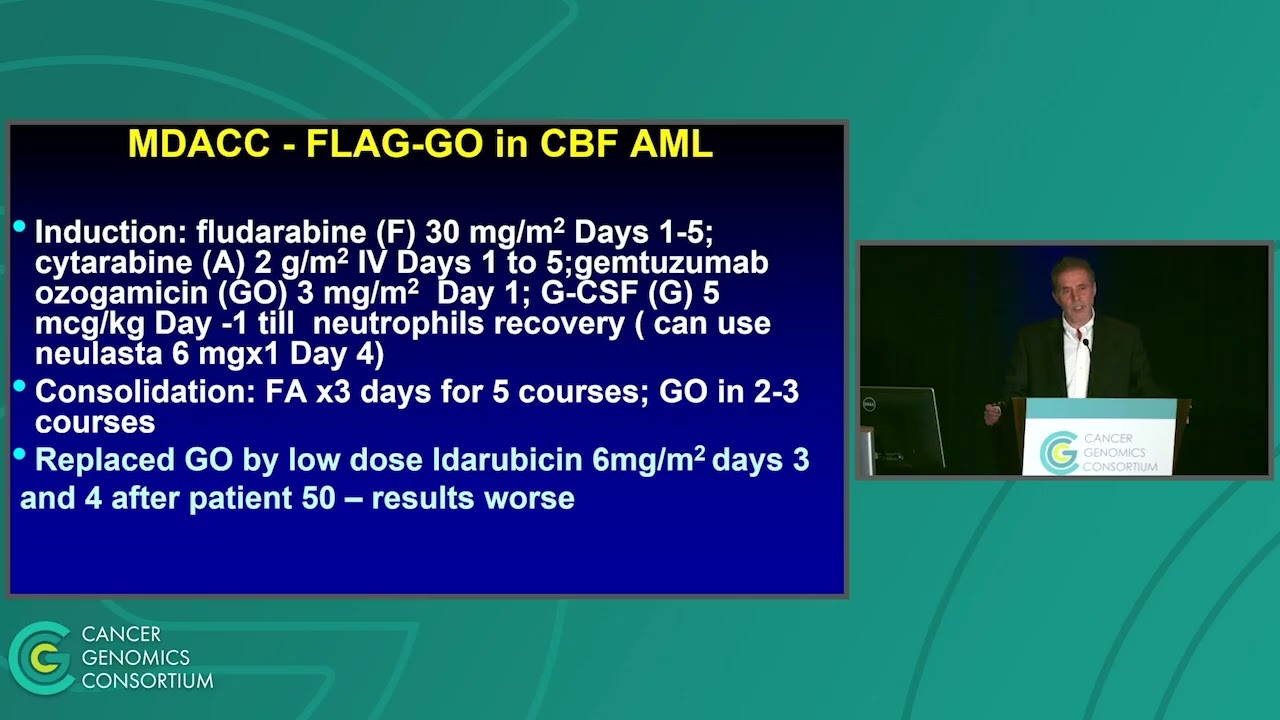
- Core-binding factor AML: gemtuzumab ozogamicin and monitoring
- Chronic myeloid leukemia: BCR-ABL inhibitors and treatment-free remission
- Chronic lymphocytic leukemia: BTK and BCL2 inhibitors
- Philadelphia-positive ALL: non-chemotherapy regimens
Cited Sources
- New England Journal of Medicine study on vemurafenib and obinutuzumab in hairy cell leukemia — Mentioned as a recent study in the NEJM
- MD Anderson data on cladribine and rituximab in hairy cell leukemia — Institutional data presented
- German-Italian consortium randomized trial of ATRA and arsenic trioxide in APL — Mentioned as confirming MD Anderson regimen
- MD Anderson data on ATRA and arsenic trioxide in APL — Institutional data presented
- MD Anderson sequential studies on core-binding factor AML — Institutional data presented
- Animal models of BCR-ABL in CML — Mentioned as basic research leading to imatinib
- European data on stopping TKI therapy in CML — Mentioned as data from over 700 patients
- MD Anderson study on ibrutinib and venetoclax in CLL — Published study by Dr. Nitin Jain
- MD Anderson data on ponatinib and blinatumomab in Philadelphia-positive ALL — Unpublished update presented
Concurring Sources
- MD Anderson Cancer Center — Institution where the speaker is based and where many studies were conducted.
- National Cancer Institute — General cancer information and research.
Contribution & Novelties
The presentation offers a comprehensive overview of how molecular genomics has revolutionized leukemia management, providing expert insights into current and emerging therapies. It highlights the shift towards targeted and non-chemotherapy approaches, and emphasizes the importance of molecular monitoring for treatment decisions.
Pour aller plus loin :
- BCR-ABL fusion protein — Key molecular target in CML and Philadelphia-positive ALL.
- Acute promyelocytic leukemia — Overview of APL and its molecular basis.
- Minimal residual disease — Concept of MRD monitoring in leukemia.
79 words
Radar Profile
The radar profile shows high scores across all dimensions, indicating a highly informative and reliable presentation. The speaker's expertise and the depth of content are reflected in the strong scores for quantity and quality of information, as well as technical level and global reliability.
💬 No comments were provided for analysis.