Invited Session 1 Federal Regulations Affecting Molecular Diagnostic Testing and Gene Patenting
Keywords
Summary
179 words
Critical Evaluation
Value of the Information & Strength of the Argument
The value of the information is high for professionals in molecular diagnostics, as it provides an insider’s perspective on regulatory developments and the rationale behind CAP’s positions. The argumentation is solid, grounded in the speaker’s extensive experience and direct involvement in advocacy. He presents a balanced view, acknowledging both the need for oversight and the risks of overregulation. The proposal for a risk-based approach is well-reasoned and supported by examples. However, the talk is largely opinion-based, and some claims (e.g., about the FDA’s flexibility) are presented without specific evidence.
Scientific Rigor, Source Quality, Title Accuracy
The speaker demonstrates rigor by referencing specific regulations, court cases, and FDA guidance documents. He mentions the CLIA statute, the FDA’s AI action plan, and the Myriad case, among others. The sources are credible, though not formally cited with URLs. The title accurately reflects the content, and the talk is well-structured. The speaker’s authority and direct involvement in the issues lend credibility to the presentation.
169 words
Title / Content Match
The title accurately reflects the content, which covers federal regulations affecting molecular diagnostics and gene patents.
Quality & Reliability
8/10
The speaker is a highly qualified expert (president of CAP, professor of pathology) with direct involvement in regulatory advocacy. The content is based on his professional experience and current regulatory knowledge. However, it is an opinion/perspective piece rather than a peer-reviewed study, and some claims (e.g., about the FDA's flexibility) are subjective.
Key Moments
Markers derived by PSI from the transcript: the creator did not define chapters.
- Introduction of Dr. Donald Carter by Dr. Bruzzo.
- Overview of CLIA and CMS regulation of molecular diagnostics.
- Discussion of the need for updates to CLIA and the role of CLEAC.
- Explanation of the FDA's role in regulating molecular tests as medical devices.
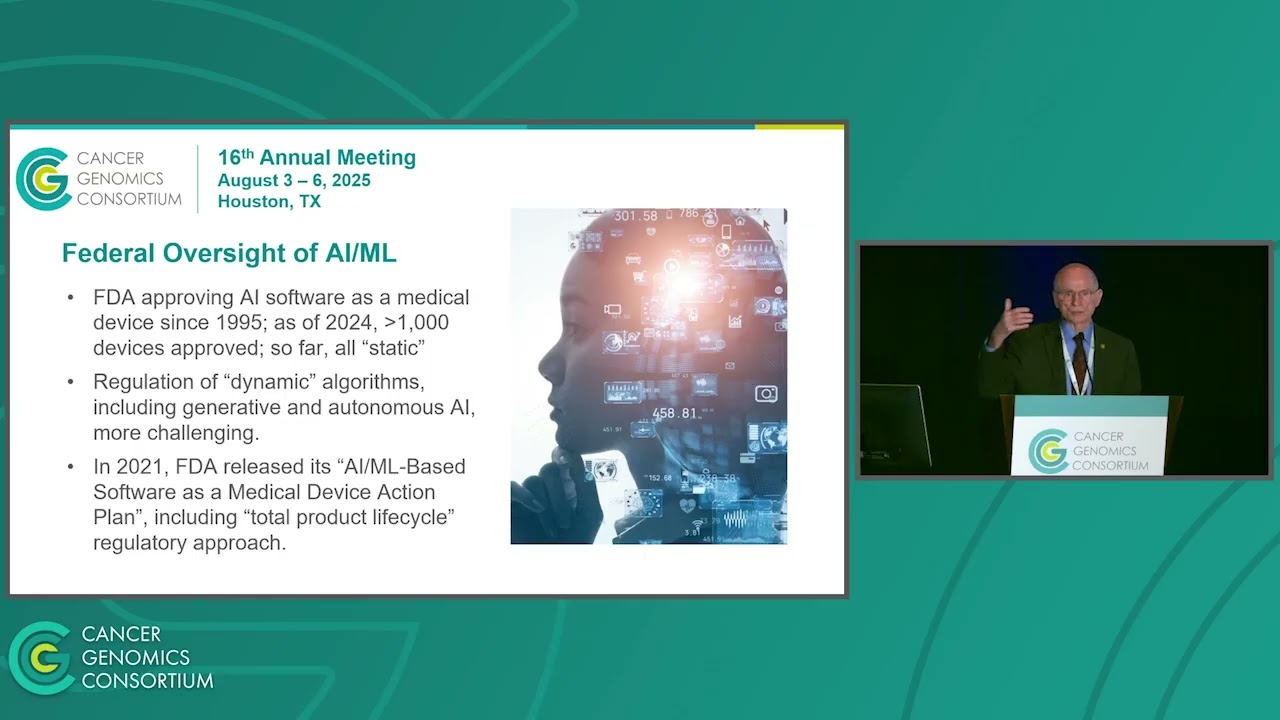
- Introduction to AI regulation in diagnostics and the FDA's action plan.
- History and current status of LDT regulation, including the FDA final rule and court decision.
- Proposal for a risk-based approach to LDT oversight.
- Discussion of gene patents and the Myriad case.
- Current thinking on patent eligibility and potential reforms.
Contribution & Novelties
The talk provides an up-to-date, insider perspective on the regulatory landscape for molecular diagnostics, including the recent vacating of the FDA’s LDT rule and the disbanding of CLEAC. It offers a nuanced proposal for a risk-based approach to LDT oversight, which is a valuable contribution to the ongoing debate. The discussion of AI regulation and the need for explainable AI is also timely.
Pour aller plus loin :
- FDA’s LDT Final Rule — The final rule that was vacated, providing context.
- Myriad Genetics case — Landmark Supreme Court case on gene patents.
- FDA’s AI/ML Action Plan — Official FDA page on AI regulation.
103 words
Radar Profile
The radar profile shows high scores in information quantity, quality, and reliability, reflecting the speaker's expertise and the comprehensive coverage of the topic. The technical level is moderate, indicating that the content is accessible to a professional audience but not overly technical. The overall balance suggests a well-rounded and credible presentation.