Detection of IGHMYC and a cryptic IGHBCL6 rearrangement refines diagnosis in high grade B-Cell
Keywords
Summary
163 words
Critical Evaluation
Value of the Information & Strength of the Argument
The video provides valuable insights into the diagnostic workup of high-grade B-cell lymphomas, emphasizing the importance of thorough FISH analysis and the recognition of cryptic rearrangements. The argumentation is well-structured, presenting the case step-by-step, from initial karyotype to the final confirmation of the cryptic IGHBCL6 rearrangement. The presenter effectively explains the rationale behind each testing decision and the significance of the findings, supported by a 2024 report on poor outcomes for patients with MYC and BCL6 rearrangements. The case underscores the need for high technical quality in FISH assays and the value of interdisciplinary communication.
Scientific Rigor, Source Quality, Title Accuracy
The scientific rigor is high, with a detailed description of the methods used, including karyotype, FISH assays, and sequential G-banding. The presenter acknowledges the limitations, such as the inability to validate interphase FISH for IGHBCL6, but provides reassuring metaphase results. The sources cited include a 2024 report on outcomes, though specific details are not provided. The title accurately reflects the content, focusing on the detection of IGHMYC and a cryptic IGHBCL6 rearrangement. No comments were provided for analysis.
188 words
Title / Content Match
The title accurately reflects the content, focusing on the detection of IGHMYC and a cryptic IGHBCL6 rearrangement in a high-grade B-cell lymphoma case.
Quality & Reliability
8/10
The video presents a detailed case study with clear methodology, including karyotype, FISH assays, and sequential G-banding, and references a 2024 report for clinical context. The presenter is a technologist at a university hospital cytogenetics laboratory, indicating expertise. Limitations include lack of peer-reviewed publication and reliance on a single case.
Key Moments
Markers derived by PSI from the transcript: the creator did not define chapters.
- Introduction and case presentation
- Initial karyotype results and communication with hematopathology
- FISH confirmation of IGHMYC rearrangement
- IHC results not compatible with Burkitt lymphoma, concern for double-hit
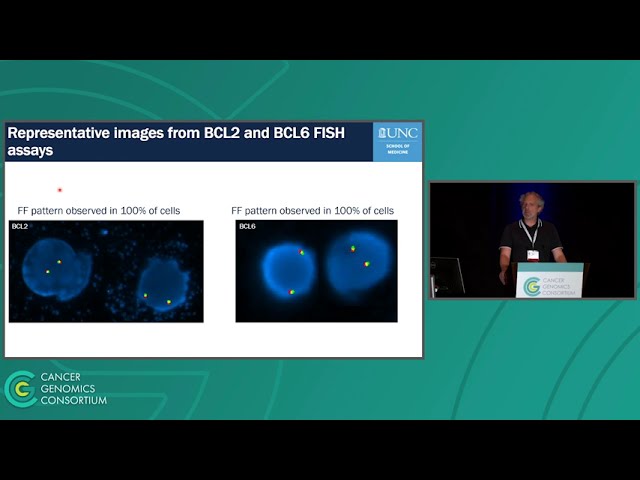
- Break-apart FISH for BCL2 and BCL6 normal
- Additional IGH signal observed on IGHBCL2 assay
- Metaphase analysis and localization of extra IGH signal to chromosome 3
- Sequential G-banding and FISH confirm IGHBCL6 rearrangement
- Update of pathology diagnosis and clinical implications
- Discussion of 2024 report on outcomes and conclusion
Cited Sources
- 2024 report on outcomes for large B-cell lymphoma with MYC and BCL6 rearrangements — Referenced in the video to affirm poor outcomes for patients with independent MYC and BCL6 rearrangements.
Concurring Sources
- WHO classification of lymphoid neoplasms — Provides context on classification systems for lymphomas, relevant to the discussion of diagnostic criteria.
Contribution & Novelties
This video provides a detailed case study demonstrating the detection of a cryptic IGHBCL6 rearrangement through meticulous FISH analysis, highlighting the importance of technical quality and open-mindedness in cytogenetic diagnostics. It underscores the value of pursuing unexpected findings to refine diagnosis and impact patient care.
Pour aller plus loin :
- WHO classification of lymphoid neoplasms — Provides context on classification systems for lymphomas.
- Fluorescence in situ hybridization — Background on FISH technique.
- Double-hit lymphoma — Overview of double-hit lymphomas and their significance.
82 words
Radar Profile
The radar profile shows high scores across all dimensions, indicating a well-rounded and reliable presentation. The video excels in providing detailed information and technical depth, with strong scientific rigor and source quality.