Invited Session 4 Clinical Variant Interpretation Knowledgebases in Cancer Genomics
Keywords
Summary
174 words
Critical Evaluation
Value of the Information & Strength of the Argument
The session provides valuable insights into the current state and challenges of cancer variant interpretation, particularly regarding complex variants and gene fusions. The speakers effectively argue for the need for standardized nomenclature and improved knowledgebase interoperability. They support their points with concrete examples from various knowledgebases and illustrate the practical difficulties in representing complex variants. The argumentation is solid, grounded in the speakers’ expertise and ongoing consortium efforts, though it is more descriptive than analytical, lacking critical evaluation of existing approaches.
Scientific Rigor, Source Quality, Title Accuracy
The session demonstrates scientific rigor by referencing established standards (HGVS, HGNC, ISCN) and ongoing consortium work. The speakers are credible experts, and the content aligns with current practices in the field. The title accurately reflects the session’s content. No external sources are cited beyond the consortium’s own resources and standards, which is appropriate for an invited session. The session does not include a public comment section, so no trends can be analyzed.
168 words
Title / Content Match
The title accurately reflects the session's focus on clinical variant interpretation knowledgebases in cancer genomics, covering consortium updates, standards, and challenges.
Quality & Reliability
8/10
The session is presented by experts from the Variant Interpretation for Cancer Consortium (VIC), with clear references to established standards (HGVS, HGNC, ISCN) and ongoing initiatives. The content is consistent with current practices in cancer genomics, though it is primarily a review of consortium activities and emerging topics rather than a peer-reviewed study.
Key Moments
Markers derived by PSI from the transcript: the creator did not define chapters.
- Introduction by moderators and speaker introductions
- Beth Patell begins overview of VIC activities and CME case series
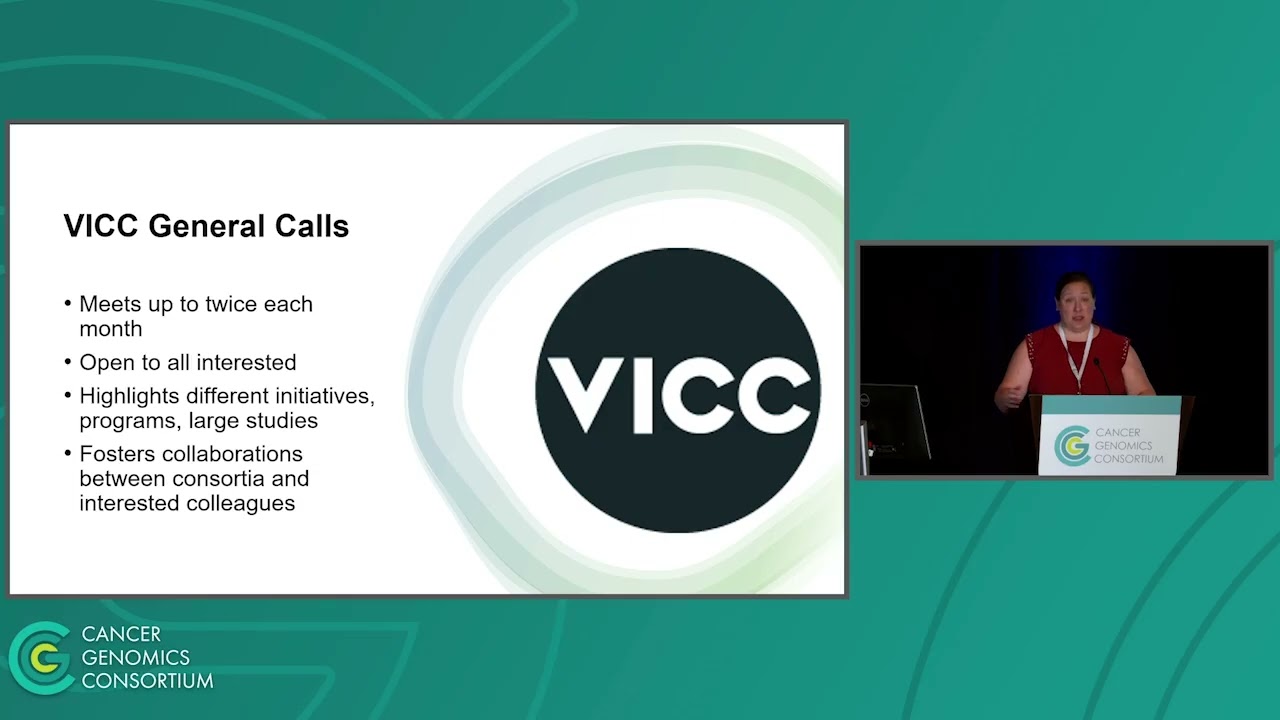
- Discussion of VIC general calls and virtual molecular tumor board
- Introduction of complex variant working group and challenges in bioinformatics
- Examples of knowledgebase assertions (CIViC, Molecular Oncology Almanac, cBioPortal)
- Discussion of limitations in bioinformatics and AI pipelines
- Alex Wagner begins presentation on gene fusion nomenclature
- Definition of gene fusion classes and development of syntax
- Examples of gene fusion representation using the proposed syntax
- Discussion of exon-based representation and variable partners
- Conclusion and invitation for community involvement
Cited Sources
- VIC Gene Fusion Specification — Referenced by Alex Wagner as the online specification for gene fusion nomenclature.
- HGVS Nomenclature — Mentioned as the standard for variant nomenclature, with which the gene fusion syntax aligns.
- HGNC Gene Fusion Recommendations — Referenced as the source of the double colon syntax for gene fusions.
- ISCN — Mentioned as a standard for cytogenetic nomenclature, relevant to complex variants.
- CIViC — Used as an example of a knowledgebase with specific evidence item format.
- Molecular Oncology Almanac — Used as an example of a knowledgebase with different assertion format.
- cBioPortal — Used as an example of a platform integrating knowledgebase information.
- OncoKB — Mentioned as a knowledgebase providing oncogenicity and therapeutic implications.
- Cancer Hotspots — Mentioned as a resource for recurrent mutations.
Concurring Sources
- HGVS Recommendations — The proposed gene fusion syntax aligns with HGVS recommendations, as stated in the session.
- HGNC Gene Fusion Recommendations — The double colon syntax is based on HGNC recommendations, as mentioned.
Contribution & Novelties
This session provides an update on the activities of the Variant Interpretation for Cancer Consortium (VIC), highlighting ongoing efforts to standardize gene fusion nomenclature and address challenges in complex variant interpretation. The presentation of the VIC gene fusion specification is a novel contribution, offering a structured syntax for representing chimeric transcripts and regulatory fusions. The discussion of complex variants and the need for interoperability between knowledgebases is also valuable. The session does not present new research findings but rather synthesizes current initiatives and standards.
Pour aller plus loin :
- HGVS Recommendations — Official guidelines for sequence variant nomenclature, essential for understanding the context of the proposed gene fusion syntax.
- ClinGen Somatic Working Group — Relevant to the clinical interpretation of somatic variants, including cancer.
- GA4GH Genomic Knowledge Standards — Work stream focused on standards for representing genomic knowledge, relevant to the interoperability challenges discussed.
144 words
Radar Profile
The radar profile shows high scores in quantity and quality of information, reflecting the session's comprehensive coverage of variant interpretation topics. The technical level is moderately high, suitable for a specialized audience. The overall reliability is strong due to the expertise of the speakers and alignment with established standards.