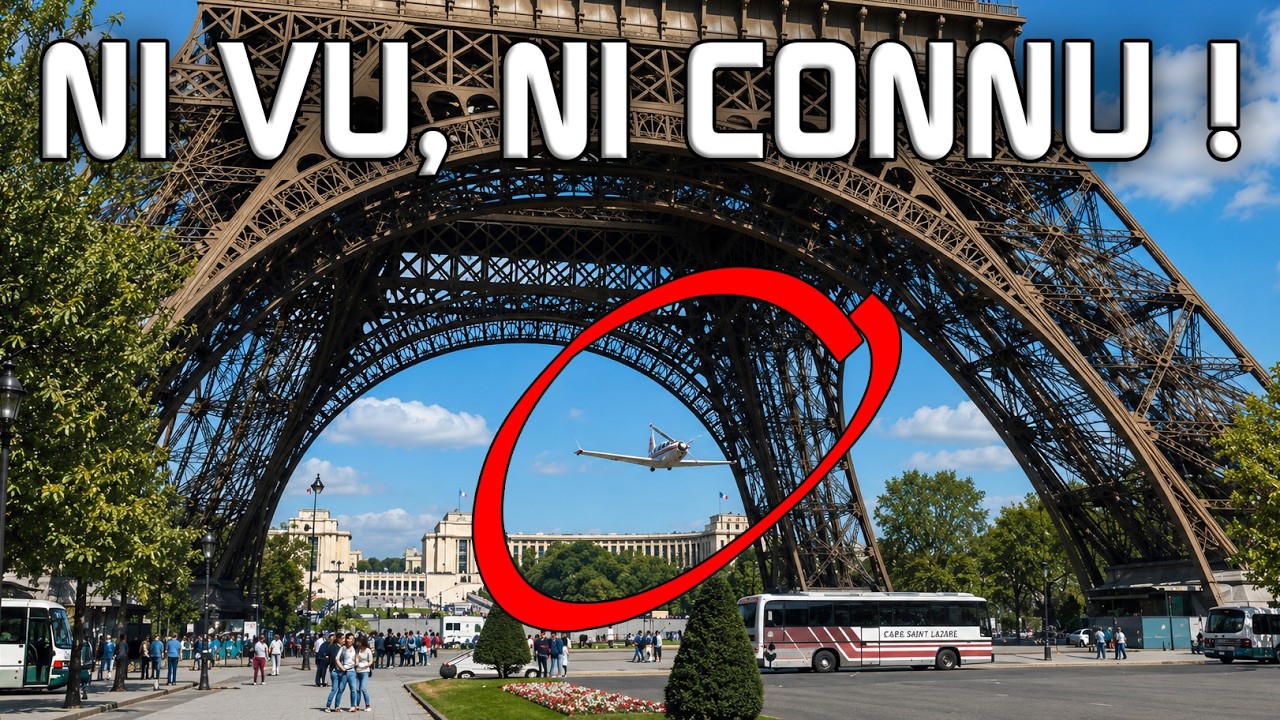
🪐Incognito, il passe sous la tour Eiffel !
Keywords
Summary
156 words
Critical Evaluation
The video is a masterful blend of historical narrative and poetic reflection. It provides a detailed account of Robert Moriarty’s life and the context of his famous flight, drawing on verifiable facts such as his military service, records, and the 1984 event. The storytelling is engaging, with a strong narrative arc that builds from Moriarty’s early life to the climactic moment under the tower. The inclusion of previous attempts adds depth and historical perspective. The video’s argumentation is solid, presenting Moriarty’s act as a symbol of freedom and individuality, while also acknowledging the risks and legal implications. The sources are not explicitly cited in the video, but the information aligns with known historical records and Moriarty’s own writings. The production quality is high, with evocative music and visuals that enhance the narrative. The title accurately reflects the content, and the video does not overstate its claims. Overall, it is a compelling and informative piece that offers both entertainment and historical insight. The only minor weakness is the lack of explicit source citations, but the content appears reliable based on the presenter’s reputation and the coherence of the story.
188 words
Title / Content Match
The title is catchy and accurately reflects the content, which focuses on the story of a pilot flying under the Eiffel Tower.
Quality & Reliability
8/10
The video is a well-researched historical narrative about Robert Moriarty's 1984 flight under the Eiffel Tower. It relies on public records, the pilot's own accounts, and historical context. The storytelling is engaging and the facts are presented accurately, though some details are dramatized for effect. The video does not cite specific academic sources but references the pilot's book and known historical events.
Key Moments
Markers derived by PSI from the transcript: the creator did not define chapters.
- Introduction: poetic framing of the story
- Robert Moriarty's early life and Vietnam War service
- Post-war career as a record-breaking pilot
- The 1984 race and mechanical failure
- Decision to fly under the Eiffel Tower
- The flight under the tower and its aftermath
- Previous attempts: Léon Colot and William Overstreet Jr.
- Moriarty's later life and anti-war views
- Reflection on freedom and the meaning of the act
Cited Sources
- Meeting aérien de la Ferté-Alais — Promotional link for an airshow mentioned in the description.
- Hasselblad Masters 2026 — Photography competition mentioned in the description, possibly related to the video's content.
- Incompetech Music — Source of the music used in the video, under Creative Commons license.
Concurring Sources
- Robert Moriarty's official website — Personal site with his biography and achievements.
- Aviation Safety Network — Database of aviation incidents and records, potentially corroborating the flight details.
Dissenting Sources
- Some sources claim the flight was unauthorized and illegal — While the video presents the act as a peaceful stunt, some may argue it was a security breach. However, no specific contradictory sources are cited.
Contribution & Novelties
The video brings to light a lesser-known aviation feat, providing a detailed and engaging narrative that combines historical facts with philosophical reflections on freedom and the value of seemingly useless acts. It offers a fresh perspective on a historical event that is not widely known to the general public.
Pour aller plus loin :
- Robert Moriarty’s book ‘The Art of Peace’ — A primary source by the pilot himself, offering his anti-war views.
- William Overstreet Jr. Wikipedia — Background on the WWII pilot who flew under the Eiffel Tower in 1944.
- Eiffel Tower official website — Historical information about the tower and its significance.
104 words
Radar Profile
The radar profile shows high scores in information quantity and quality, with a moderate technical level. This indicates a well-researched and informative video that is accessible to a general audience, with a strong emphasis on storytelling rather than technical details.
💬 Très positif. Sur les 30 commentaires analysés, les spectateurs expriment une admiration unanime pour la narration poétique et l'histoire captivante, avec de nombreux éloges pour l'écriture de Gontran H. et la voix d'Arnaud.