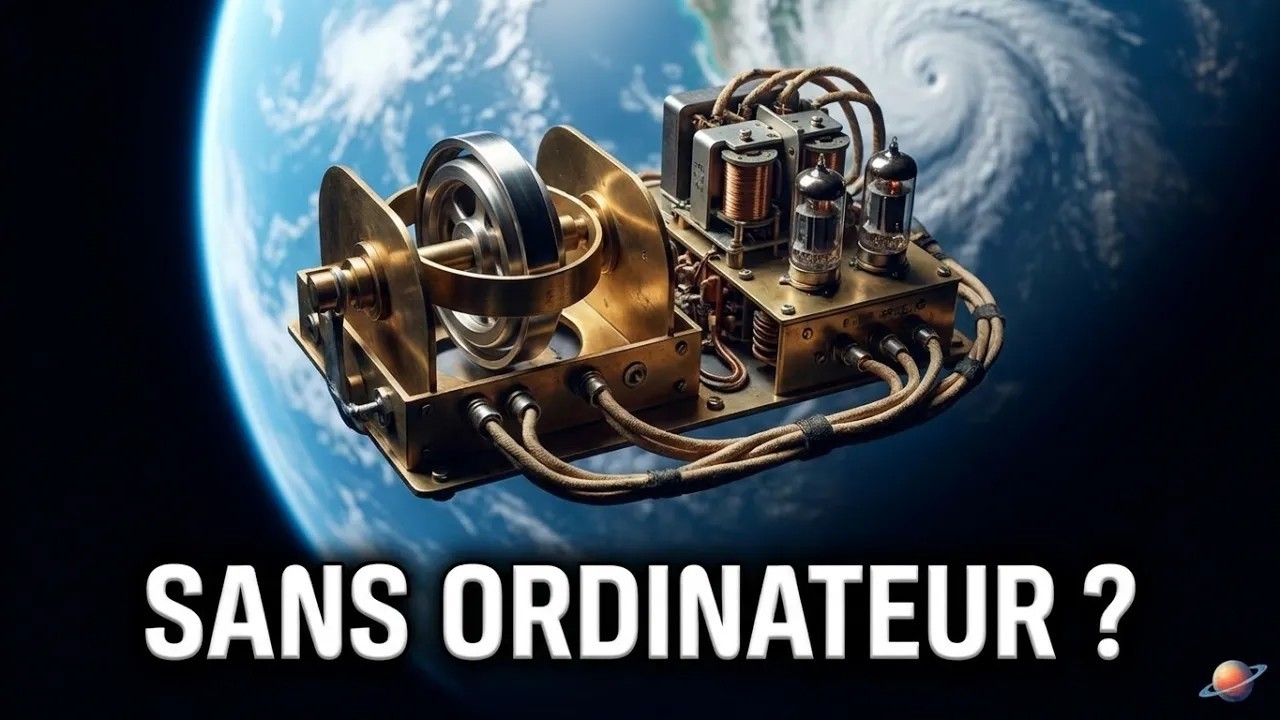
🪐Les premiers vaisseaux étaient plus archaïques que vous ne le pensez.
Keywords
Summary
181 words
Critical Evaluation
The video offers a solid educational overview of early spacecraft stabilization techniques, blending historical context with accessible explanations of physics. The host’s use of analogies (e.g., pushing a wardrobe, balloons) makes complex concepts understandable. However, the scientific rigor is moderate: while the physics is accurate, the video lacks specific citations to primary sources or archival documents, relying instead on general knowledge. The discussion of gyroscopes and gimbals is clear, but the explanation of the vector cross-product could be more precise. The video’s strength lies in its engaging narrative and visual aids, which help convey the challenges of early space engineering. The sponsored segment is clearly separated and does not detract from the content. The title accurately reflects the content, which highlights the primitive nature of early probes. Overall, the video is informative and well-structured, but it would benefit from more explicit references to technical documents or historical records to enhance its credibility.
152 words
Title / Content Match
The title is catchy and hints at the archaic nature of early spacecraft, which matches the content's focus on the rudimentary technology of early lunar probes.
Quality & Reliability
7/10
The video provides a detailed historical account of early space probes, with accurate references to Newton's laws and gyroscopic principles. However, it lacks explicit citations to primary sources, and some technical details are simplified for a general audience.
Key Moments
Markers derived by PSI from the transcript: the creator did not define chapters.
- Start of the main episode after the sponsored segment.
- Introduction to the space race and the need for stabilization.
- Explanation of Newton's third law and action-reaction.
- Discussion of spin stabilization in Luna 1 and 2.
- Challenges of Luna 3 and the need to stop spin for photography.
- Introduction of cold gas thrusters for attitude control.
- Explanation of gyroscopes and their role in orientation.
- Details on gimbals and measuring angles.
- Comparison with American Ranger 3 and conclusion.
Cited Sources
- Incompetech Music — Music used in the video, composed by Kevin MacLeod under Creative Commons license.
- NordVPN — Sponsored link mentioned in the video for a VPN service.
Concurring Sources
- NASA History - Luna 3 — Official NASA historical page providing details on the Luna 3 mission.
Dissenting Sources
- Some sources suggest different methods for angle measurement — The video mentions multiple possible methods (potentiometer, magnetic coils) without confirming which was used, as archives are unclear.
Contribution & Novelties
The video provides a clear and engaging explanation of early spacecraft stabilization techniques, specifically focusing on the transition from spin stabilization to active attitude control using cold gas thrusters and gyroscopes. It highlights the engineering challenges faced by the Soviet Luna probes and draws parallels with American efforts. The content is valuable for those interested in space history and basic physics.
Pour aller plus loin :
- Gyroscope — Provides a comprehensive overview of gyroscope principles and applications.
- Newton’s laws of motion — Explains the fundamental physics behind spacecraft propulsion and control.
- Luna 3 — Details the mission and achievements of the Soviet probe that photographed the far side of the Moon.
111 words
Radar Profile
The radar profile shows a balanced distribution across all dimensions, with slightly higher scores in information quantity and reliability, indicating a well-rounded educational video with good technical depth.