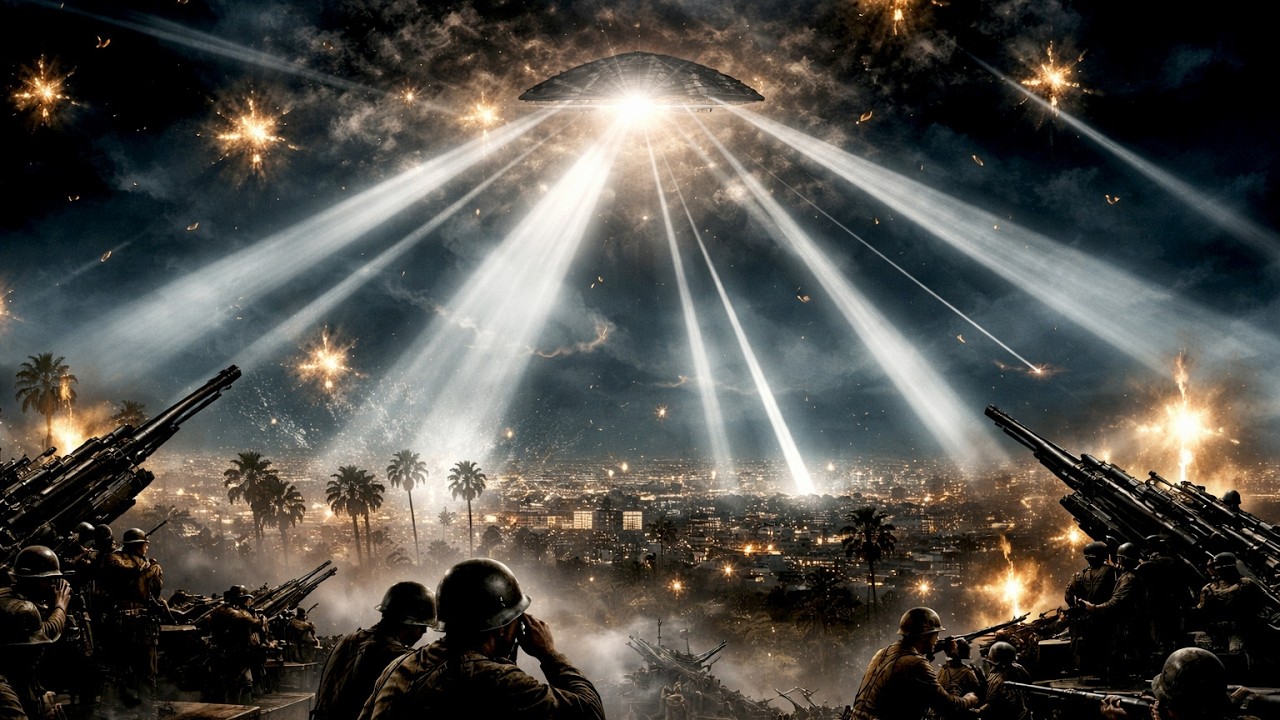
🪐L'OVNI le plus marquant de l'Histoire : la bataille de Los Angeles
Keywords
Summary
174 words
Critical Evaluation
The video provides a thorough and engaging account of the Battle of Los Angeles, a well-known UFO incident. The creator, AstronoGeek, demonstrates a critical approach, systematically debunking common myths and presenting logical arguments against simplistic explanations. The historical context is well-researched, with accurate details about the events leading up to the incident, such as the attack on Pearl Harbor and the subsequent panic on the West Coast. The use of eyewitness testimonies and contemporary newspaper reports adds credibility to the narrative. However, the video relies heavily on secondary sources and does not delve into primary archival documents, which could strengthen the analysis. The creator’s skeptical stance is evident, but he remains open to the possibility of extraterrestrial involvement, which is a balanced approach. The production quality is high, with engaging storytelling and visual aids. The inclusion of humorous references to French comedy sketches adds entertainment value but may not appeal to all audiences. Overall, the video is a valuable resource for those interested in UFO history, offering a well-rounded examination of the incident. The main weakness is the lack of in-depth analysis of alternative theories, such as the possibility of a secret military exercise or a misidentified civilian aircraft. Nevertheless, the video successfully achieves its goal of providing a comprehensive overview while encouraging critical thinking.
215 words
Title / Content Match
The title accurately reflects the content, focusing on the most notable UFO incident in history.
Quality & Reliability
8/10
The video provides a detailed historical account of the Battle of Los Angeles, citing multiple contemporary sources and eyewitness reports. It critically examines various explanations, debunking myths with logical reasoning. The content is well-researched and presented in an engaging manner, though it relies on secondary sources and does not include primary archival documents.
Key Moments
Markers derived by PSI from the transcript: the creator did not define chapters.
Cited Sources
- Incompetech (music) — Music used in the video, licensed under Creative Commons
Concurring Sources
- Los Angeles Times article (1942) — Contemporary newspaper report cited in the video, corroborating eyewitness accounts.
Dissenting Sources
- Weather balloon explanation — Official explanation proposed by the Navy, which the video argues is implausible given the intensity of the barrage.
Contribution & Novelties
This video offers a comprehensive and critical examination of the Battle of Los Angeles, synthesizing historical records and eyewitness accounts. It stands out for its rigorous debunking of popular myths, such as the weather balloon theory, and its balanced approach to the possibility of extraterrestrial involvement. The video also highlights the psychological impact of the incident on the public and the military’s response.
Pour aller plus loin :
- Battle of Los Angeles - Wikipedia — Provides a detailed overview of the incident and its historical context.
- The Battle of Los Angeles - History.com — Offers additional historical perspective and analysis.
- UFO sightings during World War II - National Archives — Primary sources on military records from the era.
118 words
Radar Profile
The radar profile shows high scores in information quantity, quality, and reliability, with a slightly lower technical level, indicating a well-researched and accessible presentation.
💬 Positif : Les commentaires sont très positifs, saluant l'humour et la qualité des explications, avec une appréciation particulière pour les références culturelles et la rigueur du debunking.