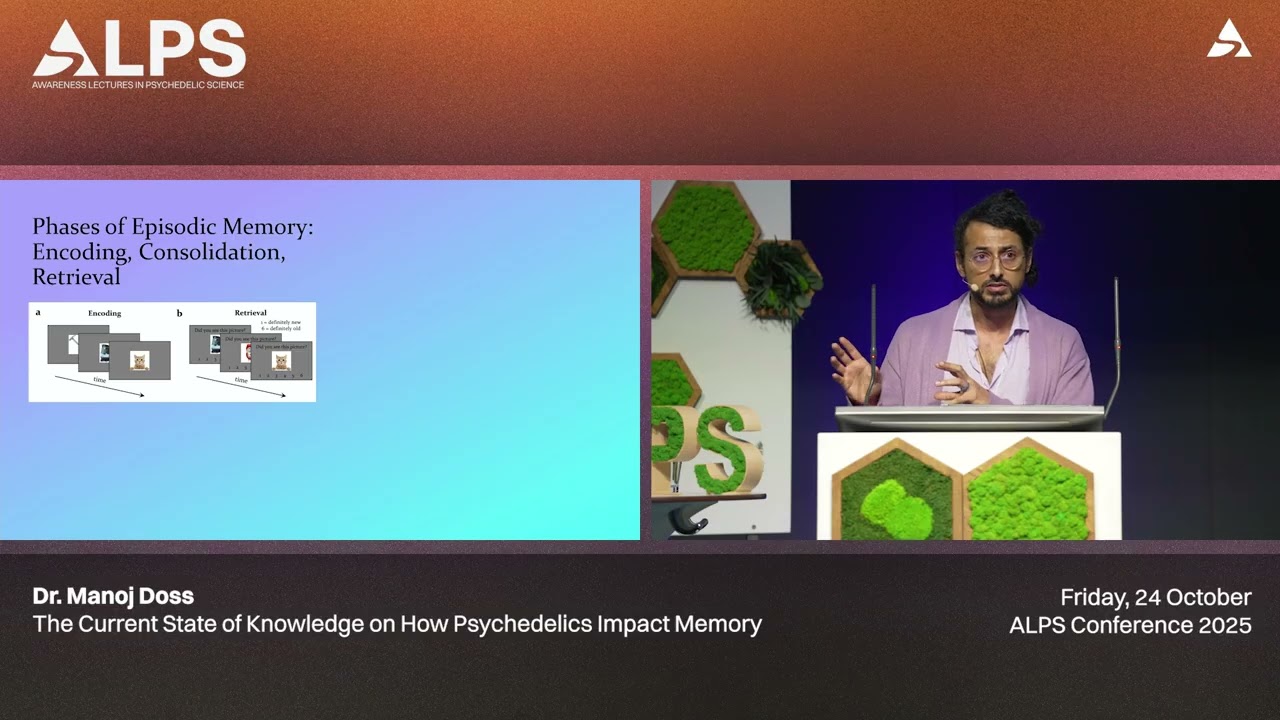
Dr. Manoj Doss — The Current State of Knowledge on How Psychedelics Impact Memory
Keywords
Summary
241 words
Critical Evaluation
Value of the Information & Strength of the Argument
The talk provides valuable insights into the nuanced effects of psychedelics on memory, challenging the simplistic view that they only impair cognition. The speaker presents a compelling argument that psychedelics selectively impair recollection while enhancing familiarity, which could have implications for psychotherapy. He supports his claims with data from multiple studies, including his own, and discusses potential mechanisms involving serotonin 2A receptors. The argumentation is logical and well-structured, though some interpretations are post-hoc and require further replication. He also highlights the importance of experimental design, such as timing of drug administration, which adds depth to the discussion.
Scientific Rigor, Source Quality, Title Accuracy
The speaker demonstrates scientific rigor by referencing specific studies, including his own published work and ongoing research. He acknowledges limitations and alternative explanations, such as the potential artifact in the replication study. The sources are credible, coming from established researchers and institutions. The title accurately reflects the content, which is a focused review of current knowledge on psychedelics and memory. The talk does not include promotional content, and the speaker maintains a neutral, evidence-based tone.
187 words
Title / Content Match
The title accurately reflects the content, which focuses on the impact of psychedelics on memory systems.
Quality & Reliability
8/10
The talk is delivered by a neuropsychopharmacologist with direct research experience, referencing multiple studies including his own and others. The content is technically detailed and aligns with current scientific understanding, though it includes some preliminary findings and post-hoc interpretations.
Key Moments
Markers derived by PSI from the transcript: the creator did not define chapters.
- Introduction: Why study psychedelics and memory? The importance of memory in therapeutic effects.
- Overview of memory systems: episodic, semantic, procedural, and fear conditioning.
- Introduction to Endel Tulving and the episodic/semantic memory distinction.
- Dual-process model: recollection vs. familiarity, and their neural substrates.
- Serotonin 2A receptor distribution and its implications for memory systems.
- Experimental design considerations: drug administration timing and its impact on results.
- Effects of alcohol and other drugs on recollection and familiarity.
- MDMA and psilocybin studies: impairment of recollection and enhancement of familiarity.
- Replication attempt with psilocybin and 2C-B: initial failure and artifact explanation.
- EEG data (FN400) supporting familiarity enhancement and misattribution.
Cited Sources
- Psilocybin and 2C-B study (unpublished) — Mentioned as a study conducted at MRI University with psilocybin and 2C-B, including a memory task.
- MDMA study on memory — Referenced as a study where MDMA impaired recollection but enhanced familiarity.
- Hopkins psilocybin study — Reanalysis of data from Johns Hopkins with three doses of psilocybin.
Concurring Sources
- Psychedelics and memory: a review — General scientific consensus that psychedelics affect memory processes, though specific effects on recollection vs. familiarity are less established.
Dissenting Sources
- Some studies showing no effect of psychedelics on memory — The speaker mentions that some studies have not found significant effects, and he notes the replication failure, indicating variability in findings.
Contribution & Novelties
The talk provides a novel synthesis of how psychedelics differentially affect memory systems, specifically highlighting the unique pattern of impaired recollection and enhanced familiarity. This challenges the prevailing notion that psychedelics uniformly impair cognition. The speaker also introduces the concept of misattributed familiarity as a potential mechanism for false insights, which has implications for understanding the risks and benefits of psychedelic therapy. The discussion of serotonin 2A receptor distribution and its correlation with memory processes offers a mechanistic explanation.
Pour aller plus loin :
- Episodic memory — Provides background on the distinction between episodic and semantic memory.
- Serotonin 2A receptor — Details the receptor’s distribution and function in the brain.
- Dual-process theory of memory — Explains the recollection-familiarity distinction.
- FN400 ERP component — Describes the event-related potential associated with familiarity.
130 words
Radar Profile
The radar profile shows high scores across all dimensions, indicating a technically detailed, reliable, and informative talk. The balance between quantity and quality of information is strong, with a high level of technical depth suitable for a scientific audience.
💬 Sur les 0 commentaires analysés, aucune tendance n'est disponible.