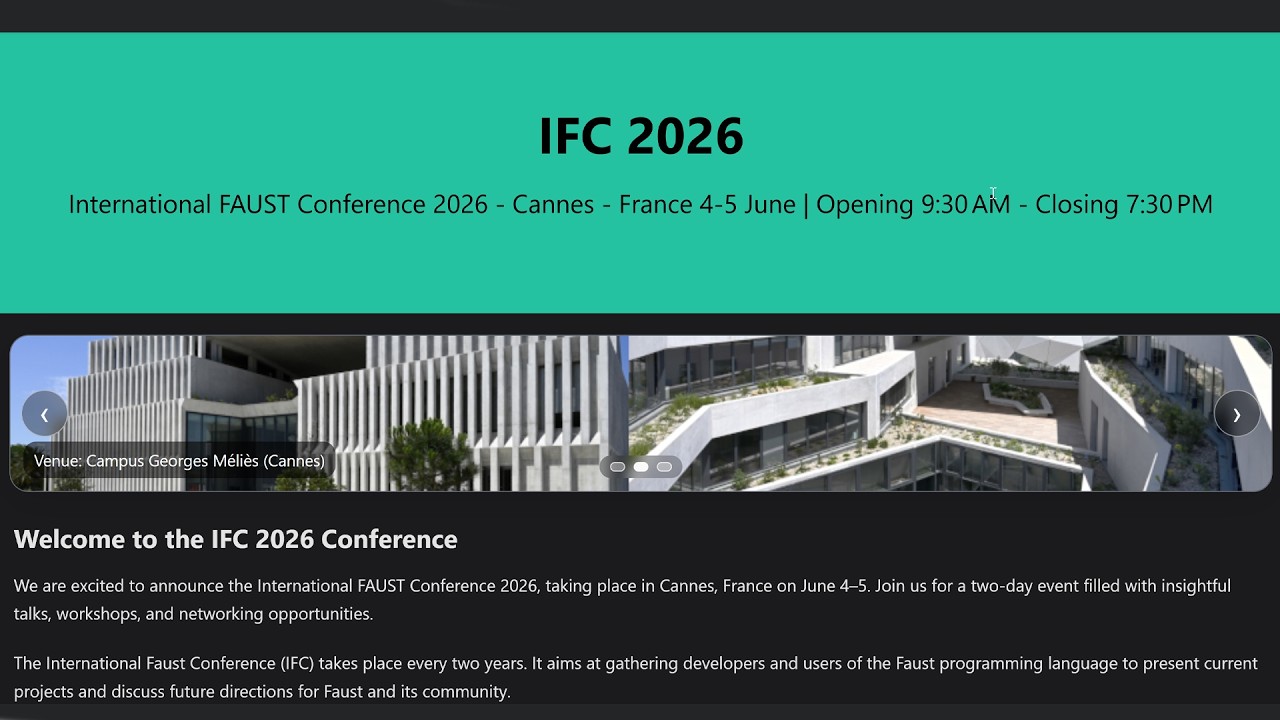
International FAUST Conference 2026
Keywords
Summary
172 words
Critical Evaluation
Value of the Information & Strength of the Argument
The video provides valuable insights into the practical applications of the FAUST language in computer music and research. The speakers present a clear and well-structured argument for the benefits of FAUST, supported by concrete examples and project outcomes. They demonstrate the language’s flexibility and power in creating complex audio processing tools, and they effectively argue for its adoption in educational and research settings. The argumentation is solid, with references to specific projects and collaborations that validate their claims.
Scientific Rigor, Source Quality, Title Accuracy
The scientific rigor is high, as the content is presented by experts in the field with extensive experience. The sources cited include their own research projects and publications, which are credible. The title accurately reflects the content, as it is a recording of the conference. The video does not include any external sources or references beyond the speakers’ own work, but the information is presented with sufficient detail and technical depth to be considered reliable.
168 words
Title / Content Match
The title accurately reflects the content: a full recording of the International FAUST Conference 2026.
Quality & Reliability
7/10
The video is a recording of a scientific conference (IFC 2026) featuring presentations by researchers and developers. The content is technical and appears accurate, but it is not peer-reviewed and may contain personal opinions. The source is the official channel of the conference, which adds credibility.
Key Moments
Markers derived by PSI from the transcript: the creator did not define chapters.
- Opening remarks and welcome by the organizers.
- Introduction to the conference and venue.
- Keynote presentation begins: 'FAUST by and for musicians'.
- Discussion on FAUST in music education at Paris 8.
- Overview of research projects: HOA, ABC, Kiwi.
- Presentation of BBDMI and ERC G3S projects.
- Demonstration of FAUST-based tools and compositions.
- Q&A session and discussion on methodologies.
Cited Sources
- FAUST Programming Language — Mentioned as the core language discussed throughout the conference.
- HOA Library — Referenced as a library for high-order ambisonics developed by the speakers.
- ABC Library — Mentioned as a library for spatial audio processing.
- Kiwi Platform — Referenced as a collaborative patching platform.
Concurring Sources
- FAUST Documentation — Provides detailed information on the FAUST language, supporting the technical claims made in the video.
Contribution & Novelties
The video provides an in-depth look at the latest developments in the FAUST ecosystem, particularly in the context of computer music and spatial audio. It highlights the integration of FAUST into educational curricula and research projects, showcasing its versatility and power. The presentation of the ABC library and the G3S project offers new insights into the future of spatial audio processing. The speakers’ emphasis on open science and fair principles is a valuable contribution to the community.
Pour aller plus loin :
- FAUST Programming Language — Official website with documentation and resources.
- High-Order Ambisonics — Overview of ambisonics, a key concept in spatial audio.
- Max/MSP — A visual programming environment for music and multimedia, often used with FAUST.
- Pure Data — Another visual programming language for audio, compatible with FAUST.
130 words
Radar Profile
The radar profile shows high scores in information quantity, quality, and technical level, indicating a content-rich and technically deep presentation. The reliability score is slightly lower, reflecting the lack of peer review and the subjective nature of some claims. Overall, the video is a valuable resource for those interested in FAUST and computer music.
💬 Sur les 0 commentaires analysés, aucune tendance n'a pu être dégagée.