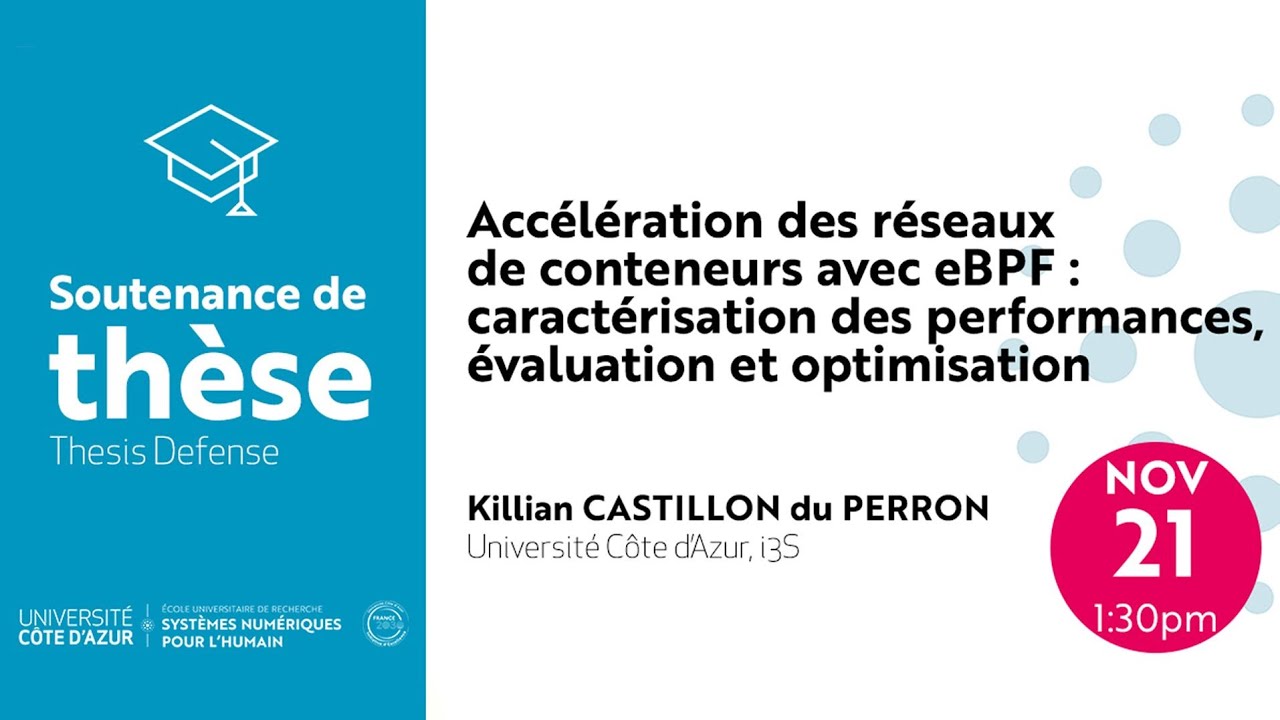
Thesis Defense - Killian Castillon du Perron (Université Côte d'Azur, Laboratoire i3S) - 21/11/2025
Keywords
Summary
157 words
Critical Evaluation
Value of the Information & Strength of the Argument
The value of the information is high, as it provides original empirical data on AF_XDP latency and CNI performance, filling a gap in existing literature. The argumentation is solid, with a clear methodology: automated benchmarking, clustering analysis, and a novel topology generator. The speaker systematically compares results and draws conclusions based on data. The optimization for Cilium is well-motivated and evaluated with concrete metrics. The presentation is logical and builds on previous contributions.
Scientific Rigor, Source Quality, Title Accuracy
The scientific rigor is strong, with a peer-reviewed publication (ICC 2024) for the AF_XDP study. The speaker references relevant prior work, such as the microservice topology study, and uses standard tools like the AF_XDP sample application. The title accurately reflects the content. The defense is well-structured and transparent about limitations, such as the complexity of AF_XDP and the need for fallback for security policies.
152 words
Title / Content Match
The title accurately reflects the content, which covers acceleration of container networks with eBPF, including performance characterization, evaluation, and optimization.
Quality & Reliability
8/10
The defense presents original research with a rigorous methodology, including extensive benchmarking (over 100 configurations for AF_XDP, 170 topologies for CNI comparison) and a peer-reviewed publication (ICC 2024). The speaker is a PhD candidate, and the work is supervised by established researchers. The presentation is detailed and transparent about methods and limitations.
Key Moments
Markers derived by PSI from the transcript: the creator did not define chapters.
- Introduction and context of the thesis on container network acceleration with eBPF.
- Explanation of microservices and container networking challenges, including latency issues.
- Introduction to eBPF and XDP, and the AF_XDP mechanism for bypassing the kernel network stack.
- First contribution: AF_XDP latency study, methodology, and results showing 6.5 µs minimum latency.
- Second contribution: CNI comparison (Antrea, Cilium, Flannel) using a microservice topology generator.
- Third contribution: XDP acceleration for VXLAN overlay in Cilium, achieving up to 28.8% latency reduction.
- Conclusion and future work, emphasizing the importance of both infrastructure and application architecture.
Cited Sources
- EUR DS4H funded theses — Mentioned in the video description as a link to learn more about theses funded by EUR DS4H, which funded this thesis.
Concurring Sources
- Understanding Delays in AF_XDP-based Applications (ICC 2024) — The speaker mentions this publication as the basis for the first contribution, but no URL is provided.
Contribution & Novelties
The thesis provides original contributions: a comprehensive latency characterization of AF_XDP, a comparative evaluation of CNIs using realistic microservice topologies, and a novel XDP-based optimization for VXLAN overlay networks. The work highlights the importance of both infrastructure and application architecture in network performance.
Pour aller plus loin :
- eBPF — Background on eBPF technology.
- XDP — Overview of XDP.
- AF_XDP — Official documentation on AF_XDP.
- Cilium — Official website of Cilium, an eBPF-based CNI.
- Kubernetes — Official website of Kubernetes, the container orchestration platform.
84 words
Radar Profile
The radar profile shows high scores across all dimensions, indicating a well-rounded and reliable presentation. The high scores in quantity and quality of information reflect the depth of the research, while the technical level is appropriate for an expert audience. The overall reliability is strong due to the peer-reviewed publication and rigorous methodology.