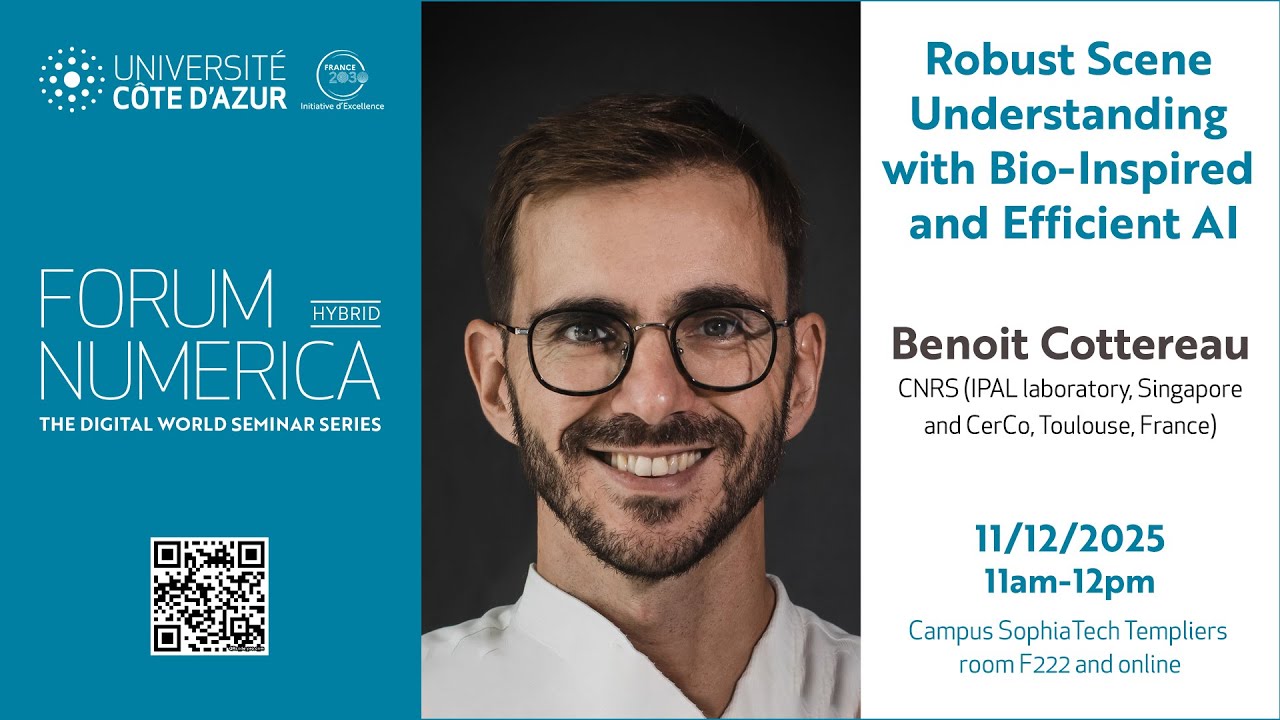
Forum Numerica - Benoit Cottereau - Robust Scene Understanding with Bio-Inspired and Efficient AI
Keywords
Summary
160 words
Critical Evaluation
Value of the Information & Strength of the Argument
The talk provides valuable insights into the application of bio-inspired AI for robust scene understanding. The speaker demonstrates the potential of event-based cameras and SNNs to overcome limitations of traditional deep learning, particularly in challenging conditions. The argumentation is solid, supported by recent peer-reviewed publications and quantitative results. However, some claims are qualitative and the talk is an overview rather than a detailed technical exposition. The speaker acknowledges that their methods are not always state-of-the-art in accuracy but offer better trade-offs in energy efficiency and neuromorphic compatibility, which is a reasonable and well-argued position.
Scientific Rigor, Source Quality, Title Accuracy
The talk is scientifically rigorous, with references to specific datasets (M3ED, MVSEC) and methods (CLIP, SAM, STDP). The speaker cites his own published works and collaborations, indicating a strong research background. The title accurately reflects the content, focusing on robust scene understanding with bio-inspired and efficient AI. The talk is well-structured and the speaker is transparent about limitations and trade-offs. No external sources are cited beyond the speaker’s own work and the seminar series, but the technical depth and peer-reviewed basis lend credibility.
192 words
Title / Content Match
The title accurately reflects the content, focusing on robust scene understanding using bio-inspired and efficient AI.
Quality & Reliability
8/10
The speaker is a CNRS research director with expertise in bio-inspired vision and AI. The talk presents recent peer-reviewed works (CVPR, etc.) and includes technical details. However, it is a seminar presentation without full methodological transparency, and some claims are qualitative.
Key Moments
Markers derived by PSI from the transcript: the creator did not define chapters.
- Introduction to the talk's focus on spatial vision and limitations of deep neural networks with RGB data.
- Explanation of event-based cameras and their advantages over standard cameras.
- Overview of the talk's structure: semantic segmentation, depth estimation, motion processing, and future work.
- Introduction to OpenESS for open-vocabulary event-based semantic segmentation using CLIP and domain adaptation.
- Presentation of EventFly for cross-platform adaptation in event-based perception.
- Introduction to StereoSpike, a deep convolutional SNN for depth estimation from event-based stereo cameras.
- Discussion of motion processing using STDP learning and applications in sports.
- Conclusion and future perspectives on neuromorphic hardware implementation.
Cited Sources
- Forum Numerica seminar series — The talk is part of this seminar series, providing context for the research presented.
Concurring Sources
- OpenESS: Open-Vocabulary Event-based Semantic Segmentation — The speaker's work on open-vocabulary event-based segmentation, presented at CVPR.
- EventFly: Cross-Platform Event-based Perception — The speaker's work on cross-platform adaptation for event-based perception.
- StereoSpike: Depth Estimation with Spiking Neural Networks — The speaker's work on depth estimation using SNNs.
Contribution & Novelties
The talk presents novel approaches for robust scene understanding using event-based cameras and spiking neural networks. Key contributions include OpenESS for open-vocabulary event-based semantic segmentation, EventFly for cross-platform adaptation, and StereoSpike for efficient depth estimation. These methods address limitations of traditional deep learning in terms of robustness and energy efficiency. The talk also highlights the potential of bio-inspired learning rules like STDP for motion detection.
Pour aller plus loin :
- Spiking Neural Network — Provides background on SNNs and their advantages.
- Event camera — Explains the principles and applications of event-based cameras.
- CLIP (Contrastive Language-Image Pre-training) — The paper introducing CLIP, which is foundational to OpenESS.
- Segment Anything Model (SAM) — The model used for superpixel generation in OpenESS.
- STDP (Spike-Timing-Dependent Plasticity) — A bio-inspired learning rule used in the motion processing work.
133 words
Radar Profile
The radar profile shows high scores across all dimensions, indicating a well-rounded presentation with substantial information, technical depth, and reliability. The talk excels in providing a comprehensive overview of the research area while maintaining scientific rigor.