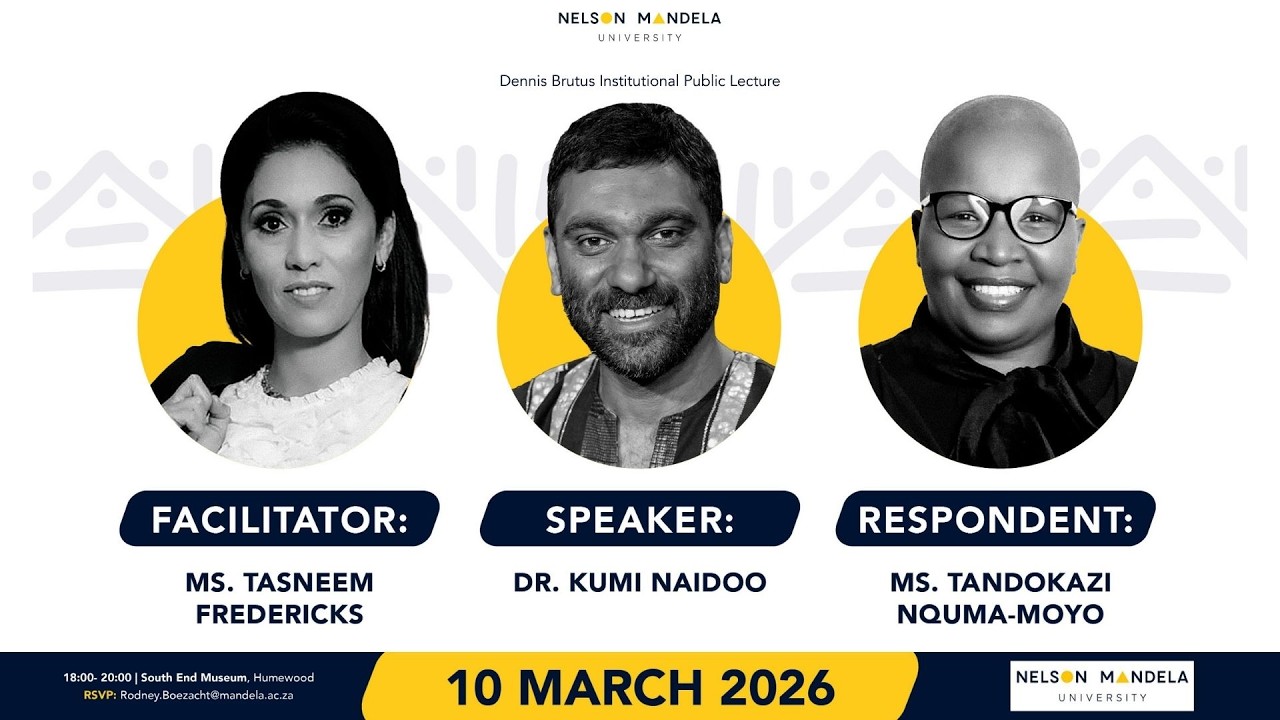
Dennis Brutus Institutional Public Lecture
Keywords
Summary
148 words
Critical Evaluation
Value of the Information & Strength of the Argument
The lecture provides valuable insights into the socio-economic impacts of environmental degradation, particularly in the South African context. Dr. Naidu’s argumentation is grounded in his extensive experience as a climate justice activist, and he effectively connects local environmental issues to global systemic challenges. He emphasizes the importance of community-led solutions and the role of education in fostering environmental stewardship. The argumentation is persuasive, though it relies more on anecdotal evidence and ethical appeals than on empirical data. The inclusion of a school principal’s testimony about integrating technology into environmental education adds a practical dimension. However, the lecture could benefit from more concrete examples and data to strengthen its claims.
Scientific Rigor, Source Quality, Title Accuracy
The lecture demonstrates a strong commitment to scientific rigor, with references to climate change and environmental degradation. However, specific sources are not explicitly cited within the transcript, and the description provides no links. The title accurately reflects the content, focusing on environmental degradation and its socio-economic impact. The lecture is well-structured, with clear introductions and a coherent flow. The presence of a public lecture format and the involvement of academic institutions lend credibility. Nevertheless, the lack of explicit citations and the incomplete transcript limit the ability to verify the claims made. The event’s alignment with Dennis Brutus’s legacy adds historical and ethical depth, but the scientific basis could be more thoroughly documented.
236 words
Title / Content Match
The title accurately reflects the content, which is a public lecture honoring Dennis Brutus, focusing on environmental degradation and its socio-economic impacts.
Quality & Reliability
7/10
The lecture is an expert opinion by a renowned human rights and climate justice activist, with references to scientific concepts and community initiatives. However, it lacks detailed citations and empirical data, and the transcript is incomplete, affecting the overall reliability.
Key Moments
Markers derived by PSI from the transcript: the creator did not define chapters.
- Opening and moment of resistance for oppressed peoples
- Welcome and introductions by program director
- Message from the South End Museum trustee
- Message from Patterson High School principal
- Artistic performance by Sutto Mandrovo
- Introduction of keynote speaker Dr. Kumi Naidu
- Keynote lecture on environmental degradation and socio-economic impact
- Q&A session and discussion
- Vote of thanks and closing remarks
Contribution & Novelties
The lecture contributes to the discourse on environmental justice by framing environmental degradation as a human rights issue, drawing on the legacy of Dennis Brutus. It highlights the importance of community-based solutions and the role of education in fostering environmental stewardship. The integration of technology in schools, as mentioned by the principal, offers a novel approach to environmental monitoring. The lecture also emphasizes the need for hope and collective action in the face of systemic challenges.
Pour aller plus loin :
- Environmental justice — Provides a framework for understanding the intersection of environmental issues and social justice.
- Climate justice — Explores the ethical and political dimensions of climate change impacts.
- Dennis Brutus — Background on the poet and activist honored in this lecture.
- Sustainable development goals — Relevant to the discussion of possible solutions.
134 words
Radar Profile
The radar profile shows high scores in quantity and quality of information, reflecting the lecture's comprehensive coverage of environmental and socio-economic issues. The technical level is moderate, indicating accessibility to a general audience. Overall reliability is strong, supported by the speaker's expertise and institutional backing.