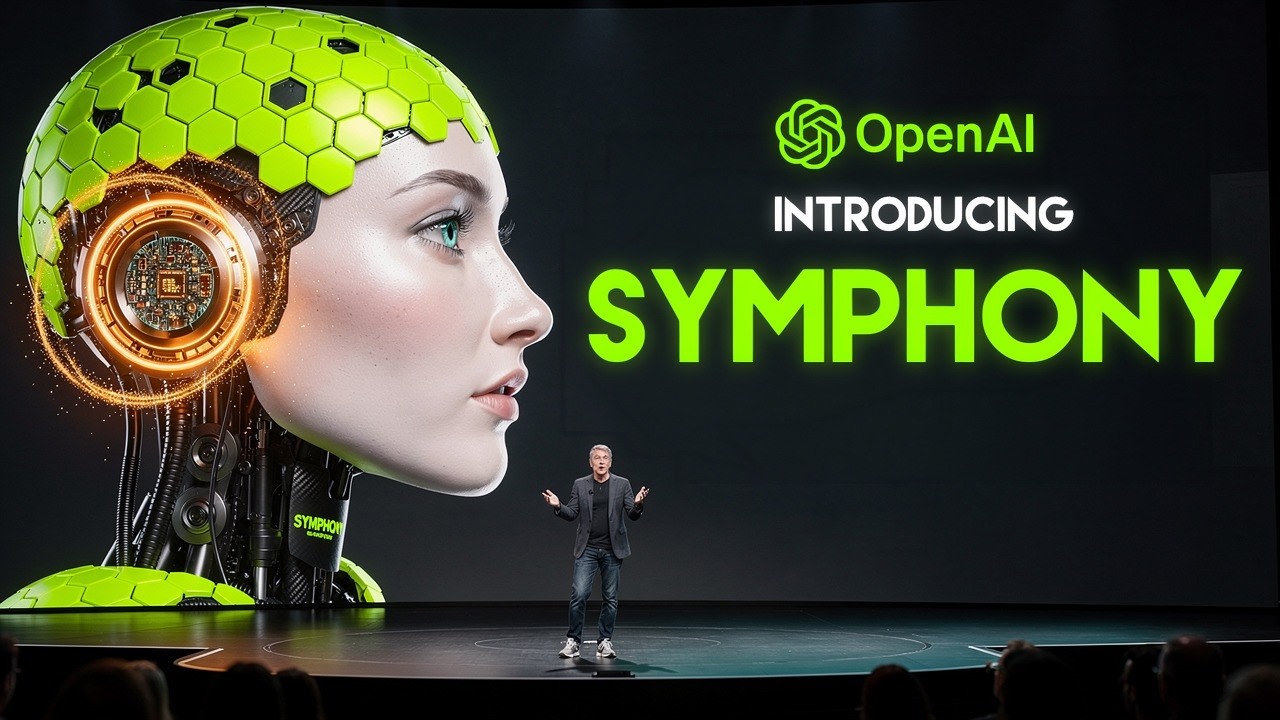
OpenAI Just Dropped Symphony: The First AI That Actually Works
Keywords
Summary
117 words
Critical Evaluation
Value of the Information & Strength of the Argument
The video provides a substantial amount of technical detail about each system, explaining concepts like implementation runs, proof of work, harness engineering, inference execution cycles, and mid-fusion architecture. The argumentation is mostly descriptive, presenting the features and capabilities as reported by the companies. It does not critically evaluate the claims or compare them with alternative approaches, but it does highlight potential limitations, such as the need for well-structured codebases for Symphony. The value lies in its concise synthesis of multiple AI announcements, making it a useful overview for a general tech audience.
Scientific Rigor, Source Quality, Title Accuracy
The video does not cite specific sources or provide links to official documentation, relying instead on the creator’s narration. The only link in the description is a sponsored product, not a source for the claims. The title is somewhat clickbait, but the content is generally accurate in describing the systems. The video includes a sponsored segment for a cinematic image generation tool, which is clearly marked as such. The technical details and benchmark numbers are presented without verification, so the overall scientific rigor is moderate.
192 words
Title / Content Match
The title is somewhat sensationalist ('first AI that actually works') but the content does focus on Symphony as a novel agent system, so it is broadly accurate, though it overstates the claim.
Quality & Reliability
6/10
The video provides a clear overview of recent AI releases (OpenAI Symphony, Xiaomi Miclaw, Microsoft Phi-4 Vision) with technical details and specific benchmark numbers. However, it lacks direct citations to primary sources, relies on the creator's interpretation, and includes a sponsored segment. The information appears plausible but should be verified against official documentation.
Key Moments
Markers derived by PSI from the transcript: the creator did not define chapters.
- Introduction to OpenAI Symphony and its ability to send AI agents to complete coding tasks.
- Explanation of how Symphony monitors task trackers like Linear and triggers implementation runs.
- Description of isolated workspaces and the proof of work requirement for AI agents.
- Mention of workflow.md as a contract for AI behavior and the use of Elixir/Erlang for reliability.
- Sponsored segment for Soul Cinema, a cinematic image generation tool.
- Introduction to Xiaomi Miclaw, a phone-level AI agent that controls apps and smart home devices.
- Explanation of Miclaw's inference execution cycle and context memory system.
- Discussion of Miclaw's personal context understanding and smart home integration.
- Introduction to Microsoft Phi-4 Vision, a compact multimodal model for visual reasoning.
- Explanation of Phi-4 Vision's architecture, training, and benchmark results.
Cited Sources
- Soul Cinema (sponsored product) — Mentioned as a sponsored tool for cinematic image generation, not as a source for the main content.
Concurring Sources
- OpenAI Symphony official page — Likely source for Symphony details, but not verified in the video.
Dissenting Sources
- None found — No conflicting sources were mentioned in the video.
Contribution & Novelties
The video synthesizes recent AI agent developments from major companies, highlighting the shift from chatbots to autonomous systems. It provides a clear explanation of technical concepts like proof of work and mid-fusion architecture, making them accessible. The coverage of Xiaomi’s Miclaw and Microsoft’s Phi-4 Vision adds breadth beyond the usual OpenAI focus.
Pour aller plus loin :
- OpenAI Symphony documentation — Official documentation for Symphony, if available.
- Elixir programming language — The language used to build Symphony, known for reliability.
- Model Context Protocol (MCP) — Protocol mentioned for Miclaw’s expansion features.
- SigLIP-2 vision encoder — Research paper on the vision encoder used in Phi-4 Vision.
- Linear issue tracker — The project management tool integrated with Symphony.
116 words
Radar Profile
The radar profile shows a balanced but moderate performance across all dimensions, with quantity of information and technical level slightly higher than quality and reliability. This suggests the video is informative and technically detailed but lacks strong sourcing and critical analysis.