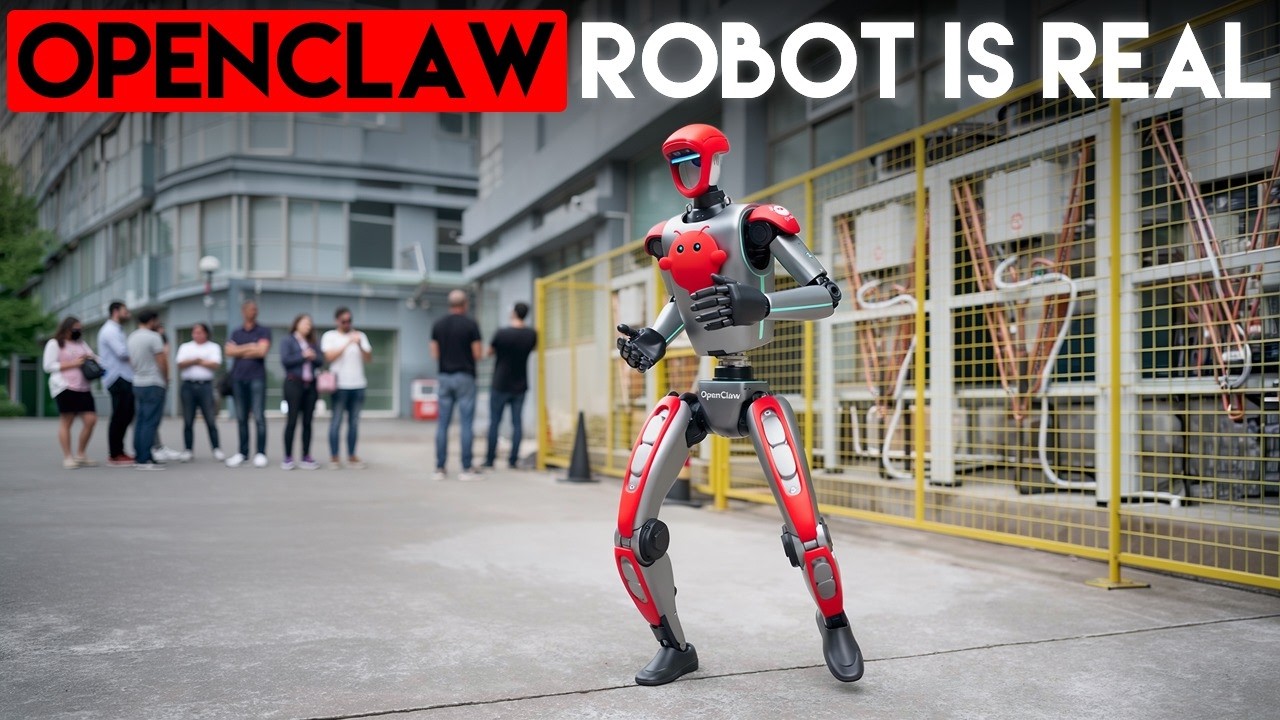
New OpenClaw Robot Feels Shockingly Aware (Detonated Skynet)
Keywords
Summary
125 words
Critical Evaluation
Value of the Information & Strength of the Argument
The video provides a valuable overview of a significant development in embodied AI, explaining the concept of spatial agent memory and its potential implications. The argumentation is generally clear, using analogies like ‘giving AI systems hands’ and explaining voxelization in an accessible way. However, the video is largely a summary of a single source and lacks critical analysis or independent verification. The claims are presented as fact, and the potential limitations or challenges are only briefly mentioned. The sponsored segment, while clearly marked, may bias the presentation of the technology’s benefits.
Scientific Rigor, Source Quality, Title Accuracy
The video cites a single source, a 36Kr article, which is a reputable tech news outlet but not a primary research paper. The information is presented without critical evaluation, and the video does not provide links to the OpenClaw project or any technical documentation. The title is somewhat sensationalist, but the content generally matches the title’s promise of showcasing a robot with world memory. The video includes a sponsored segment for an AI masterclass, which is clearly indicated but may affect the perceived objectivity. The comments show a mix of excitement and concern, with some users questioning the technical details.
206 words
Title / Content Match
The title is somewhat sensationalist ('Detonated Skynet') but accurately reflects the video's focus on OpenClaw's new spatial memory and its implications.
Quality & Reliability
6/10
The video provides a clear overview of OpenClaw's spatial memory capabilities and integrations, but relies heavily on promotional content and lacks in-depth technical verification. The single source link is a secondary news article, and the video includes a sponsored segment.
Chapters
- Intro
- OpenClaw Robot Demo — Spatial Memory Revolution
- SpatialRAG — Querying the Physical World
- How Voxelization Turns Space Into Searchable Data
- OpenClaw Framework — Giving AI Systems Hands
- QwestorClaw — Combining Execution With Cognition
- Real Robots Running OpenClaw (Unitree G1, Aero Hand, NERO Arm)
- Machine Economy — Robots With Digital Identities
Cited Sources
- 36Kr article on OpenClaw — The primary source for the video's claims about OpenClaw's spatial memory and integrations.
- Outskill AI Mastermind (sponsor) — Sponsored link to an AI masterclass, mentioned in the video.
Concurring Sources
- OpenClaw GitHub repository — The open-source project mentioned in the video, which is the basis for the claims.
Dissenting Sources
- Criticism from robotics engineers — Some engineers argue that using LLMs for spatial reasoning is inefficient compared to specialized models, as mentioned in the video.
Contribution & Novelties
The video highlights the novel concept of spatial agent memory, which allows robots to build a persistent, queryable model of the physical world, going beyond simple navigation. This is a significant step towards more context-aware and autonomous robots. The video also showcases the integration of OpenClaw with various hardware platforms, demonstrating the framework’s versatility.
Pour aller plus loin :
- Spatial memory (Wikipedia) — Provides background on the cognitive science concept that inspired the technology.
- Voxel (Wikipedia) — Explains the 3D pixel concept used for spatial representation.
- Simultaneous localization and mapping (Wikipedia) — Related to the robot’s ability to map and navigate its environment.
103 words
Radar Profile
The radar profile shows a balanced but moderate performance across all dimensions, with slightly higher scores in information quantity and technical level, but lower in reliability due to the reliance on a single source and promotional content.
💬 Positif : Sur les 30 commentaires analysés, le climat général est enthousiaste et fasciné par les capacités de mémoire spatiale, avec des références à la science-fiction (Skynet, Johnny 5) et des discussions sur les implications éthiques et techniques, bien que quelques commentaires expriment des inquiétudes sur les risques potentiels.