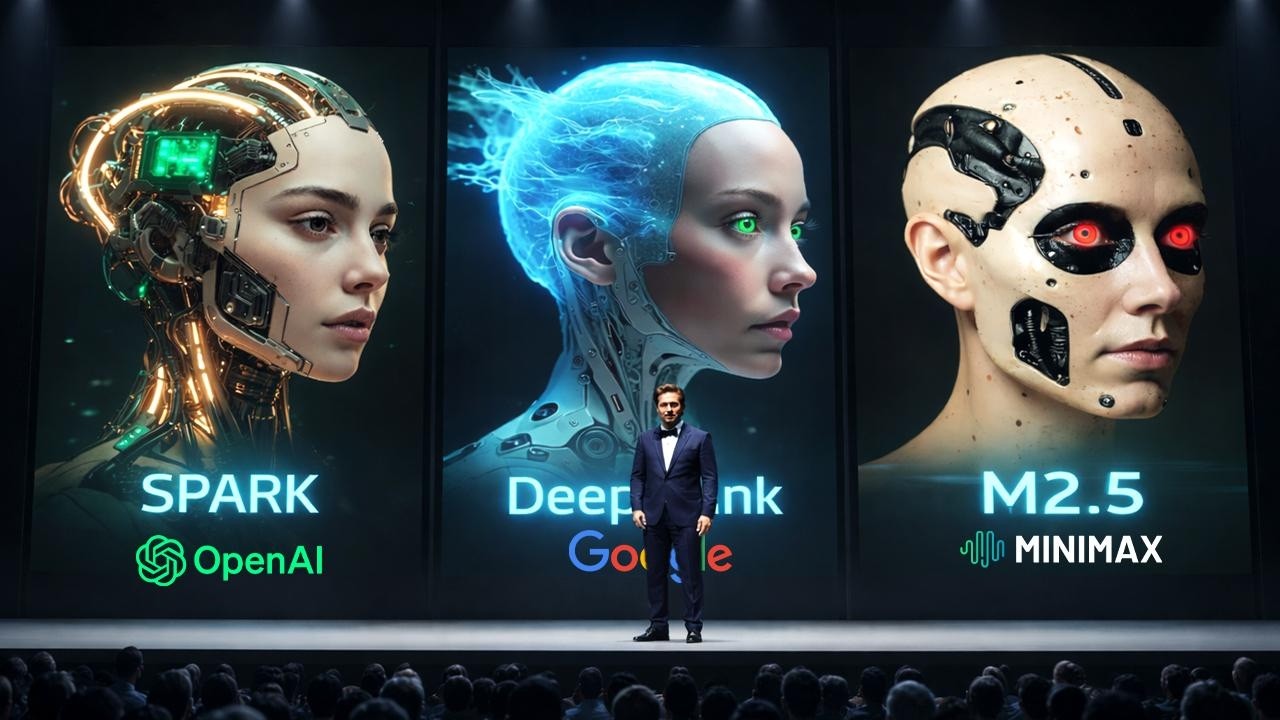
Google, OpenAI and MiniMax Just Dropped Insanely Powerful AI at Once (Shocking Update)
Keywords
Summary
124 words
Critical Evaluation
Value of the Information & Strength of the Argument
The video provides a valuable roundup of recent AI developments, offering a comparative view of three different approaches: speed, reasoning, and cost-efficiency. The argumentation is largely descriptive, presenting vendor claims without deep critical analysis. The presenter does a good job of contextualizing each model’s target use case, but the lack of independent verification or discussion of potential limitations weakens the overall argumentative strength.
Scientific Rigor, Source Quality, Title Accuracy
The video relies almost exclusively on official announcements and benchmark scores provided by the companies themselves. No independent sources or expert opinions are cited. The title accurately reflects the content, and the video is well-structured with clear chapters. The presence of a sponsorship segment is disclosed, but it does not detract from the core content. The overall scientific rigor is moderate, as the information is presented without critical scrutiny.
147 words
Title / Content Match
The title accurately reflects the content, which covers simultaneous releases from OpenAI, Google, and MiniMax.
Quality & Reliability
6/10
The video provides a broad overview of recent AI model releases, but relies heavily on vendor-provided benchmark claims without independent verification. The presentation is clear and structured, but the lack of critical analysis and the presence of a sponsorship segment reduce the overall reliability.
Chapters
Cited Sources
- Higgsfield AI - Kling 3.0 — Sponsor link in the description, not directly related to the main content.
Concurring Sources
- OpenAI Codex — Official page for OpenAI's coding agent, likely to contain details on the Spark variant.
- Google Gemini — Official page for Google's Gemini models, including Deep Think.
- MiniMax — Official site for MiniMax, where M2.5 details may be available.
Contribution & Novelties
The video synthesizes recent AI model releases, providing a snapshot of the competitive landscape. It highlights the trend towards specialized hardware and cost-efficient deployment. The discussion of MiniMax’s internal adoption and the ‘architect-first’ approach offers a glimpse into practical agent deployment.
Pour aller plus loin :
- Cerebras Wafer-Scale Engine — Background on the hardware powering Codex-Spark.
- SWE-bench — The benchmark used to evaluate MiniMax M2.5’s coding abilities.
- ARC-AGI-2 — The benchmark referenced for Gemini 3 Deep Think’s reasoning performance.
79 words
Radar Profile
The radar profile shows a balanced but moderate performance across all dimensions, with quantity of information slightly higher than quality and reliability. This reflects a video that provides a good overview but lacks depth and critical analysis.