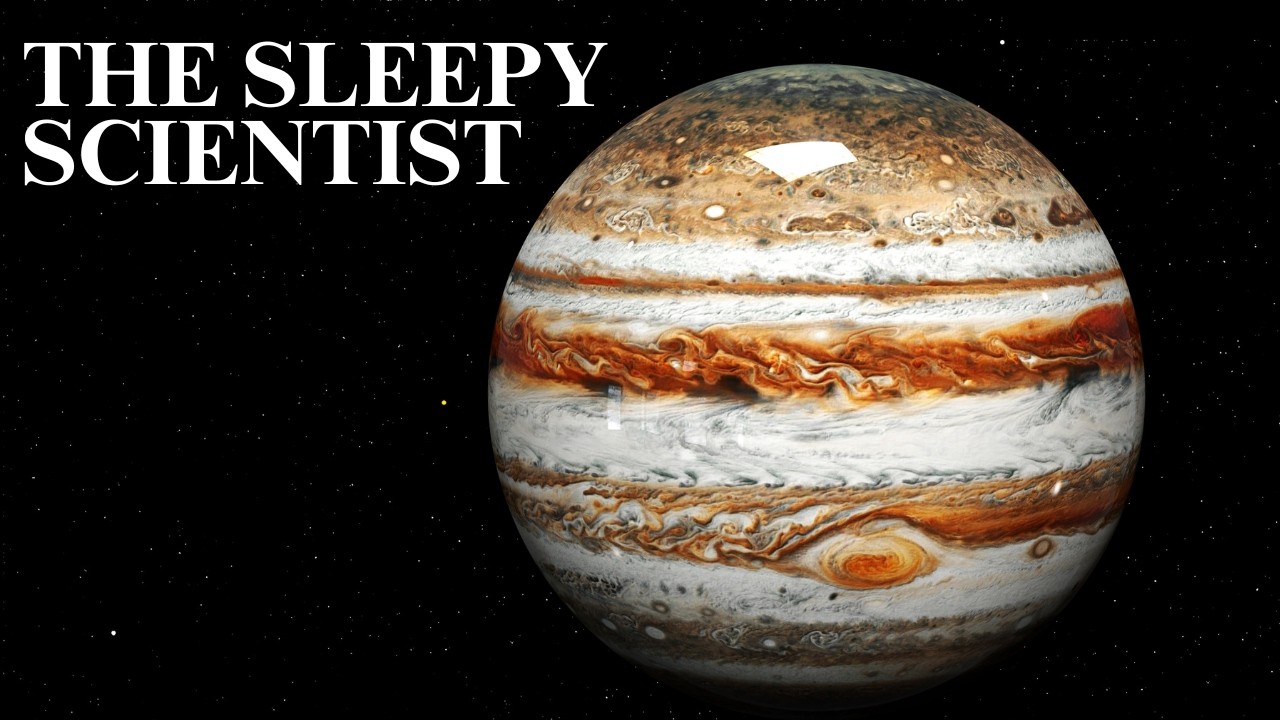
Jupiter: The King of Planets | Science for Sleep
Keywords
Summary
160 words
Critical Evaluation
The video provides a scientifically accurate and engaging overview of Jupiter, suitable for a general audience interested in astronomy. The information presented is consistent with current planetary science, covering key topics such as formation theories, gravitational influence, and internal structure. The discussion of core accretion and disc instability is well-explained, and the mention of Juno’s measurements adds credibility. The video’s strength lies in its ability to convey complex concepts in an accessible and calming manner, making it effective for its intended purpose of aiding sleep. However, it lacks explicit citations to primary sources, which would enhance its scientific rigor. The narrative is somewhat poetic and may prioritize atmosphere over exhaustive detail, but this is appropriate for the sleep-focused format. The title accurately reflects the content, and the video successfully blends education with relaxation. Overall, it is a valuable resource for those seeking to learn about Jupiter in a soothing context, though it may not satisfy viewers seeking in-depth technical analysis.
160 words
Title / Content Match
The title accurately reflects the content, which focuses on Jupiter as the largest planet and its role in the solar system, presented in a calming, sleep-oriented style.
Quality & Reliability
8/10
The video presents scientifically accurate information about Jupiter's formation, structure, and influence, with no major errors. It covers core accretion, disc instability, orbital resonances, and the moons, all consistent with current planetary science. The content is well-researched and up-to-date, though it lacks explicit citations to primary sources within the video itself.
Key Moments
Markers derived by PSI from the transcript: the creator did not define chapters.
- Introduction and welcome, setting the calming tone.
- Discussion of Jupiter's formation via core accretion and disc instability.
- Explanation of Jupiter's role as a gravitational sculptor of the solar system.
- Description of Jupiter's atmosphere, lack of solid surface, and internal structure.
- Exploration of Jupiter's magnetic field and its moons, including Io and Europa.
- Discussion of Jupiter's influence on the asteroid belt and Trojan asteroids.
- Reflection on Jupiter's significance and closing remarks.
Cited Sources
- The Sleepy Scientist Website — Mentioned in the description as a resource for related content.
- Earth: The Living Planet — Related video in the series, mentioned in the description.
- Venus: The Hidden World — Related video in the series, mentioned in the description.
- Mercury: Where Silence Meets the Sun — Related video in the series, mentioned in the description.
- Mars: Our Future Home? — Related video in the series, mentioned in the description.
Concurring Sources
- NASA Solar System Exploration: Jupiter — Provides authoritative information on Jupiter's characteristics, consistent with the video's content.
- Juno Mission Updates — Recent findings from Juno support the video's descriptions of Jupiter's structure and magnetic field.
Contribution & Novelties
The video offers a unique blend of scientific information and sleep-inducing narration, making complex planetary science accessible in a calming format. It synthesizes current knowledge about Jupiter’s formation, structure, and influence, presenting it in a poetic and engaging manner. This approach may help a broader audience appreciate the wonders of the solar system while relaxing.
Pour aller plus loin :
- Jupiter (Wikipedia) — Comprehensive overview of Jupiter’s physical characteristics, moons, and exploration history.
- Juno Mission (NASA) — Official NASA page for the Juno spacecraft, providing detailed information about Jupiter’s interior and atmosphere.
- Core Accretion Theory (NASA) — Explanation of planet formation theories, including core accretion and disc instability.
- Kirkwood Gaps (Wikipedia) — Detailed explanation of the gaps in the asteroid belt caused by orbital resonances with Jupiter.
127 words
Radar Profile
The radar profile shows high scores in information quantity, quality, and reliability, with a moderate technical level. This indicates a well-balanced video that is both informative and accessible, suitable for a general audience interested in astronomy.
💬 Sur les 0 commentaires analysés, aucune tendance n'a pu être dégagée.