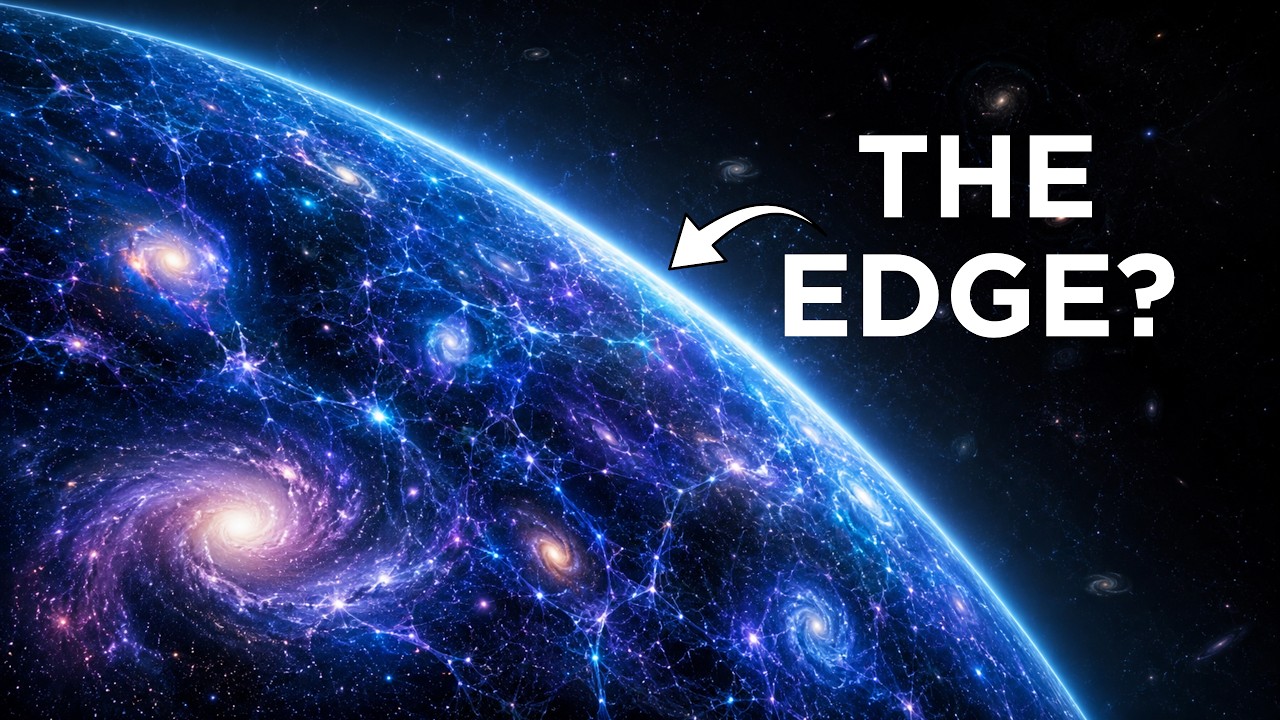
What Lies Beyond the Edge of the Universe? | The Sleepy Scientist
Keywords
Summary
198 words
Critical Evaluation
The video provides a clear and accurate introduction to the concept of the edge of the universe, effectively correcting common misconceptions. It correctly distinguishes between the observable universe and the entire universe, explaining that the edge is a horizon, not a physical boundary. The explanation of cosmic expansion and the finite speed of light is scientifically sound and well-articulated. The use of analogies, such as the Earth’s surface, helps make complex ideas accessible. The video avoids speculative claims, presenting multiverse ideas as theoretical possibilities rather than established facts. However, it lacks specific citations to scientific sources, which would enhance its credibility. The presentation is somewhat slow-paced, which may not suit all viewers, but it aligns with the channel’s calming style. The content is well-structured, progressing logically from the basic question to more nuanced concepts. Overall, it is a reliable and informative resource for those seeking a gentle introduction to cosmology, though it does not delve into mathematical details or recent research. The title accurately reflects the content, and the video fulfills its promise of exploring what lies beyond the observable universe.
181 words
Title / Content Match
The title accurately reflects the content, which explores the concept of the edge of the universe and what lies beyond, focusing on the observable universe and cosmic horizons.
Quality & Reliability
8/10
The video presents established cosmological concepts (observable universe, particle horizon, cosmic expansion, general relativity) with accuracy and clarity. It avoids speculative claims, clearly distinguishing between established science and theoretical ideas like multiverse. The presentation is consistent with current scientific consensus, though it lacks detailed citations and in-depth mathematical rigor.
Key Moments
Markers derived by PSI from the transcript: the creator did not define chapters.
- Introduction to the question and the common image of the universe as a sphere.
- Explanation that the universe is not an object in space but space itself.
- Discussion of the observable universe and its boundary as a horizon.
- Explanation of the finite speed of light and looking back in time.
- Introduction of the particle horizon and the size of the observable universe.
- Discussion of cosmic expansion and the stretching of space.
- Analogy of Earth's surface to explain finite but unbounded space.
- Mention of general relativity and the dynamic nature of spacetime.
- Exploration of cosmic inflation and the possibility of a multiverse.
- Conclusion that beyond the observable universe, there may simply be more universe.
Cited Sources
- The Sleepy Scientist Website — The creator's website, mentioned in the description, offering the ebook 'Quantum Physics, Explained Clearly'.
Concurring Sources
- NASA - Universe Expansion — NASA's overview of the universe and its expansion, supporting the video's explanation of cosmic expansion.
Contribution & Novelties
The video offers a clear and calming explanation of a complex cosmological question, emphasizing the distinction between the observable universe and the entire universe. It provides a solid foundation for understanding cosmic horizons and the nature of space. The presentation is original in its approach, making advanced concepts accessible without oversimplifying.
Pour aller plus loin :
- Observable universe - Wikipedia — Provides a detailed overview of the observable universe, its size, and the concept of the particle horizon.
- Cosmic inflation - Wikipedia — Explains the theory of cosmic inflation, which is briefly mentioned in the video and is crucial for understanding the early universe.
- Multiverse - Wikipedia — Discusses various multiverse hypotheses, including those arising from eternal inflation, which the video touches upon as speculative.
125 words
Radar Profile
The radar profile shows high scores in quantity and quality of information, with a moderate technical level, indicating a well-balanced educational content that is accessible yet informative. The reliability is high, reflecting the accurate presentation of established cosmology.